 Cottage at Home
Disclosure: some links below are affiliate links, and if you buy through one we may earn a small commission, at no extra cost to you.
Cottage beadboard ideas: the bathroom, the kitchen, the mudroom and the ceiling
Where cottage beadboard goes, room by room, how high to stop it, what to cap it with, and the colour and paint finish that keep it looking right.
In this guide
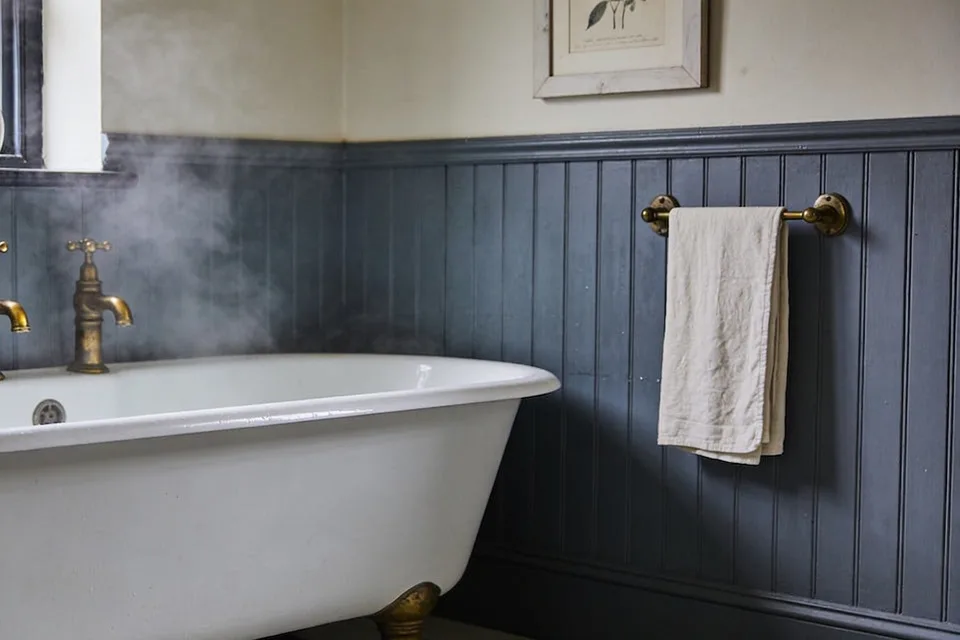
The boards in the bathroom were painted the year the bath went in, and they've been wiped down more mornings than anyone has counted. They stop at about the height of your shoulder, on a plain rail, and above that the wall is cream. Nearly every working room in the house has a version of that line. This page goes through where the boards go, room by room, then how high to stop them and what to paint them.
What cottage beadboard is, and the other words for it
Cottage beadboard is a wall of narrow painted boards, each joined to the next with a tongue and groove and milled with a small rounded bead beside the joint. It usually covers the lower part of a wall up to a rail, which is what wainscoting means. It belongs to the rooms that got wet, muddy or scrubbed.
The words get used loosely, so here is how they fit together. Tongue-and-groove is the joint: one edge has a tongue, the next has a slot, and the boards lock together like floorboards. The bead is the profile, a thin rounded ridge with a groove on each side, and it is what gives beadboard its fine, even lines. Wainscoting (dado, in an English house) is where it goes, on the lower part of a wall, and it can also be flat panels. Shiplap is the other thing: boards that overlap on a stepped edge, with a wider gap and no bead.
It is an old wall. Real beadboard goes back to Victorian houses, where it was solid boards fitted one by one. Today it also comes as sheets with the grooves cut in, which is quicker to put up and looks close enough from across a room. More on that choice near the end.
Cottage beadboard in the bathroom
The bathroom is where beadboard looks most at home. Run it to around shoulder height, cap it with a rail, and paint the wall above a warm cream. The boards take the splashes and carry the colour, and a fresh coat every ten years or so is all the upkeep they ask.
That is the room in the picture at the top: boards in a slate blue with a lot of grey in it, a brass towel bar screwed straight onto them, and plaster above where the print hangs. The vintage bathroom page is about that room, and the English cottage bathroom does the same thing in sage green.
Two things keep it lasting. Keep it out of the shower itself, where tile or another waterproof wall belongs, and caulk the joint where the boards meet the bath so water can't get behind them. A towel bar or a row of hooks on the boards is the right place for them, since boards hold a screw much better than old plaster does. If yours wobbles, an old brass towel bar goes on beautifully and looks better every year it's used.
The powder room is the one bathroom that can go further. With no steam in it, boards can run all the way to the ceiling in the darkest colour in the house.
Cottage beadboard in the kitchen
In the kitchen, beadboard belongs low and dark: along the wall under a run of shelves, behind a plate rack, or on the side of an island or a dresser. Put the deepest colour there, a green or a blue, and keep the upper walls light, so the room stays bright where you work.
A kitchen takes beadboard in smaller pieces than a bathroom. The back of an open shelf, the panel under a window, the end of a cupboard run. The plate rack looks its best against dark green boards, because the plates stand out against the lines. And the English cottage kitchen explains why a taller North American kitchen can take a darker wainscot than the low original ever could.
Behind the stove and the sink is the one place to stop. Boards there are always wet or always hot, so give those two spots tile or a stone upstand and let the beadboard pick up again on either side.
A shelf along the top of the boards is the most useful thing in a cottage kitchen. A narrow ledge with a lip, or an old wooden plate shelf, holds a row of plates, a jug and the tea caddy right where you can reach them.
The mudroom and the laundry
The mudroom and the laundry are the two rooms that need beadboard most, because they take the most knocks. In the mudroom, run deep green boards to shoulder height with hooks along the top. In the laundry, paint them chalk white, because that is the room where the washing gets looked at closely.
The mudroom is beadboard in its hardest-working form. Wet coats, muddy boots and a dog's tail all hit the same metre of wall every day, and a dark painted board shrugs it off where plaster would chip. A row of pegs or a pine peg rail fixed along the top of the boards gives the coats somewhere to go.
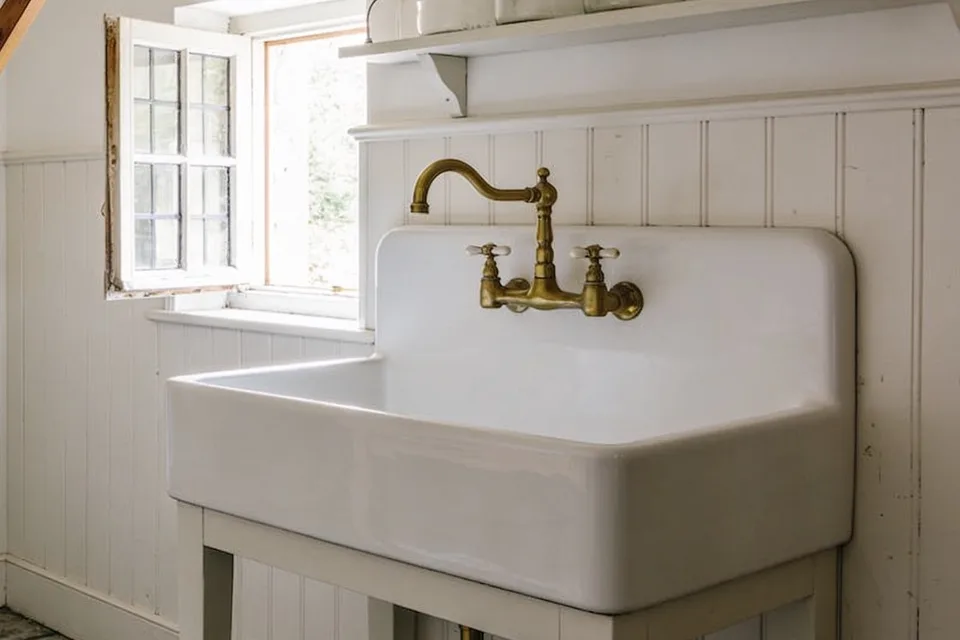
The laundry breaks the dark-boards habit on purpose. Every other room here goes deep, but this is where whites are checked for stains, so the boards are white, the wall above is white, and the light from the window gets everything it can. You can see the ledge along the top of the boards in the picture, which is handy for a jar of pegs.
The sitting room, the bedroom and the hall
Most sitting rooms and bedrooms are better with plaster or plain painted walls, because nothing in them gets wet and the boards can make a big room feel busy. Use beadboard there only on one wall with a reason: a hall that takes bags and shoulders, a window seat, or a small bedroom under the roof.
The hall is the best of these. A cottage hallway gets brushed by every coat and bag carried through it, and boards to dado height save the paint above. In a bedroom, boards behind the bed can stand in for a headboard, and in a study a green board wall gives the desk something calm to face. If you only do one wall in a sitting room, make it the wall that already has the most going on, like the alcove beside a chimney, so the boards feel like they've always been there.
Cottage beadboard on a ceiling
A boarded ceiling is the most cottage thing beadboard can do. It suits a low room, a sloped room under the roof and, above all, a porch or a screened room, where the boards were always the ceiling. Paint it a shade lighter than the walls, or the same white, so the room doesn't feel lower.
At the lake it is often the whole room. The Muskoka room has painted boards on the walls and the ceiling alike, and plenty of older cottages were built that way from the start, with no plaster anywhere. In town, the same idea works best in one small place: a loft, a bathroom with a sloping ceiling, or a porch. Run the boards across the room's shorter length, and paint them in the same finish as the walls.
How high to stop, and what to cap it with
In an ordinary room, stop the boards at about a third of the wall height, cap included, which is around 80 to 90 cm (32 to 36 in). In a bathroom, mudroom or laundry, go higher, to about shoulder height. Finish the top with a plain rail or a narrow ledge, never a bare cut edge.
The third-of-the-wall rule is an old carpenters' rule of thumb, and it works because it lines up with the back of a chair, which is why the old name is a chair rail. Beadboard sheets are commonly sold 8 feet long, and cut into three it gives you boards of about 32 inches, so the arithmetic is kind. The higher line in wet rooms is our habit: the splashes from a basin and the shoulders of a wet coat land higher than a chair back, and the boards should cover where the wall really gets touched.
Whatever height you pick, run it at the same line all the way around the room and line it up with something, the bottom of a window, a sill or the top of the bath. A line that lands a few centimetres off a window sill looks like a mistake. The cap can be a simple moulded rail, or a ledge deep enough for a cup, which is more useful and more cottage.
The colour, the paint finish, and boards or sheets
Give the boards the room's colour, usually the deeper one, with a warm cream or off-white above. Paint them in eggshell or satin wherever the room steams or gets wiped, and flat paint only in a dry room. Prime and paint every face and edge of whatever you put up before it goes on the wall.
The four colours the boards in this house carry are slate blue in the bath, sage green in the English bathroom, deep green in the mudroom and the kitchen, and chalk white in the laundry. Paint a spare board, stand it against the wall and look at it in the light you'll actually use the room in, morning light for a bathroom and lamplight for a study, before you choose. The moody cottage bathroom explains why flat paint marks in a steamy room, and the home office why flat paint is fine in a dry one.
On solid boards versus sheets: solid tongue-and-groove boards look best and can be repainted forever. Sheet beadboard is quicker and cheaper, and many are made from MDF. That is fine in a dry room and needs care in a damp one, because MDF swells where water gets in, and the cut edges are where it gets in first. If you use sheets in a bathroom, choose a board sold for damp rooms, prime the cut edges as well as the faces, and keep it away from standing water. Whichever you choose, caulk the joints along the top and the bottom before the last coat goes on.
One wall to start with
You don't have to board a whole room to get this feeling. Start with the wall that takes the most knocks, the one behind the hooks by the back door or the wall beside the bath, run the boards to a line you've lined up with the window, and live with the colour for a week before you do the next one.
Common questions
What is the difference between beadboard and wainscoting?
Wainscoting is any covering on the lower part of a wall, up to a rail. Beadboard is one kind of it: narrow tongue-and-groove boards with a small rounded bead running down beside each joint. So all beadboard used low on a wall is wainscoting, but wainscoting can also be flat panels or plain boards.
How high should cottage beadboard go?
The old rule of thumb is about a third of the wall, cap included, which is roughly 80 to 90 cm (32 to 36 in) in an ordinary room. In a bathroom, a mudroom or a laundry we run it higher, to around shoulder height, because that is where the splashes and the wet coats land. A small room can take boards all the way up.
Can you put beadboard in a bathroom?
Yes, and it is one of the best rooms for it, as long as it stays out of the shower itself. Paint every face and every cut edge before the boards go up, or use a board sold for damp rooms, caulk the joint where it meets the bath, and finish it in eggshell or satin so it can be wiped.
Should beadboard be painted the same colour as the wall above it?
Usually not. The boards carry the room's colour, most often the deeper one, and the wall above is a warm cream or off-white, so the line where they meet does the work. The exception is a pale room like a laundry, where white boards under a white wall keep everything as bright as possible.