 Cottage at Home
Disclosure: some links below are affiliate links — buy through one and we may earn a small commission, at no extra cost to you.
Vintage bathroom decor ideas: the room that makes its own weather
Vintage bathroom decor ideas from a kept house — brass taps worn bright by hands alone, milk glass on the sill, old linen towels, and printed botanicals over slate-blue beadboard, under the steam rule.
In this guide
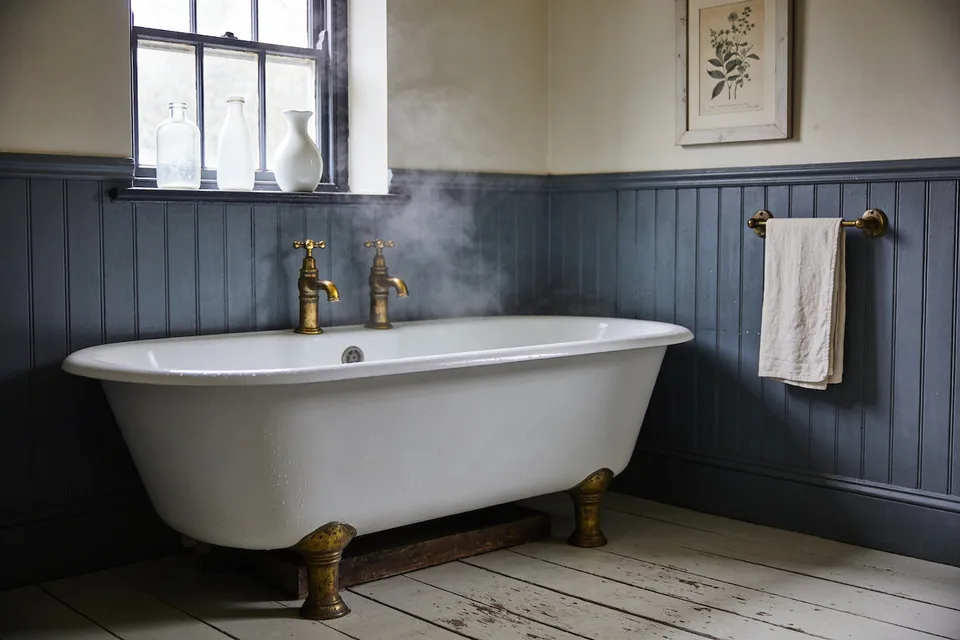
By half past seven the smallest room in the house has made its weather. The mirror is fogged to its corners, the window stands open an inch to let the steam go find the cold, and the glass on the sill wears a fine sweat, beaded gray with the morning. Ten minutes more and the storm is over — the mirror clears from its edges inward, the beadboard sheds its mist, the brass taps drip themselves quiet — and the room dries toward noon the way it has ten thousand mornings running. No other room is asked for this daily, and everything that stays in here has answered for it.
The room the steam interviews
Go looking for vintage bathroom decor ideas and what comes back is mostly plumbing — new brass aged at the factory, vanities costumed for a century they never stood in. This house reads the room from the other end: not what to install, but what to let in. The bath is furnished the way the whole house is furnished, one thing at a time, each thing hired for a job before it crosses the threshold — but in here every candidate sits a second interview, because the room will rain on it twice a day for the rest of its life. What passes is a short list a century of bathrooms already proved: brass, white china, thick glass, painted wood, linen. What fails — gilt, old silvering, bare paper, anything proud — is not refused so much as excused to drier rooms. The steam does the sorting; the house only writes it down.
Brass the water stopped arguing with
The taps have outlived every washer ever fitted inside them. Two brass pillars, hot and cold, and the household's record is on the metal: handles worn bright where hands land forty times a day, bodies gone deep and dark below, freckled where hard water dried and was never chased after. Nobody polishes them. Handling is the only polish brass gets in this house, and the two-tone coat it earns — bright where the room touches it, dark where it doesn't — is the same one the candlesticks and the door knobs wear. New taps arrive factory-aged now, the wear laid on evenly, everywhere at once — the way no thumb ever wore anything.
The rest of the room's brass holds rather than pours: a short row of antique brass hooks screwed in just above the boards, bought one and two at a time, no two castings quite agreeing, taking the towels and the robe at shoulder height. They do for this room what the peg rail does for the coats by the back door — keep the working cloth where air can reach both sides — and they survive in such numbers because a hook has no moving parts to fail and no finish worth protecting.
Milk glass is back at its old address
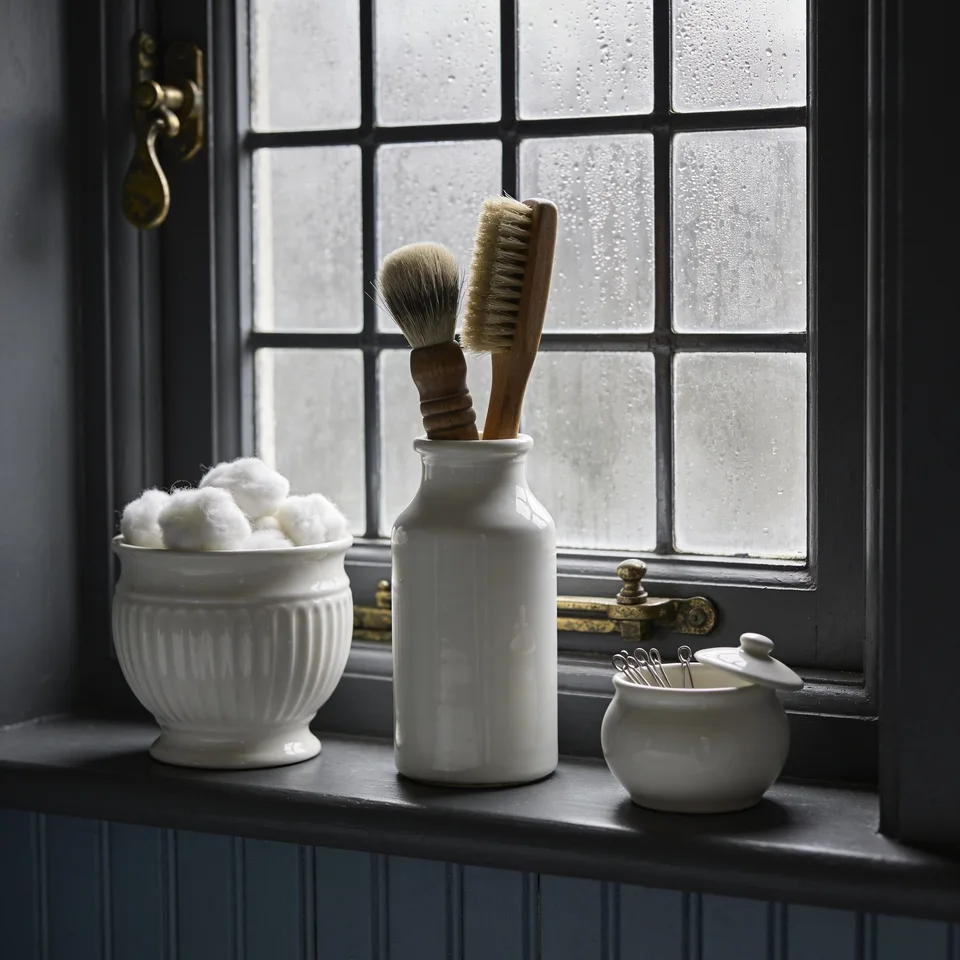
Milk glass is the one old glass with a bathroom past. The squat white jars and pots of a hundred years ago were packaging — cold cream, salve, shaving soap, sold in glass respectable enough to stay out on the washstand — so vintage milk glass jars on a sill are not being asked to imagine a new career. They are back at their old address. Three stand on the deep sill here, gathered one at a time: a ribbed pot holding cotton wool, a taller jar for the wooden-handled brushes, a small one whose lid stopped seating true some other decade and rests askew over the pins. White glass takes the room's light the opposite way from clear — it does not sparkle, it glows, holding a wet gray morning and handing it back softened — and steam means nothing to it: the fog beads, runs, and leaves no record. On a dark sill the three of them read as small lamps that happen to be off.
Beadboard, and a color chosen at seven in the morning
The walls answer the weather the way the old bathrooms answered it: wood to shoulder height, tongue and groove, painted. Beadboard earns its place on temperament — paint wipes down, boards take the daily swelling that plaster cracks over, and a fresh coat every decade is maintenance in the old register. It is the same wainscot the mudroom wears in deep green over its stone flags: that room stops the weather that arrives by the door, this one takes the weather the house brews for itself. But the two rooms share a trade, not a uniform. The bath's boards are painted a slate blue with the gray well folded in — rain on a window, a fountain pen, never the seaside — deep enough that the white glass and the worn-bright brass stand forward from it like lit things.
Most rooms here audition their paint at nine at night, under the lamp that does the actual lighting, because that is when those rooms are lived in. The bath is the house's one true morning room, so its color sat the audition at the opposite hour — seven o'clock, wet gray light, the window running. The blue that would sulk beside a fire has no fire to answer to in here. It has mornings, and it is good at them.
The steam rule decides the walls
What hangs above the boards was ruled on where the house's paper is written up, in one sentence with no appeal: steam ripples paper and clouds old gilt, and though a printed copy costs nothing to replace, a hundred-year-old frame is owed drier air. So the bath hangs copies, gladly. A botanical printed at home goes into a plain frame — painted wood, waxed pine, nothing with a century to lose — and hangs where the fog can find it; the seaweeds pressed flat as lace are the natural tenants, water plants for the water room. When a few winters of mornings have rippled the sheet, the printer makes another for the price of the paper — the ripple was never damage, only the room initialing its art. The free botanicals keep a wall like this in copies for nothing; the genuinely old pages and frames stay where the air deserves them. When the wall wants more than the free ones, our printable sets print and reprint the same way.
The mirror obeys the same law. The sitting room's gilt mirror took a century to cloud, and the clouds are its value; steam would forge that record in a winter, and the house checks references. So the glass over the basin sits in plain painted wood with nothing old enough to lose, and fogs to its corners every morning with nothing to grieve. If the walls around it go dark, the light by that glass matters more than the paint, and the moody cottage bathroom is where the house works that out.
Linen dries better than it looks
The towels are the room's last old things and its hardest working. Vintage linen towels — the pebbled huck weave, woven precisely to dry things, often carrying somebody's red cross-stitched initials — turn up for a fraction of what new linen costs, because terry talked everybody out of them. Linen is the quick one: it dries hands without leaving lint, dries itself on the hook within the hour, and washes softer for decades, which is the opposite of terry's arc. The bath sheet can stay terry; nobody argues with a warm acre of it. At the basin, though, the old linen does the work — and when a towel finally wears through, it demotes the way everything here demotes, down to the rag basket, where old linen polishes glass and brass better than anything sold for the purpose.
Carry one thing to drier air
Begin with a removal, not a purchase. In most bathrooms hangs the one thing the steam is quietly taking — the gilt frame from a grandmother's landing, the photograph going wavy in its mat, the little mirror already growing clouds ahead of its years. Tonight, take it down and walk it to a drier wall; the house will make room, old things being welcome everywhere in it. Then print something for the nail it leaves — a seaweed, a fern, any page with water in its past — and frame it plainly, knowing the room will initial it by spring. The bath is the easiest room in the house to begin on, because its first vintage gesture is a rescue, and rescues are free.
Common questions
What vintage decor can survive in a bathroom?
A short list a century of bathrooms already proved: brass, white china, thick glass, painted wood, linen. The room rains on everything in it twice a day, so each candidate sits that interview before it stays — and what fails, gilt, old silvering, bare paper, anything proud, is not refused so much as excused to drier rooms. Milk glass is the easy first admission, since the squat white jars of a hundred years ago were bathroom packaging to begin with — cold cream, salve, shaving soap — and steam means nothing to them: the fog beads, runs, and leaves no record.
Is it okay to hang art in a bathroom?
Copies, yes; originals, no. Steam ripples paper and clouds old gilt, and though a printed copy costs nothing to replace, a hundred-year-old frame is owed drier air. So the bath hangs copies, gladly: a botanical printed at home goes into a plain frame — painted wood, waxed pine, nothing with a century to lose — and hangs where the fog can find it. When a few winters of mornings have rippled the sheet, the printer makes another for the price of the paper; the ripple was never damage, only the room initialing its art. The genuinely old pages and frames stay where the air deserves them.
Are linen towels better than terry cloth?
At the basin, yes. Linen is the quick one: it dries hands without leaving lint, dries itself on the hook within the hour, and washes softer for decades, which is the opposite of terry's arc. The old towels in the pebbled huck weave, woven precisely to dry things and often carrying somebody's red cross-stitched initials, turn up for a fraction of what new linen costs, because terry talked everybody out of them. The bath sheet can stay terry; nobody argues with a warm acre of it. And when a linen towel finally wears through, it demotes to the rag basket, where old linen polishes glass and brass better than anything sold for the purpose.