 Cottage at Home
Vintage printable wall art: botanical plates, old engravings, and the frames that deserve them
Vintage printable wall art, honestly done — plate-book botanicals, survey engravings, foxed paper tones, and the old frames they belong in.
In this guide
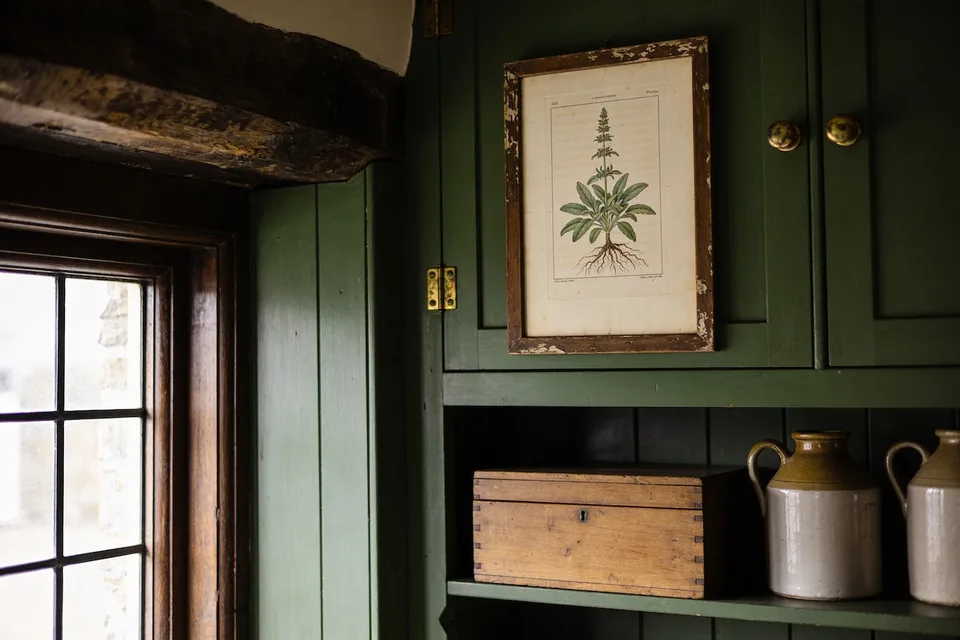
Above the flour bin, in a narrow oak frame that cost less than its nail, hangs a stem of sage — the whole plant, root to seed, drawn a century and a half ago for a book that needed one herb told from another. The paper behind it has gone the color of weak tea, freckled brown along one edge where damp found it in some earlier house. Fig. 4, says the caption, in letters cut by hand. No one here has ever needed sage identified, and the plate has never once been asked to come down.
That plate is what vintage printable wall art means in this house: a page from a real old book, copied honestly, printed at home, and framed in wood that had a life before it. Cottage walls want paper with some history in it, and the quiet fact of the matter is that the history costs nothing — the great flower books and county surveys of the 1800s were scanned years ago and set loose, waiting for anyone with an afternoon and a printer. What follows is the whole craft: what makes a print read as genuinely old rather than costumed, where the good pages come from, how to print them so they don't arrive looking like office paper, which frames deserve them, and which walls in the house will want them.
An honest copy of an old thing
Start with the distinction that decides everything else, because most of what is sold as vintage printable wall art fails it. A print of an 1870s botanical plate is a copy of a real thing. The drawing happened, the book happened, the hundred and fifty years happened, and the scan carried the whole record forward — the cream of the paper, the freckles of damp, the plate number in its corner. Nothing about it pretends. A new graphic wearing an age filter is another matter: paper texture laid on by software, a sepia wash applied evenly from corner to corner, antique lettering off a font menu. The kitchen already runs on this exact distinction — old, and made to look old, are different things — and it holds on the wall precisely as it holds on the shelf. One is a record; the other is a costume.
The tells are the same, too, once the eye knows to ask. Real age is uneven, because damp and light and handling never visit a page evenly: the brown freckling the book trade calls foxing gathers along an edge or clusters in one corner, and the tone deepens toward the margins the fingers turned. Applied age arrives everywhere at once, the same amber at every corner, like weather from a spray can. And the honest plate carries workmanlike details no decorator would think to invent — the Latin caption, the numbered figures, the faint pressed rectangle where the printing plate met the paper, color sitting a hair off the printed line because a hand laid it there with a brush. Choose pages with the record still in them. The wall can tell.
What the old books left behind
Three families of old paper do most of the work on a cottage wall, and all three were made for use rather than for decorating — which is exactly why they decorate so well.
- Botanical plates. The flower books and herbals of the 1700s and 1800s drew plants for identification: the whole specimen, root to seed head, the flower taken apart in small numbered figures down one side, the name in Latin beneath. Nothing in the composition is trying to charm, and that is the charm — the plant floats calm on its page, informative as a recipe. Herbs, orchard fruit, ferns, seaweeds pressed flat as lace: whole shelves of them were engraved, and they hang as gladly by a pantry door now as they informed then.
- Survey engravings and charts. County maps with their hills built from fine hatched strokes, harbor charts sounding out a coastline, the drawn fronts of buildings long since altered — the working paper of people measuring the world. An old chart hangs like a window facing somewhere else, and its hand lettering alone is better drawing than most art.
- The working ephemera. Smaller and warmer: seed catalog pages with their prize onions, nursery lists, a bill of sale in copperplate handwriting, the cover of some parlor sheet music. Paper that was never meant to outlive the season it served, which is what makes a surviving page so likable. These frame small and hang low, tucked among the sturdier plates like footnotes.
As for where the pages come from: the great libraries, museums, and botanical gardens have spent years scanning their plate books and putting the files where anyone can reach them, and work this old has generally outlived its copyright — the archives state plainly, file by file, what may be freely printed. Take the largest scan offered, the one showing the whole page rather than a cropped flower, and gather slowly: one good plate found on a winter evening is worth forty downloaded in a hurry. The habit is thrifting, carried out of the shop and into the archive.
Printing it past office paper
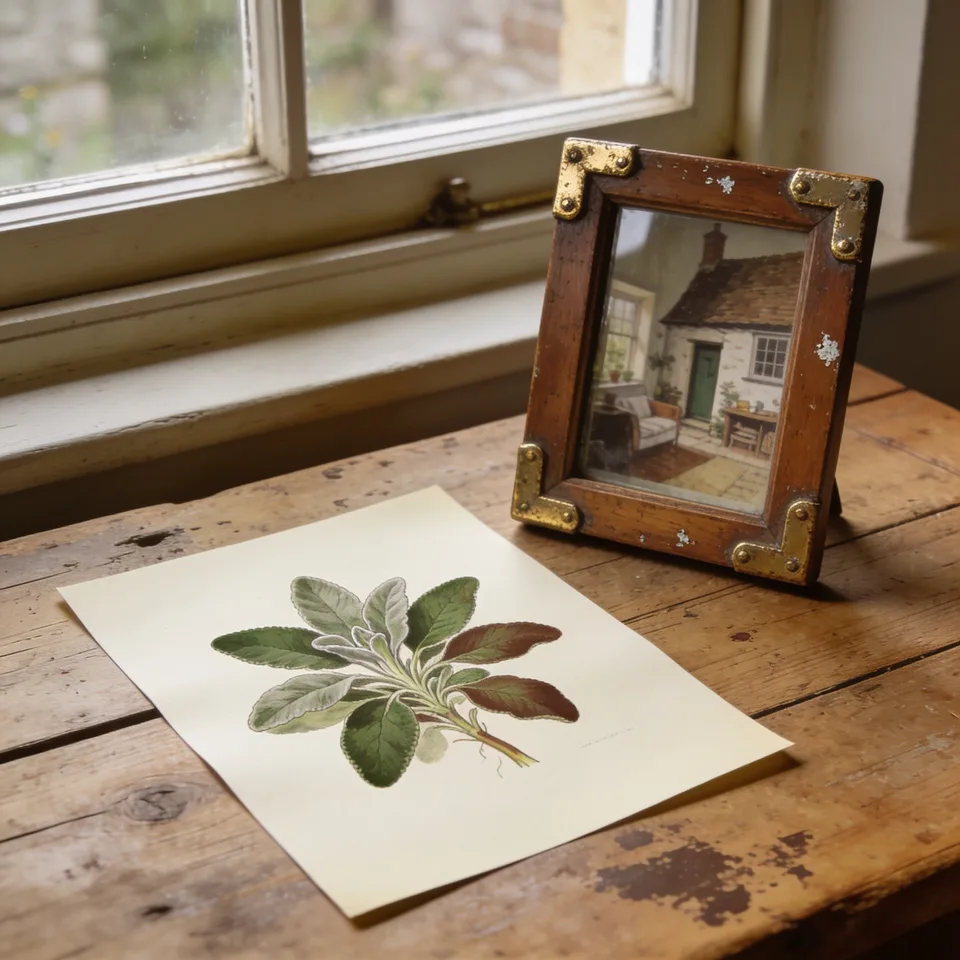
An ordinary sheet of printer paper announces itself from across the room — too white, too thin, too recent. The general mechanics of home printing are short and forgiving — a heavy matte stock, the printer set to its best quality and told the truth about what it holds — but a vintage plate asks for three further habits of its own.
First, keep the page's own ground. The cream tone and the freckled edge are not flaws in the scan; they are the age itself, carried forward. Let no software correct them toward white — a plate scrubbed of its tone arrives looking like a figure from a textbook, which is to say new. For the same reason, choose the warmest sheet the paper aisle offers; matte stocks come in naturals and creams, and a warm paper meets the plate's old tone halfway instead of surrounding it with glare.
Second, print the whole page. The margins, the caption, the plate number, the soft shadow of the binding along one side — that is the book still present in the picture. Cropped to the flower alone, the same file turns into clip art. The empty paper around the drawing was part of the composition when the engraver set it, and it still is.
Third, stay near the original size. These plates were made for books held in two hands, and their fine hatched lines were drawn to be read from a reader's distance. Enlarged toward poster size, crisp lines go soft and gray and the whole page takes on the look of a photocopy of itself. Where a wall wants more presence, print a second plate rather than inflating the first; plates spent their working lives in company anyway.
And one refusal: never age the print yourself. No tea bath, no oven, no careful crumpling — that is the sprayed-on weather again, applied by hand this time. The age already happened, in a real library, over an actual century; it came through the scanner and it will come through the printer. Anything added after that is costume.
Frames that deserve an old plate
A vintage plate is particular about its frame in one way only: the frame must be at least as quiet as the page. Engravings and charts, being all line, want narrow dark wood — fine hatching reads best inside a thin, plain edge that keeps out of its way. Hand-colored botanicals can take more warmth: honey oak, walnut, gilt rubbed soft at the corners by a century of dusting. What neither wants is anything wide, glossy, or manufactured last year to look elderly. A frame with real wear does for the plate exactly what the plate does for the wall, and the thrift shop asks a few dollars for old wood the frame aisle cannot sell at any price.
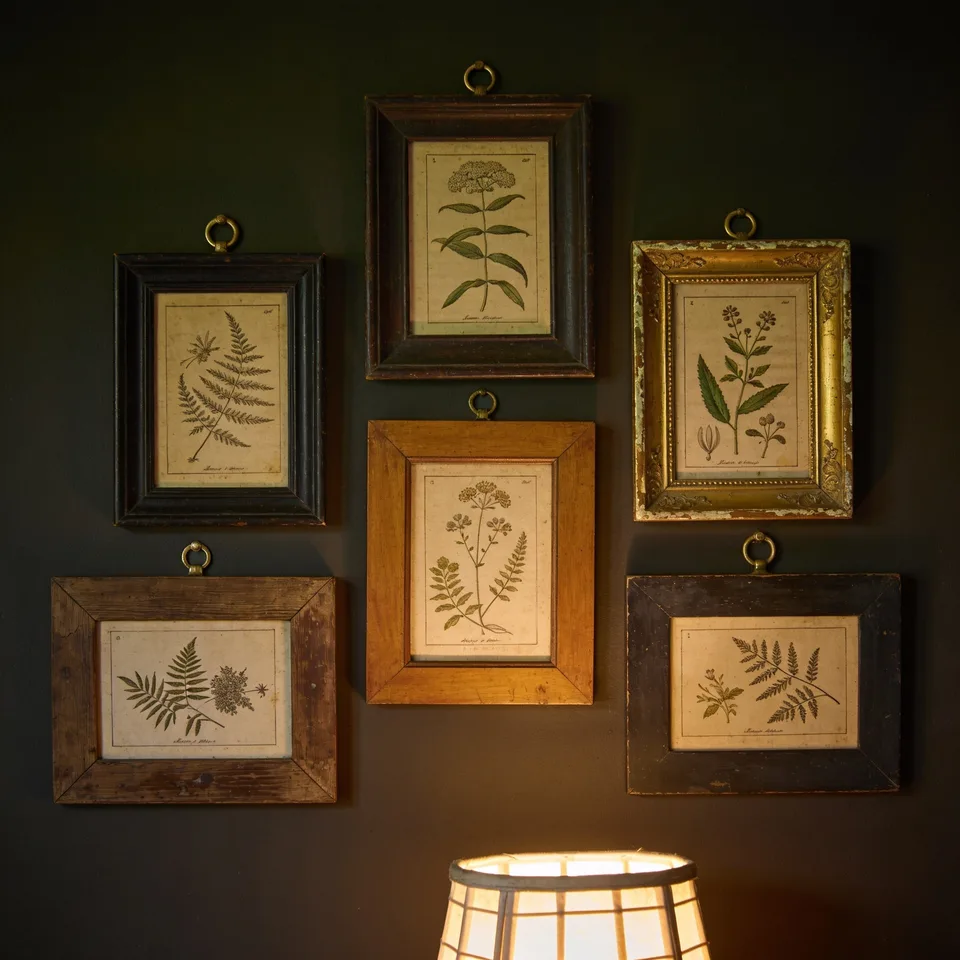
Give the plate its margin back, too. In the book, every plate floated in generous paper, so a mat cut wide and a shade warmer than white restores the proportions the page was drawn to — and quietly settles the eternal difference between old frame sizes and printed sheets while it is about it.
Mismatch, finally, is the historical truth of the thing rather than something to put up with. Study walls were always assembled the way this one will be — a plate at a time, a frame at a time, over years — so five engravings in five frames that never met before this wall read as exactly what they are: a small collection, kept by someone. Uniform frames from one shelf of one store read as the other thing.
The walls that want them
Botanical plates are kitchen and pantry things before they are anything else. Herbs, orchard fruit, the garden in cross-section — food drawings belong where food happens, and small frames do their best work among working objects: beside a doorframe, over the flour bin, on the short strip of wall between shelf and ceiling that never knew what it was for. A working shelf will carry one as well — the one idle thing a working shelf is allowed might as well be a framed plate of the herb the cooking actually leans on — propped rather than hung, so the washing-up can jostle past it without ceremony.
The hall and the stair belong to the surveys. A run of county maps climbing the staircase wall turns the most passed-through stretch of the house into the most examined, because a chart rewards exactly the half-minute a landing gives it. Bedrooms take the quietest plates — ferns, grasses, seaweeds, anything with no errand — and the bath is the one room to think twice about: steam ripples paper and clouds old gilt, and though a printed copy costs nothing to replace, a hundred-year-old frame is owed drier air.
These plates are the standing collection — hung once and right, as true in July as in January, which is why they can keep nails the seasonal walls cannot. The turning wall is its own pleasure: each fall these rooms swap in the amber autumn pack, six autumn prints free from this house to yours, and let the botanicals keep the rest of the year. The two habits share every skill — the paper, the thrifted frames, the clustered hanging — and divide the house between them.
The house's own paper
One source outranks every archive: the household's own drawer. A recipe card in a grandmother's handwriting, the seed packet from the year the beans finally came good, a letter with a stamp the price of which dates it to the month — the same scanner and printer that copy a library's plates copy these just as faithfully. Print the copy, frame the copy, and let the original stay in the working box where flour can reach it, safe from sunlight and pushpins alike. It is the same keeping that runs a grandmother's kitchen, carried up the wall — and one such page hung among the botanicals stops the wall being a collection at all and makes it a record of the house that hung it.
One plate first
Let the kitchen choose the first one: the herb this house cooks with most — the sage, the thyme, the bay. Some evening this week, find its plate in an archive, print it at the size the book gave it, and stand it unframed on the pantry shelf, leaned against the wall. Leave it there while the right frame takes its time turning up at the thrift shop, which it will. A page that waited a hundred and fifty years to be printed does not mind waiting a few weeks to be hung — and meanwhile the shelf will tell you whether it belongs, which no guide can.
Common questions
Where can I find vintage prints that are free to print?
The great libraries, museums, and botanical gardens have spent years scanning their plate books and putting the files where anyone can reach them. Work this old has generally outlived its copyright, and the archives state plainly, file by file, what may be freely printed. Take the largest scan offered, the one showing the whole page rather than a cropped flower, and gather slowly: one good plate found on a winter evening is worth forty downloaded in a hurry.
How do I print a vintage plate so it does not look like office paper?
Use heavy matte paper, set your printer to its best quality, and choose the warmest sheet the paper aisle offers: matte stocks come in naturals and creams, and a warm paper meets the plate's old tone halfway. Keep the page's own ground, too. The cream tone and the freckled edge are the age itself, carried forward, so let no software correct them toward white. Print the whole page, margins and caption and plate number, and stay near the size the book gave it: enlarged toward poster size, fine hatched lines go soft and gray.
What kind of frame suits a vintage botanical print?
One at least as quiet as the page, found at the thrift shop rather than the frame aisle. Engravings and charts, being all line, want narrow dark wood; hand-colored botanicals can take more warmth: honey oak, walnut, gilt rubbed soft at the corners. Nothing wide, glossy, or manufactured last year to look elderly. A mat cut wide and a shade warmer than white gives the plate the margin the book gave it, and mismatched frames are the historical truth of the thing: study walls were always assembled a plate at a time, over years.