 Cottage at Home
Disclosure: some links below are affiliate links — buy through one and we may earn a small commission, at no extra cost to you.
Grandma kitchen decor: the things she handed down, still working
Grandma kitchen decor done honestly — her mixing bowl, her rolling pin, her recipe box, all put back to the jobs they had in her house.
In this guide
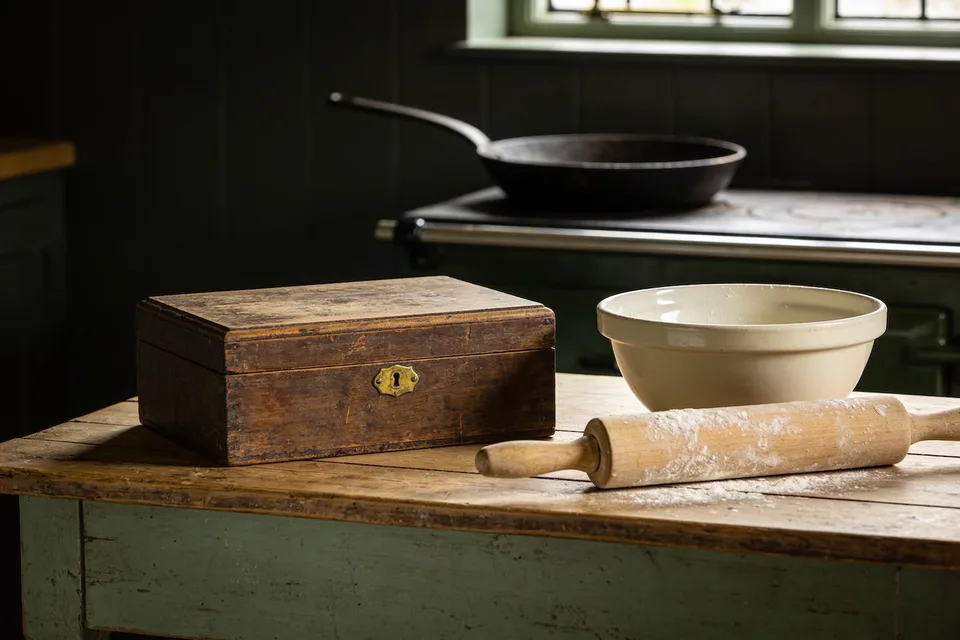
The mixing bowl comes down with two hands and a half turn, the way it has come down for fifty years, most of them in a different house. Behind it on the shelf sit a biscuit tin that never once held biscuits, a rolling pin gone satin in the middle, and a recipe box with flour worked into its hinges. Nothing up there was chosen to match, and all of it belongs together, because all of it belonged to her. This is a grandmother's kitchen, and she has not stood in it for years.
Most rooms in these notes can be gathered — found in shops, chosen against your light. This one cannot. An inherited kitchen is organized not by era or palette but by a person: things that passed through the same pair of hands long enough to take on their shape. It is not decorated so much as kept — and keeping, the daily verb the English cottage kitchen is built around, is a thing anyone can do on purpose. Here is how — and how to begin when nothing was handed down at all.
A person, not a period
Old kitchen things found at sales and shops make a room warm; things with a name attached make it remembered. The difference shows in details no stylist would think to fake: a pie tin bent at the corner that met the oven rack a thousand times, a wooden spoon worn flat on the left because she stirred left-handed, a chipped cup kept for no reason a stranger could name. Gathering old things honestly is its own subject, taken up in vintage cottage kitchen decor; this piece is the narrower, warmer case. A collected shelf says an era. An inherited shelf says a woman — her thrift, her stubbornness about the good knife, her habit of saving twine.
That is why these kitchens refuse to be bought whole. The reproduction version — new enamel in old shapes, florals printed to look faded — copies what her kitchen looked like and misses what it was: forty years of Tuesday suppers accruing in one room. The objects were never the point. The years were.
Use is how a room remembers
The first instinct with handed-down things is to protect them: the bowl wrapped in a cabinet, the tablecloth saved for a someday that keeps not coming. It is a loving instinct, and the one mistake worth talking anyone out of. A kitchen does not remember with its eyes; it remembers with its hands. The cast-iron pan is the plainest proof: its seasoning is decades of her suppers baked into the metal, and it is kept alive by more suppers, not by rest. Retired to a shelf, it is scenery. Frying Saturday eggs, it is still hers, still gaining years.
The fear underneath is breakage, and the fear is honest. Use risks the bowl. But a chip earned in your kitchen joins the chips earned in hers — one more entry in a long record — where a bowl kept safe ends as an ornament that was once a bowl. The ordinary cautions still apply — a crazed glaze holds clementines rather than cake batter; anything doubtful changes jobs rather than leaving the room. Within those limits the rule is short: give each piece the most work it can safely do.
Where her things go back to work
Placement is nearly automatic; the things arrive knowing their jobs.
- The rolling pin goes to the drawer nearest the widest stretch of counter. That is where pastry happens now, and a tool at its post is the difference between a memory and clutter.
- The apron hangs on a hook where aprons get reached for, not displayed. If it still gets worn for messy jobs, so much the better; cloth remembers a shape the way wood remembers a grip.
- The tin can keep on not holding biscuits. Forty years as her sewing box earned it the right. Button jar, string tin, the corner catch-all — a small running joke the household keeps going without her.
Two placements do more than the rest. Let one open shelf carry the memory — the bowl, the tin, a cup — with real work passing across it daily; a whole room of her things tips into museum; one working shelf stays a kitchen. And give them some dusk to stand against: worn wood and cream stoneware read richest on walls with moss or umber in them, and if the room is leaning that way, the dark cottage kitchen is the setting these pieces stand best in. The rest of our kitchen and pantry notes keep circling the same rule: what earns a place beside them is whatever you cook with. The wall above that shelf has a part to play too: a six-print set of kitchen studies in our own Etsy shop draws her kind of things, the stoneware crock, the brass scales, and one of them, printed at home and framed in something with a past, belongs over the bowl and the tin.
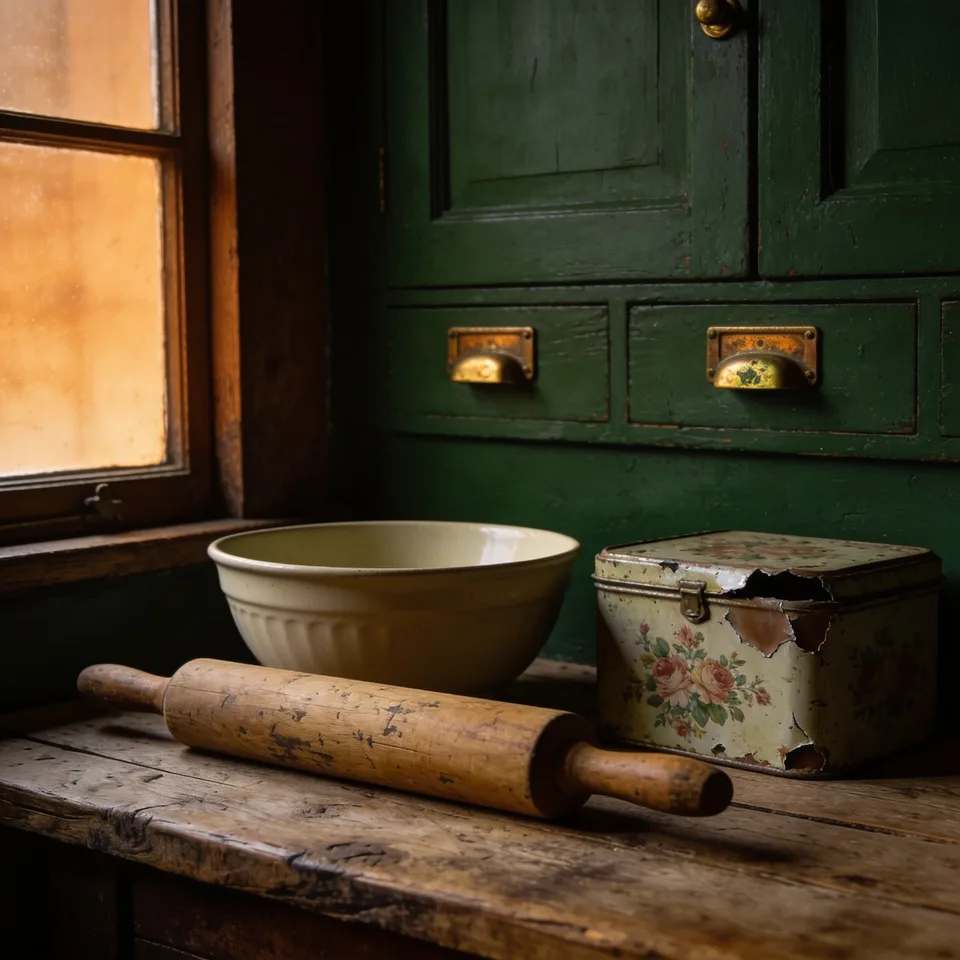
The recipe box is the heart of it
If one object holds the whole inheritance, it is the box of cards. Her handwriting is there, which photographs somehow are not — the abbreviations only she used, the margin verdicts ("more butter," a name, a date in pencil), the grease spots that mark the loved recipes. A cookbook signs its recipes; a recipe box signs its cook.
Keep it working, not preserved. Photograph every card once, so no accident can take them, then put the box back on the counter where flour can reach it. Cook from the originals. Add your own cards behind hers, in your own hand, so the box goes on accruing instead of sealing shut the year she stopped. The most-splattered card is the family's true signature dish — the stains are a vote tally — and the one to teach the next pair of hands.
When nothing was handed down
Plenty of kitchens have no box to inherit — distance, loss, a family that never kept things. There are two honest ways in, and neither is imitation. The first is to ask, now, while asking is possible: the backs of family cupboards hold more than anyone admits, and a thing asked for and given arrives with its story attached, which no sale can supply. The second is adoption. An estate-sale rolling pin carries fifty years of someone's grandmother in its grain, and using it well is not pretending; it is continuation, the same work passing to new hands.
And there is a third way, slower and surest: become the one who hands things down. Buy the plain, sound bowl and use it for thirty years. Cook the same pie every October until the card stains. Every inherited kitchen was once somebody's new one, and the only ingredient that cannot be found secondhand is the years — which begin whenever the cooking does.
Start tonight, with the handed-down thing that has been kept safe too long. Take the bowl out of the cabinet and give it back its old job at supper — and if there is a box of cards anywhere in the family, find the most-splattered one and cook it this week. The kitchen will do the rest of the remembering.
Common questions
Should you use inherited kitchen items or keep them safe?
Use them. A kitchen does not remember with its eyes; it remembers with its hands. The cast-iron pan is the plainest proof: its seasoning is decades of her suppers baked into the metal, and it is kept alive by more suppers, not by rest. The fear underneath is breakage, and the fear is honest, but a chip earned in your kitchen joins the chips earned in hers, one more entry in a long record, where a bowl kept safe ends as an ornament that was once a bowl. The ordinary cautions still apply: a crazed glaze holds clementines rather than cake batter, and anything doubtful changes jobs rather than leaving the room. Within those limits the rule is short — give each piece the most work it can safely do.
What should you do with old family recipe cards?
Keep the box working, not preserved. Photograph every card once, so no accident can take them, then put the box back on the counter where flour can reach it and cook from the originals. Her handwriting is there, which photographs somehow are not: the abbreviations only she used, the margin verdicts, the grease spots that mark the loved recipes. Add your own cards behind hers, in your own hand, so the box goes on accruing instead of sealing shut the year she stopped. The most-splattered card is the family's true signature dish, the stains a vote tally, and the one to teach the next pair of hands.
How do you get the grandma kitchen look without any heirlooms?
Ask first, then adopt; neither is imitation. Asking, now, while asking is possible, is the best way in: the backs of family cupboards hold more than anyone admits, and a thing asked for and given arrives with its story attached, which no sale can supply. Adoption is the second way: an estate-sale rolling pin carries fifty years of someone's grandmother in its grain, and using it well is not pretending, it is continuation, the same work passing to new hands. And there is a third way, slower and surest: become the one who hands things down. Buy the plain, sound bowl and use it for thirty years, and cook the same pie every October until the card stains. The only ingredient that cannot be found secondhand is the years, which begin whenever the cooking does.