 Cottage at Home
Disclosure: some links below are affiliate links, and if you buy through one we may earn a small commission, at no extra cost to you.
Cottage plate rack: what goes in the rack you eat off
A cottage plate rack holds the plates you eat off this week. What goes in it, how many, why the gaps matter, and which plates look right standing on edge.
In this guide
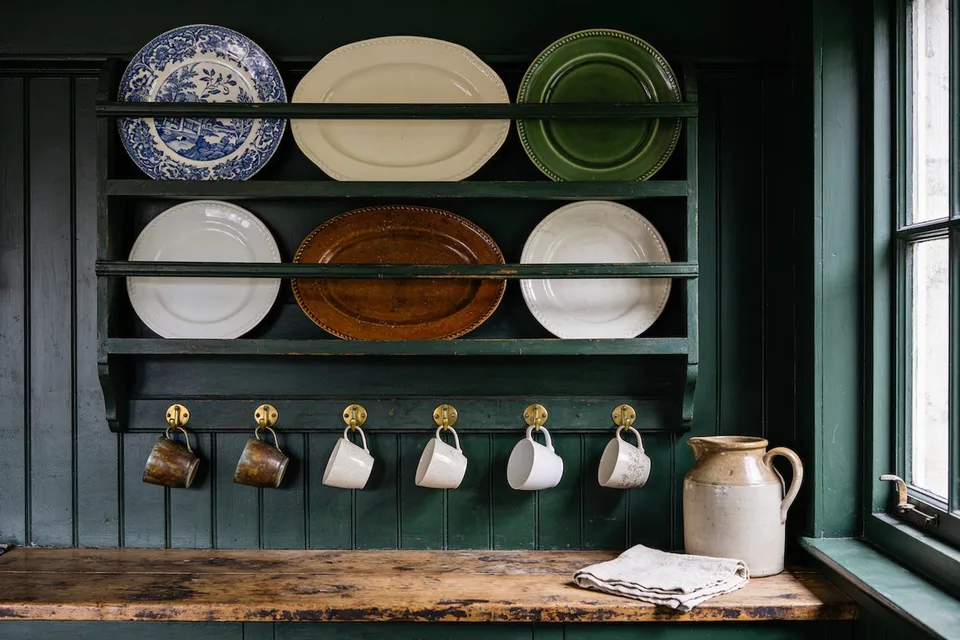
The plates in the rack over the sink are the ones we ate off last night. They went in wet, they will come out for supper, and there is a gap where the one that broke used to stand. A cottage plate rack looks right for as long as that stays true. This page is about what goes in it, and what doesn't.
What a cottage plate rack is, and the rule that fills it
A cottage plate rack is a wooden rack on the kitchen wall that holds plates standing on edge, near the sink or the table. The rule that fills it is simple: it holds the plates the house eats off. Everything else about how it looks, the mix, the number and the gaps, follows from that one rule.
Three things get called a plate rack. A wet rack hangs over or beside the sink, and the washed plates go into it to drain. A dry rack hangs on another wall and keeps the plates between meals. A plate shelf has a groove or a rail along the front and stands plates up to be looked at. The first two are for use, and this page is about them. The shelf belongs with the dresser.
The rack is the plainest case of a rule that runs through an English cottage kitchen: open storage looks kept because it can't pretend. A plain pine plate rack, old or new, does the job, and paint or wear will make a new one look settled soon enough.
What goes in: the everyday plates, in the order of the day
Put in the dinner plates you use most, then the side plates, then one platter at an end. Arrange them in the order you reach for them, with the plates you take most often nearest the table or the sink. Bowls and cups go under or beside the rack, not in it.
Dinner plates go where they stand tallest, usually the back or top row. Side plates go in front or below, where the rim of a big plate doesn't hide them. The platter goes at one end, because it comes out least often, and a platter in the middle of a row breaks it up.
If the plates are drying in the rack, the ones used at breakfast go in first and come out first at lunch. You will find the rack sorts itself this way within a week, and it is worth leaving it to.
How many plates a rack should hold
Fill a rack with about as many plates as the household uses in a day or two, and leave a few slots empty. For two people that might be six or eight dinner plates and a few side plates. Much more than that, and the plates at the back stop being used and start being decoration.
A good test is to look at the rack on a Thursday evening. If every plate in it has been off the wall at least once that week, the number is right. If a few have stood untouched since spring, they belong in a cupboard, and the rack will look better without them.
Why the gaps matter
The gaps in a plate rack are what make it look lived with. A rack filled to the last slot looks like a shop window. One with two plates out on the table, one drying on the draining board and a slot nobody has filled since the last plate broke looks like a kitchen where people eat.
So don't fill a rack to make it look finished. Leave the gaps where the plates actually are, and let the rack change through the day. By supper it is half empty, and by bedtime it is full again, which is the rack doing its job.
Which plates look right standing on edge
In a plate rack you mostly see rims, not the middles of the plates. Plates with a coloured band, a scalloped or beaded edge, or a pattern that runs out to the rim look best on edge. A plate chosen for the picture in its centre loses most of it once it is standing in a row.
Look at your plates from across the kitchen before you choose. Cream ironstone with a beaded rim, blue and white transferware with a deep border, a plain white plate with a green or brown line round it: each of these reads clearly in a row. Mismatched plates sit well together as long as they share a colour or two.
Ironstone dinner plates turn up in odd lots of four or six, and a few at a time is how a rack's worth gets gathered. There is no need to buy a set. The rack looks better when the plates came from three or four places.
What never goes in: the good china and the plate nobody uses
Keep the good china, the wedding plates and anything you would hate to break out of the rack. A rack is handled every day, plates go in wet and come out in a hurry, so it is the wrong home for a plate you would mind losing. Those belong on a dresser shelf or in a cupboard.
The same goes for the plate you like but never eat off. If it is in the rack only to be looked at, the rack slowly turns into a display, and the one thing that made it look right is gone. Hang that plate on a wall, stand it on the dresser, or start using it.
Mugs, jugs and bowls: what hangs and stands underneath
Hang the everyday cups on hooks under the rack or along a rail beside it, handles all facing the same way, and stand a jug or a stack of bowls on the counter below. That puts everything for a meal within one reach: plate, cup and bowl. Keep it to what gets used, as with the plates.
A row of brass cup hooks along the bottom rail does this, one hook per cup the household actually drinks from. Mugs hung by the handle drain and dry just as the plates above them do.
The jug on the counter underneath is for milk at breakfast or flowers the rest of the day. One jug is enough. Two starts to look arranged.
The rack at the lake: odd plates, and washing up by hand
At a lake cottage where the dishes are washed by hand, the plate rack earns its place twice over. The washed plates go straight into it to dry, and the set is whatever came up in boxes over the years: enamel, odd ironstone, one plate from somebody's mother. Nobody minds a chip up there.
That mix is the look people try to copy in town, and at the lake it happens on its own. Leave it. When a plate breaks, the next one found at a church sale or a garage sale takes its slot, and the rack carries on.
Take the plates out tonight and eat off them
Tonight, take every plate out of your rack and look at each one. Put back the ones you ate off this week, in the order you reach for them, and move the rest to a cupboard. Leave the gaps. Then use the rack for a week, and see how it looks on Friday.
Common questions
What do you put in a cottage plate rack?
The plates you eat off every day: dinner plates, a few side plates and perhaps one platter, standing on edge where you can reach them. The rack looks right because it is used, so the good china and the plates nobody touches belong in a cupboard, not in the rack.
How many plates should go in a plate rack?
About as many as the household uses in a day or two, with a few slots left empty. A rack packed tight looks like a shop display. One with gaps where plates are out on the table looks like a kitchen someone cooks in.
What is the difference between a plate rack and a plate shelf?
A plate rack holds plates upright in slots or between rails, so they can go in straight from the washing up and dry there. A plate shelf is a narrow shelf with a groove or a rail along the front that stands plates up to be looked at. A rack is for use; a shelf is mostly for show.