 Cottage at Home
Disclosure: some links below are affiliate links — buy through one and we may earn a small commission, at no extra cost to you.
Hutch decor: the dresser as the house's second pantry
Hutch decor for the months the dresser earns its keep — what comes off, what only comes out now, and how to arrange a shelf to be reached rather than admired.
In this guide
A dresser spends most of the year as a handsome place to keep things. Then the end of October comes, the cooking gets bigger, and for about ten weeks it becomes the most useful piece of furniture in the house: the second pantry, holding everything the kitchen cupboards cannot take while the kitchen is busy being a kitchen.
What hutch decor means once the season starts
Hutch decor, in a house that actually cooks, is the seasonal reshuffle of what the dresser holds. From late autumn to Twelfth Night it stops being display and starts being the overflow shelf: platters, the tureen, the cake stand, the good glasses, all out where a hand can reach them. The arranging matters, but it comes second.
That is the whole difference between this and the styled dressers in the photographs. A styled dresser is arranged once and then guarded. A working one gets pulled apart on the day, put back on the Sunday, and looks better for it, because the objects on it are the ones being carried to the table and back.
It is the same argument as the working kitchen shelf, taken up a floor. That shelf holds what you touch daily. The dresser holds what you touch for eight weeks of the year, and the rest of the time it holds it patiently.
Take out what lives there the rest of the year
Start by emptying it, or at least emptying the two shelves you can reach without a stool. The everyday plates go back to the cupboard for the season, the post and the odd bits of the household go somewhere else entirely, and whatever has accumulated at the back because it had no home gets a real decision made about it.
This is the step people skip, and it is the reason most dressers look crowded rather than full. There is no arranging that fixes a shelf with two sets of things on it. The everyday set and the season's set both want the front row, and only one of them can have it.
Keep the emptying honest. Anything that goes back in should have a job in the next eight weeks, and anything that does not can wait in the cupboard until January. A dresser is not a pantry, which earns its keep by being packed. It earns its keep by being clear enough to work from.
The things that only come out now
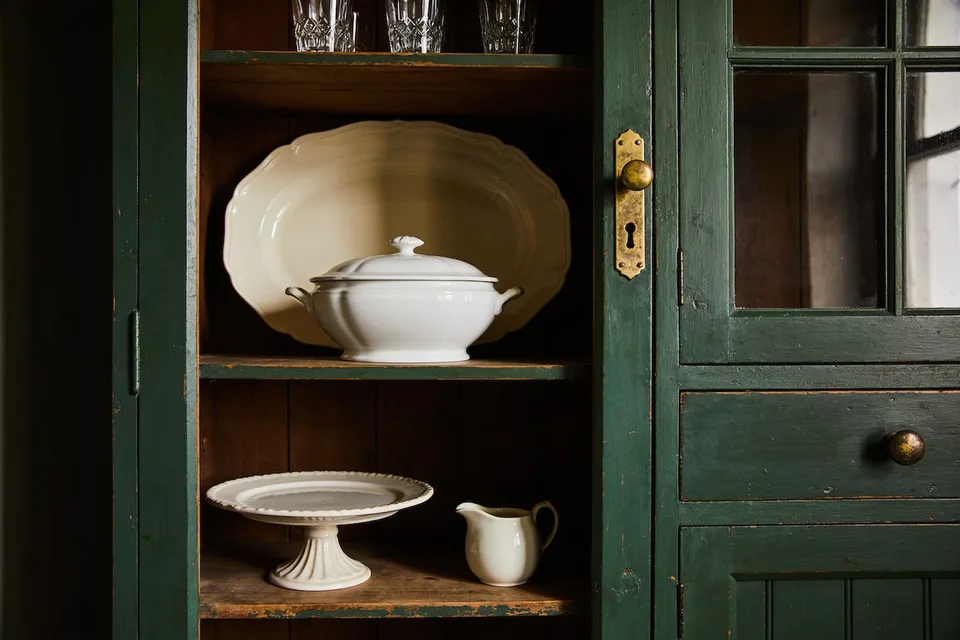
Put back the big serving pieces first, because they set the shelf. A turkey platter, the meat dish that is too big for the cupboard, a soup tureen, a cake stand, the jug that only ever holds gravy. These are the pieces most houses already own and rarely see, and a dresser is the one piece of furniture built to hold them at a sensible height.
If the house is short a tureen, that is the one gap worth filling honestly rather than decoratively. A vintage soup tureen bought secondhand costs less than most centrepieces, it holds soup for eight, and it stands on the shelf for the rest of the year looking like it belongs there because it does. An ironstone cake stand does the same double duty: a stand from November, a fruit bowl by February.
Glass goes at eye level or above, where the light finds it. Everything heavy goes at waist height, where you can take it down one-handed while the other hand is holding something hot. That single rule settles most of the arranging on its own, and it is the one the styled photographs quietly break.
Arrange it to be reached, not admired
Stand the plates upright along the back of each shelf, group the rest in threes and fives with actual gaps between the groups, and stop before the shelf is full. The gaps are not restraint for its own sake. They are where a hand goes on the twenty-fifth of December when the gravy is ready and the jug is at the back.
Plates lean better than they balance. A row of brass plate stands along the back turns a stack of dishes nobody can see into the backdrop for everything in front, and it costs a couple of inches of depth. Failing that, plates will lean against the back board on their own if the shelf has a lip, which most old dressers do.
Height is the other half. Tallest at the back, shortest at the front, and one piece allowed to break the line so the whole thing does not read as a shop display. The eye needs somewhere to stop. The handed-down pieces usually make the best interruption, because they are the ones with a chip and a story.
Light it, or the dresser goes dark at four
A dresser is a deep box with a shadow in it, and in December the daylight is gone by half past four. A small lamp standing on the dresser top, or a pair of candles at one end of a shelf, turns the whole piece from a dark wall into the warmest corner of the room. This is the cheapest thing on this page and the one that changes the most.
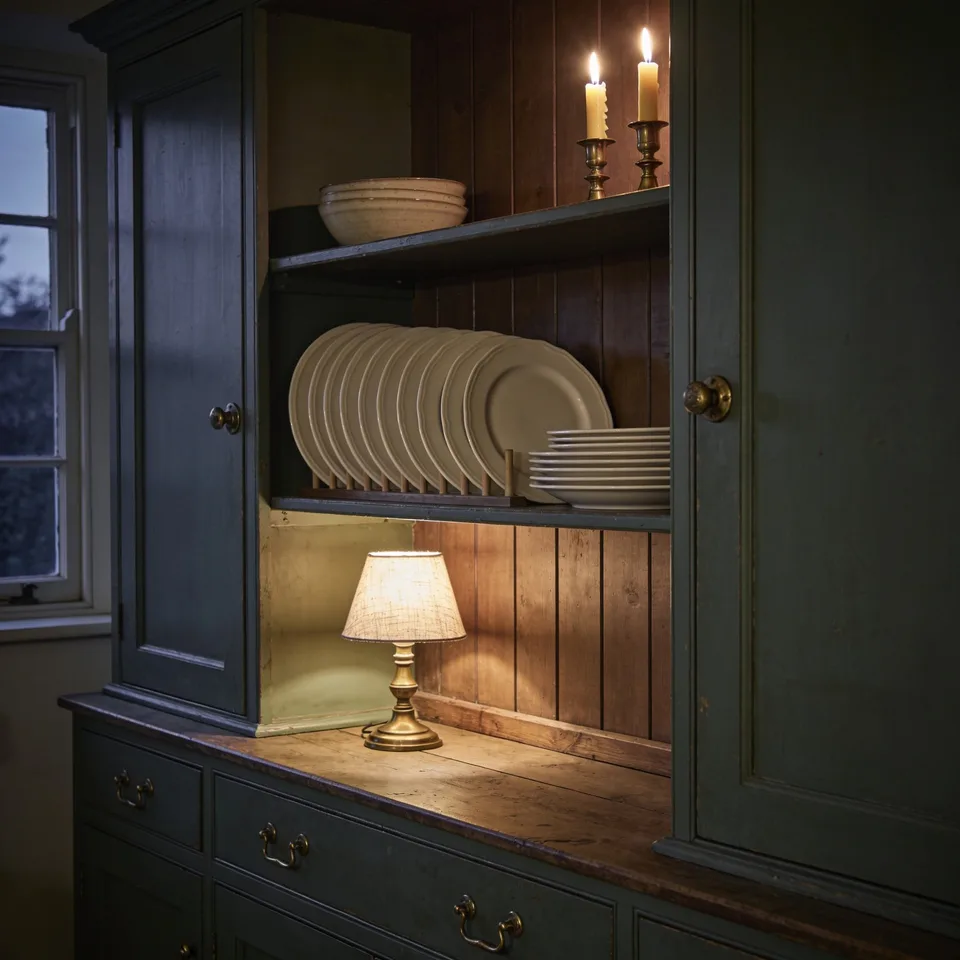
Warm bulbs, low down, more than one of them: the same rule that keeps a dark kitchen from going grim after supper. A lamp inside the dresser also does something a ceiling light cannot, which is to light the glass from behind and the plates from the side.
Candles at the ends of a shelf need a moment of sense about it. Nothing paper or dried should be within reach of the flame, and a dresser shelf is a confined space with a wooden roof, so tapers get lit while people are in the room and blown out when they leave.
What comes off at Twelfth Night
When the season ends, the greenery and the candles go, the platters go back to the cupboard, and the everyday plates come home to the front row. It takes about twenty minutes and it is worth doing in one go rather than in pieces through January, because a half-dismantled dresser looks worse than either state.
What stays is the tureen, the cake stand and the glass, which are useful all year and which have by then earned the shelf. The dresser goes back to being a handsome place to keep things, and the house gets its second pantry back in ten months.
That is the honest rhythm of a piece of furniture this size in a small house. It is a kept kitchen's biggest single object, and it works best when it is allowed to change twice a year instead of being arranged once and defended.
Common questions
How do you decorate a hutch?
Empty it first. Take out whatever lives there the rest of the year, then put back only the pieces the season actually uses: the big platters, the tureen, the cake stand, the jug that holds gravy. Stand the plates upright at the back, keep the heavy things at waist height where you can lift them down one-handed, and leave gaps. A dresser packed to the edges reads as storage. A dresser with air in it reads as a room.
What should you put on a hutch?
The serving pieces you own and only use between Thanksgiving and Twelfth Night: platters, a soup tureen, a cake stand, the gravy jug, the good glasses. Nothing bought for the shelf, and nothing that has to be taken down before it can be used. If a piece has no job in the next eight weeks, it belongs in the cupboard where it already was.
How do you style a hutch for Christmas?
Change the smallest layer and leave the rest alone, because the platters and the glass are already doing the work. A small lamp on the dresser top, or a pair of candles at one end of a shelf, is the cheapest thing you can do and the one that changes the most. Keep nothing paper or dried within reach of a flame, and leave the gaps where they are: they are where a hand goes on the twenty-fifth when the gravy is ready and the jug is at the back.