 Cottage at Home
Disclosure: some links below are affiliate links — buy through one and we may earn a small commission, at no extra cost to you.
The English cottage kitchen: kept, not imported
What makes an English cottage kitchen read as kept — open storage, painted furniture, a working sill — and how to get there without importing a thing.
In this guide
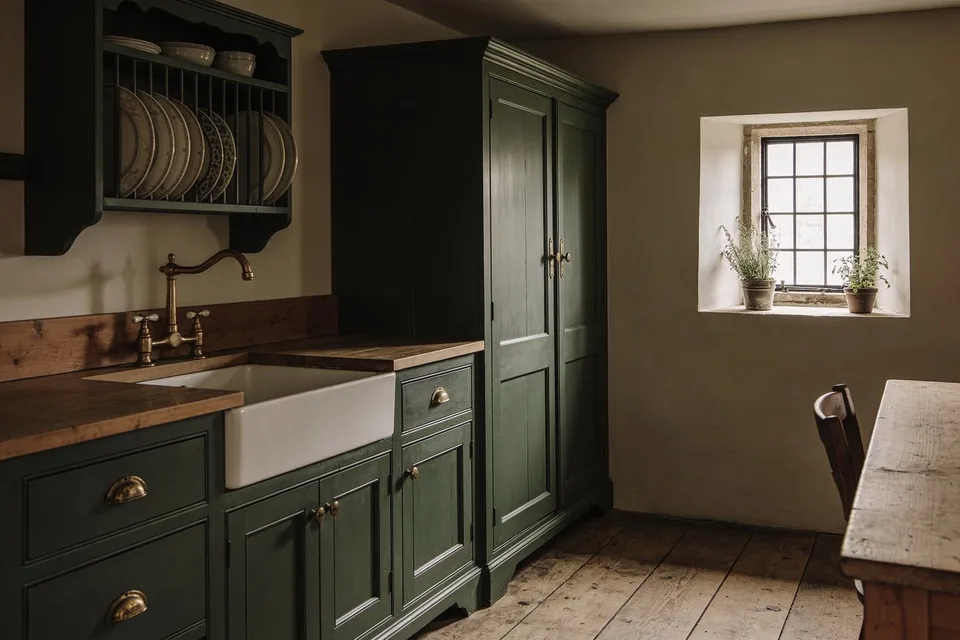
The room this whole subject comes from is small, and nobody designed it. There is a window over the sink with a sill deep enough to work as a shelf, a rack of plates draining above the taps, a rail where the towels dry warm against the stove, and a table with its leaf up because the kitchen is also where tea happens. Nothing in it was chosen in the same decade as anything else. The kettle is on, because the kettle is mostly on.
That room, famously, is somewhere else — in a low stone house at the end of a wet lane, an ocean away from the kitchen actually asking the question, which has a builder's maple cabinets, a ceiling two feet taller, and a window that has never once been called a casement. The distance looks like the problem, and it is not. What an English cottage kitchen has is not an address or an inventory; it is a condition. The room reads as kept — used daily, tended for years, accumulated rather than installed — and kept is not a nationality. It can be begun in any kitchen on this continent without a single antique crossing the water.
Kept is a habit before it is a look
Stand in the real room and the first thing that registers is not any object but the sense that the kitchen was worked in this morning, and every morning before that, by people who put things back where the work happens. Go looking for English cottage kitchen ideas, though, and what comes back is mostly inventory: the iron range cooker, the reclaimed flagstones, the dresser shipped at ruinous freight. None of it is wrong, and none of it is the point.
The condition has tells, and they are worth naming, because every one of them can be built:
- The storage is open, and it is working. Plates in a rack, cups on hooks, spoons standing in a crock. Use is visible, and visible use cannot be staged; the dishes sit exactly where they drained.
- Nothing matches, because nothing arrived together. The crockery is a census of years, not a set. Accumulation is the look, and a single delivery date is the giveaway.
- Surfaces are allowed their age. The worktop is scrubbed rather than refinished, the brass is handled rather than polished, and the paint wears through first at the latch, where the hands go.
- The kitchen is a room, not a station. There is somewhere to sit, a lamp that gets switched on at dusk, a curtain at the window. It faces its own table, not a television across an open plan.
Under all four runs the habit the word is pointing at. Kept is a verb before it is a look: the towel is hung, the board is wiped and stood on its edge, the shelf is put back in order a jar at a time and never all at once. The English kitchen holds this quality because it was never renovated in one stroke — it accreted, piece by piece, under generations of that verb. Where the generations happen to be your own, the room shades into a grandmother's kitchen, which is accretion at its warmest. Accretion cannot be ordered. It can only be started, and starting it is what the rest of this guide is for.
Cabinets painted like furniture
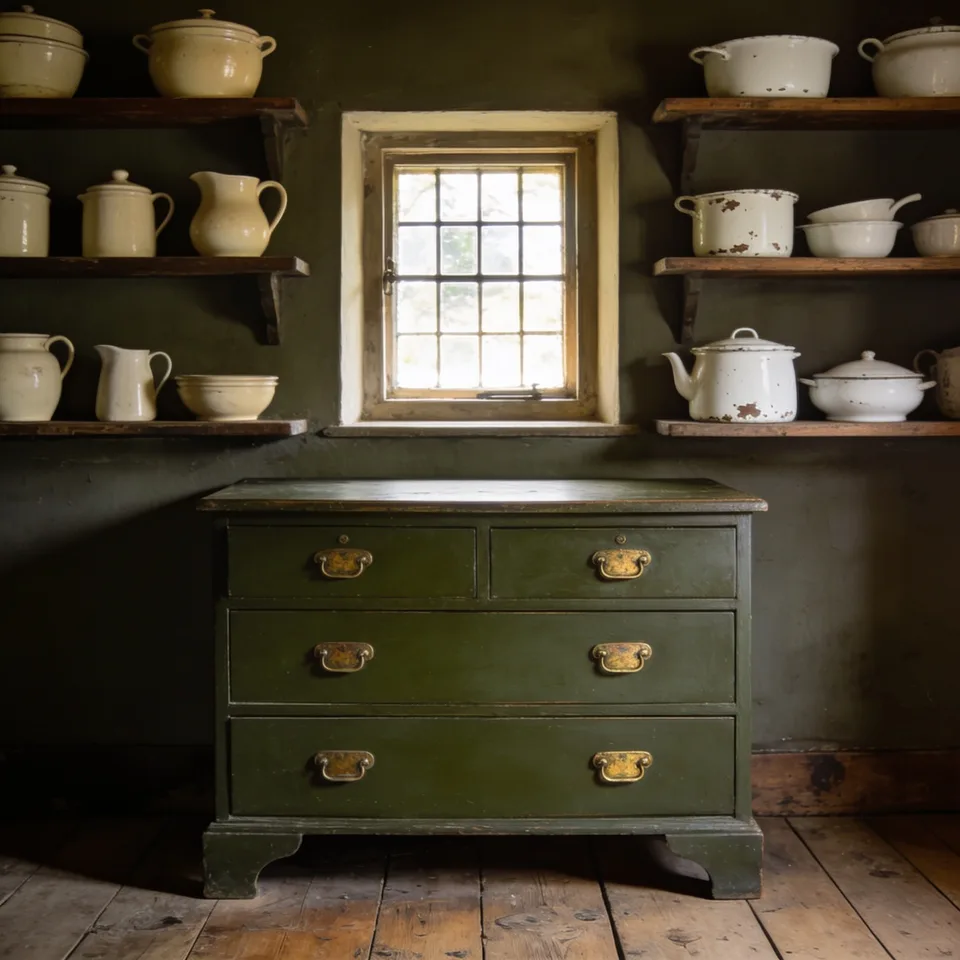
The answer to a wall of identical doors is paint, not demolition. A builder's cabinet painted a complicated furniture color — moss, deep olive, a brown with clay in it — stops reading as millwork and begins reading as a piece somebody chose. Swap the pulls for plain unlacquered brass or turned wooden knobs and let them wear where the fingers land.
The deepest difference between that room and this one is not the cabinets themselves but what the cabinets claim to be. The old cottage kitchen was unfitted: freestanding pieces — a dresser, a cupboard, a table doing the counter's work — standing on their own legs around the walls, bought and inherited one at a time. The seamless fitted run is the newer idea, and its seamlessness is precisely what reads as installed. A wall of identical doors says one decision, one invoice, one afternoon.
Then interrupt the run, once. Take one bank of upper cabinets off the wall — the stretch nearest the window is usually the right one — and hang a single deep wooden shelf in its place. Or, gentler, leave the boxes and remove only their doors, painting the inside the color of the wall. One honest interruption is enough. The eye reads the gap as history, as though the kitchen had been assembled across years, because now it has begun to be.
Storage that works in the open
Open storage is where kept lives or dies, because it is the one part of the room that cannot pretend. A closed cabinet keeps its habits to itself; an open shelf files a report every morning on how the household actually runs. This is why the English kitchen keeps its everyday things out in the air, and why the arrangement never quite looks styled. It was not styled. It was put away.
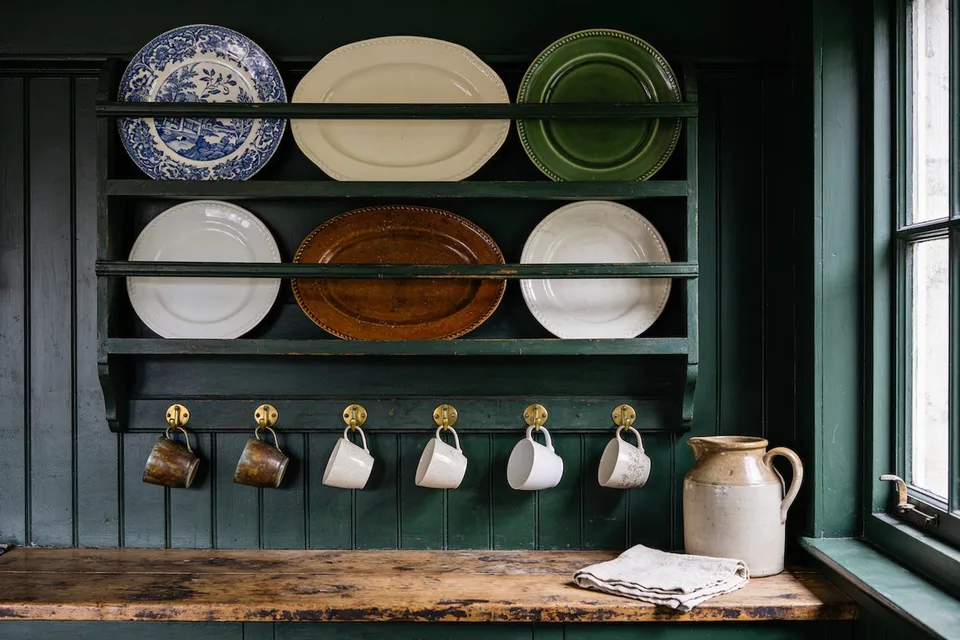
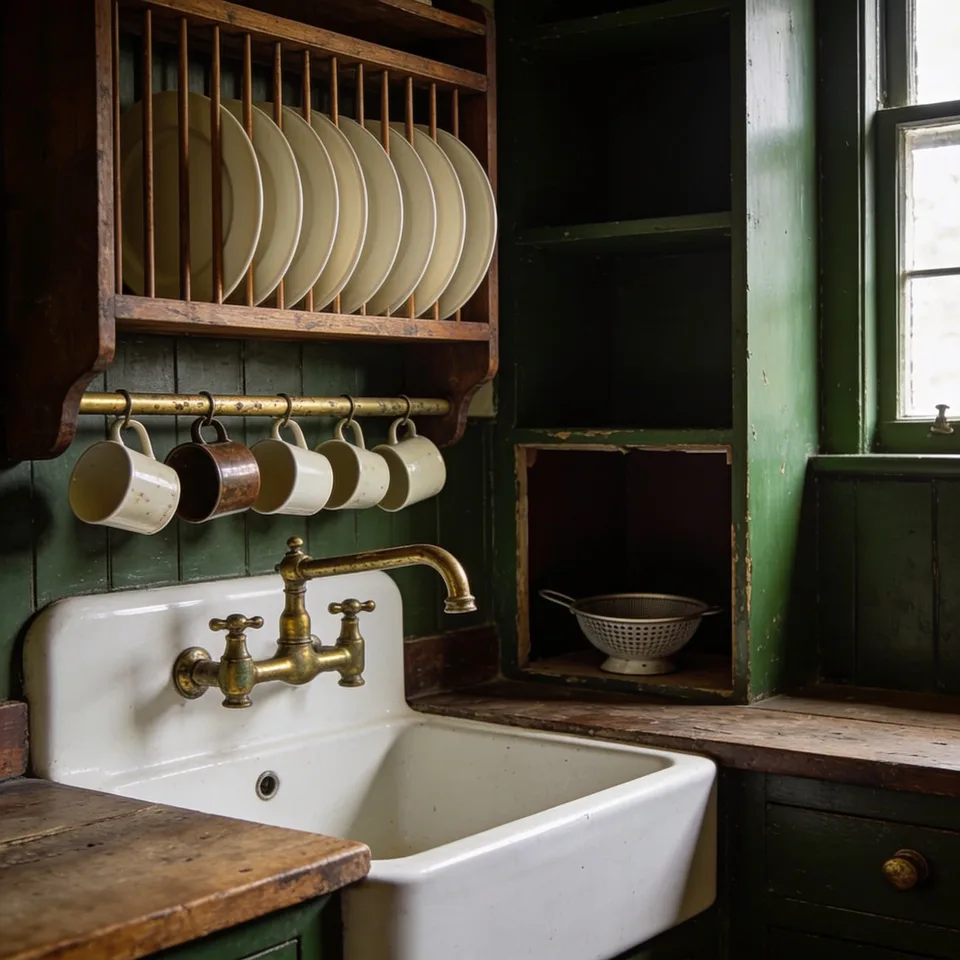
The plate rack is the best teacher in the house. Hung over or beside the sink, it takes the washed plates straight from the water and simply never gives them back — they drain, they dry, and they live there, so that the display above the sink is nothing more than supper's dishes waiting for supper. The cottage plate rack goes further into what belongs in one and how many. A plain wooden rack, new and unembarrassed about it, does the work. So does a length of rail under the shelf, hung with S-hooks for the mugs, the sieve, the scissors that actually cut. The crock of wooden spoons stands beside the stove because that is where stirring happens.
Behind all of this stands the larder — the cool cupboard of jars, tins, and the cake under its cloth, which is the original open storage and the ancestor of most of what fills our kitchen and pantry notes. Few houses here have one, and the principle survives the loss intact: keep the working things in the open where the work happens, and let the day's putting-away do the decorating.
The sink, the sill, and the curtain
An English sink window is small and set deep in a thick wall, which makes its sill a working shelf: parsley standing in a jam jar, a bar of soap in a saucer, the washing-up brush drying in a cup. A North American window is larger, its sill often shallow enough to hold nothing but dust — and the moves still translate, because none of them depend on the thickness of the wall.
Give the sill work to do, even if the work must move to a narrow shelf mounted beside the glass. The grocery bunch of mint or parsley, stood in a jar of water with its roots on, is the cheapest and most honest greenery a kitchen can hold; it is dinner, not decoration, which is exactly why it reads as kept.
Then hang a curtain — a café curtain, covering the lower half of the glass, in a linen with some weight to it, on the plainest rod sold. Half-covered glass is a quiet trick with a long history: light comes in over the top all day, privacy holds at eye level, and at night the room keeps its own soft reflection instead of a black stare. A window with a curtain belongs to the room. A bare one belongs to the street.
And retire the printed novelty towels to the rag drawer. One linen towel, hung on the oven rail and swapped when it flags, dries hands, dries plates, and softens the whole steel front of the stove — three jobs for one plain object, which is about the usual rate of exchange in this kind of kitchen.
Colors with weather in them
The English palette was never a fan deck; it looks mixed from whatever is outside the window. Moss, bracken, clay, buttermilk, the gray of a sky deciding whether to rain — colors with brown or gray folded into them, complicated enough to shift as the day moves. Clean, bright, single-note color reads as an arrival, something delivered and applied. Weathered color reads as a tenant of long standing.
A North American room usually stands taller and brighter than the cottage original, and this turns out to be an advantage: it can take real depth without going dim. Put the deepest color low — the cabinets, the wainscot, the legs of the table — keep the ceiling a soft white, and the tall bright box acquires the settled, held-close feeling the low English room was given free by its beams. How far to take that depth, and how to test a color against your own light before trusting it, is its own subject, covered properly in the dark cottage kitchen. The short version travels well: choose colors that change their mind through the day, and live with them on the wall for a week before believing them.
Old things that never crossed an ocean
Here the instinct is to reach for provenance — a Welsh dresser, English ironstone, the genuine article at genuine freight. The instinct mistakes what old things are for. What makes them read right in a kitchen is not where they were made but that they were used: the shelf edge worn round, the drawer that learned its owner's particular pull, the board dished by decades of somebody's bread. Use is local everywhere. The ocean adds shipping, not history.
And this continent is quietly full of the same class of object. The tall piece England calls a dresser is standing right now in an estate sale two towns over, called a hutch, orphaned by somebody's open-plan renovation and priced accordingly. Pine tables, stoneware mixing bowls, enamel roasters, boards and crocks and jugs — all of it surfaces weekly, all of it worn by hands no farther away than a neighboring county. One freestanding piece with legs and air around it will do more to unfit a fitted kitchen than any run of new cabinetry, and its shelves are where the mismatched crockery gets to stand and be counted. Choosing these things well — what a chip in enamel means, which old boards can go back to work — is a subject of its own, taken up in vintage cottage kitchen decor. The rule that belongs here is shorter: buy the thing that was used, wherever it was used, and let the passport go. That rule reaches well past the kitchen, and it is most of what old world decor turns out to mean once the phrase is taken off the manor house: a condition things arrive in, not a grade of furniture.
A table, a lamp, and somewhere to sit
The English kitchen is a room people stay in. Tea is taken at its table; the visitor is sat down at it within a minute of arriving; homework and shelling peas and the reading of the post all happen on its one scrubbed surface. The North American kitchen, for all its extra square footage, is often only passed through — a station of counters facing an open plan, with nowhere to sit that is not a stool at a height no grandmother trusts.
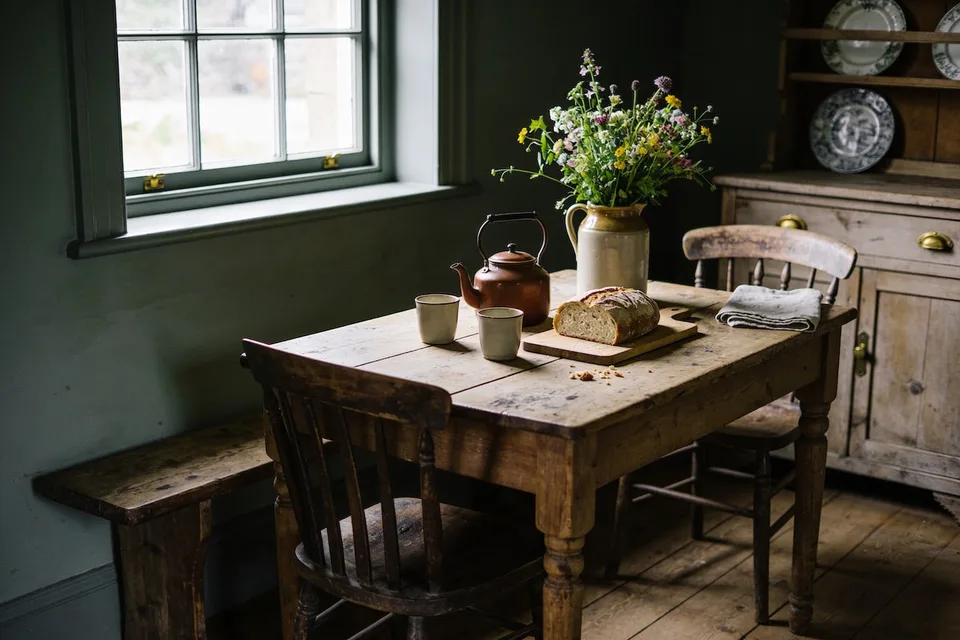
So give the room a place to stay. A cottage kitchen table is the best place of all, if there is room for one. A small table against the wall with two chairs will do; so will a bench end, or one armchair angled toward the window if the plan allows nothing else. Put a lamp on or near it — a small one, warm-bulbed, switched on at dusk before it is strictly needed — and the corner declares itself a destination rather than a throughway. In a plan without walls this is also how the kitchen finds its edges again: the pool of lamplight and the rug under the table end the room the way a wall used to, and the kitchen becomes a room within the plan rather than a countertop at the edge of one. The wall beside that table can carry the room's own subjects on paper: our Etsy shop sells six studies of the working kitchen, the copper pot and the garlic braid among them, printed at home with no ocean and no freight involved.
A kettle that sits on the stove and whistles helps more than it has any right to. It gives the room a clock, an errand, and a reason to stand in it doing nothing for four minutes — which is, in the end, the activity this entire kitchen is designed around.
One cupboard, opened
Begin this weekend with a screwdriver rather than a purchase. Take the doors off the one upper cabinet nearest the sink — four screws, ten minutes, the hardware into a jam jar at the back of a drawer — and move the everyday plates and mugs onto its shelves. Then live there for a month, putting them back, one supper's dishes at a time. That daily putting-away is the whole secret being sold under the word kept, and it costs nothing to find out whether the room wants more of it. The doors can always go back on. They tend not to.
Common questions
How do you style open shelving in an English cottage kitchen?
You don't, quite — you put things away and let that be the arrangement. The plate rack is the best teacher: washed plates go straight from the water, drain, dry, and live there, so the display above the sink is only supper's dishes waiting for supper. Open storage reads as kept because it cannot pretend.
Do you need English antiques for a cottage kitchen?
No — the ocean adds shipping, not history. What makes an old piece read right is that it was used, and use is local everywhere: the tall piece England calls a dresser is standing in an estate sale two towns over, called a hutch, and priced accordingly.
Can a fitted kitchen with builder cabinets look like an English cottage kitchen?
Yes, and paint does most of it. A builder's cabinet painted a complicated furniture color — moss, deep olive, a brown with clay in it — stops reading as millwork and begins reading as a piece somebody chose. Swap the pulls for plain brass or wooden knobs, then interrupt the run once: one bank of uppers traded for a single deep wooden shelf.