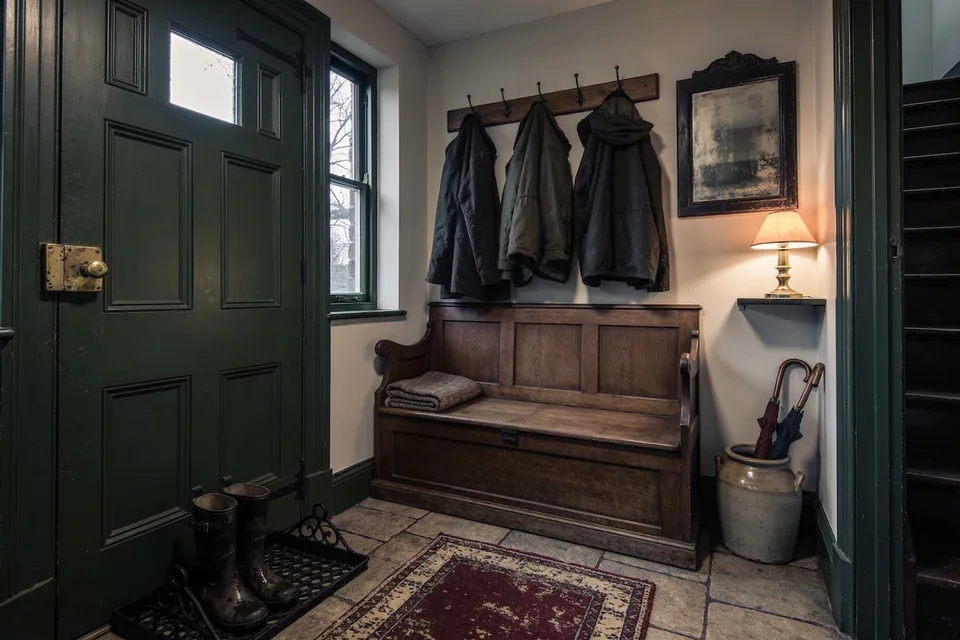
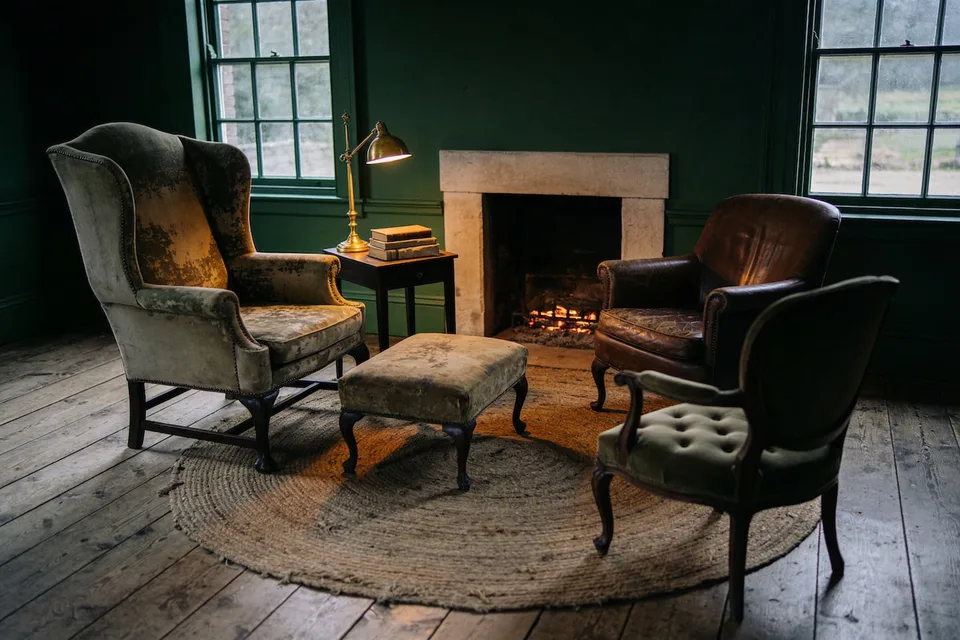
 Cottage at Home
Disclosure: some links below are affiliate links — buy through one and we may earn a small commission, at no extra cost to you.
Old world home decor: what it is and how a small house gets it
Old world home decor means deep muted colour, worn wood, iron and earthenware — a condition things arrive in, not a price bracket. A cottage can have it.
In this guide
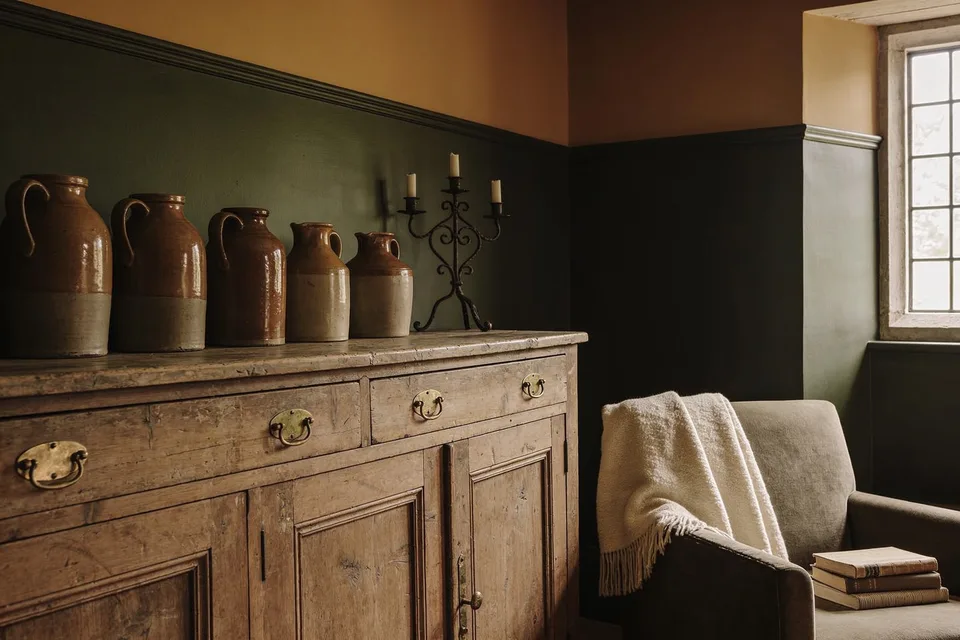
You hear the phrase before you can define it. Somebody walks into a friend's kitchen, sees a painted dresser worn back to bare wood along its edges and a row of brown jugs standing on top, and says the room feels old world. Nobody asks what that means. Everyone standing there already knows, which is a strange thing to be true of a phrase almost nobody can finish a sentence about.
What old world home decor actually means
Old world home decor is a look built out of deep muted colour, worn wood, wrought iron and earthenware, arranged so a house seems to have gathered its contents slowly rather than bought them all at once. The name points at old Europe, and the definitions all name English cottages beside French farmhouses and Tuscan villas. What those houses share is age and craft, not grandeur.
That last part is worth sitting with, because the word gets used as though it meant grand. It does not. Every list of what makes a room old world comes back to the same short set: colour with some earth in it, wood you can see the grain of, metal that was hammered rather than moulded, pottery made to be used. None of those is a matter of scale. A château and a two-up two-down can both be furnished out of that list, and the small house often does it better, because there is less room for anything that does not belong.
The English cottage is already in the definition
Every definition of old world names the English cottage in the same breath as the villa and the manor. That matters more than it sounds, because the cottage is the branch of the style most people can actually reach: small rooms, low light, plain oak, a hearth, and things kept because they still work rather than because they are rare.
The grand version is the one that gets photographed. Carved stone, gilt mirrors, a hall you could park a car in. It is real, and it is nobody's flat. The cottage version runs on exactly the same instincts at a size a person lives at: a deep-coloured wall instead of a painted ceiling fresco, a dresser instead of a hall cupboard, one iron latch instead of a suit of armour. If you have been reading about the moodier, older cottage look and wondering what the trade calls it, this is the word. It is also why the same instincts land so squarely in an English cottage kitchen, which is the room where the style was always most practical and least decorative.
Old world is a condition, not a price bracket
Old world is a condition objects arrive in, not a grade of furniture you buy. A chair earns it by having been sat in for forty years, and a costly reproduction does not earn it by costing more. That is the most useful thing about the style for anyone furnishing a small house on ordinary money.
The antique trade sells the phrase as a price tier, and that is a sales decision rather than a description. What the look is actually made of is wear: the worn shine on a stair rail, the dull patch on a brass handle where a thumb goes, the plate with a hairline you can only find in strong light. None of that can be bought new at any price, and all of it can be had cheaply second-hand, or inherited, or simply waited for. A pine table you use hard for ten years becomes an old world table by doing nothing but being used. That is the whole trick, and it is also why buying second-hand rather than new is not a thrift measure in this style. It is the method.
The one honest caution is that wear and damage are not the same thing. Old world rooms are worn, not broken, and a piece that wobbles or smells of damp is a repair job with a story attached, which is a different purchase.
The four materials that do the work
Four materials carry old world decor almost on their own: deep muted colour on the walls, wood left dark or painted and worn back, iron and brass for anything that holds or hangs, and earthenware for whatever sits out on a surface. Get those four right and everything else in the room can be quite ordinary.
The darks lean brown, green, ox-blood and ochre rather than grey or blue, because those are the colours old pigments actually made. Walls in that range hold lamplight instead of flattening under it, and they let wood, brass and brown pottery sit against them without any of the three looking stranded. The case for taking a small room genuinely dark, and how to keep it from going cold, is its own argument.
Wood is the second one, and the rule is finish rather than species. Oak, elm, walnut and pine all belong; a high gloss lacquer does not, because it reads as new no matter how old the piece underneath is. Wax, or nothing at all, is the old world finish. Iron and brass come third and they are the cheapest way into the look, because hardware is small: a hand-forged hook, a latch, a wrought iron candle sconce on a dark wall does more than a piece of furniture costing thirty times as much.
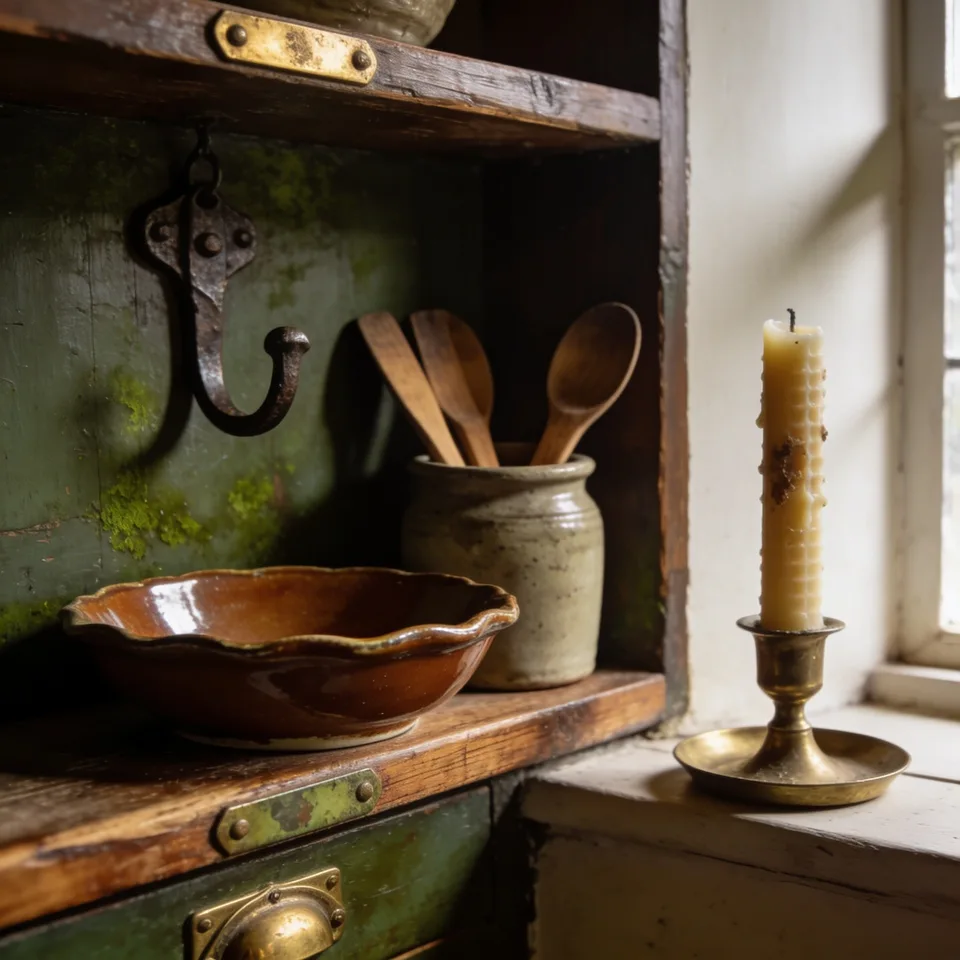
Earthenware is the fourth and the one most people miss. Brown-glazed jugs, slipware dishes, stoneware crocks kept in use for wooden spoons or dried flowers — pottery made to be handled rather than displayed. A single brown stoneware jug standing on a dresser will date a room backwards a century, and it will do it while holding the scissors.
Where to start in a small house
Start with one surface and one armful of things, not a whole room. A single shelf or a dresser top, cleared and then filled with only wood, iron and earthenware, will read old world on its own, and it will tell you whether you actually like living with it before any paint is bought.
From there the cheapest moves are swaps rather than purchases. The plastic or chrome version of a thing you already own — a hook, a bin, a lamp, a spoon jar — has an iron, wood or pottery twin, usually second-hand and usually cheaper. Warm bulbs in every lamp, because cool white light undoes deep colour faster than any furniture can repair it. And one honest gap left empty, since a room that has gathered slowly always has somewhere it has not got to yet.
If it helps to see the register on paper before you commit to it, our own shop holds a set of eighteen moody cottage prints drawn in these colours, and the rest of what we make sits in the shop.
The style is older than its name, and the name is younger than the trend that gave it to us. What outlasts both is the instinct underneath: buy less, keep it longer, choose the version that will look better worn than it did new. A small house can do that as well as a large one, and it has fewer corners to fill.
Common questions
What is old world home decor?
Old world home decor is a look built out of deep muted colour, worn wood, wrought iron and earthenware, arranged so a house seems to have gathered its contents slowly rather than bought them all at once. The name points at old Europe, and the definitions all name English cottages beside French farmhouses and Tuscan villas. What those houses share is age and craft, not grandeur.
Is old world decor expensive?
It does not have to be. Old world is a condition objects arrive in, not a grade of furniture you buy. A chair earns it by having been sat in for forty years, and a costly reproduction does not earn it by costing more. That is the most useful thing about the style for anyone furnishing a small house on ordinary money.
What colours are old world?
The darks lean brown, green, ox-blood and ochre rather than grey or blue, because those are the colours old pigments actually made. Walls in that range hold lamplight instead of flattening under it, and they let wood, brass and brown pottery sit against them without any of the three looking stranded.