 Cottage at Home
Disclosure: some links below are affiliate links — buy through one and we may earn a small commission, at no extra cost to you.
Dark cottage living room: how deep walls stay warm
A dark cottage living room stays warm by undertone — brown-black and umber, never blue-black — then brass, cream wool, firelight, and one pale surface kept.
In this guide
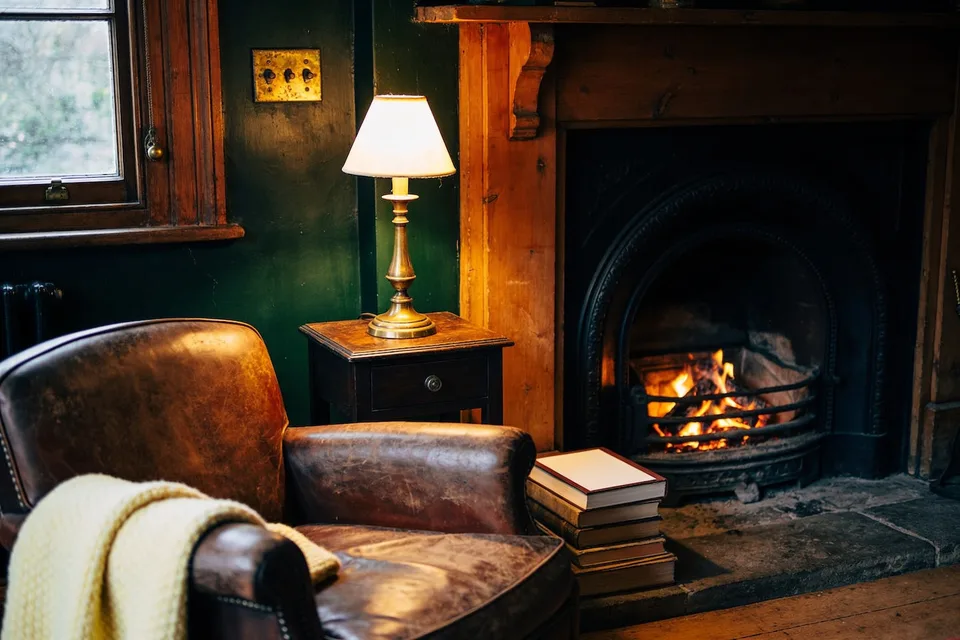
By nine the fire is down to embers, and the deep green of the walls has gone nearly black — but a warm black, the black of the hedge after the light has left it, nothing like slate in rain. The brass fender is the brightest thing in the room now. On the pale stone of the hearth, the one light surface the room kept, somebody's cup is going cold, and the dark around it looks less like nightfall than like a decision.
Before buying anything, try one corner with a lamp and throw you already own. Our dark cottage room plan helps you compare what to keep, what to move and what, if anything, belongs on a buying list.
Warm dark and cold dark
A dark cottage living room stays warm or goes cold on its undertone. Brown-black, green-black, deep umber — the darks of peat, hedge, and strong tea — carry a memory of warmth in them, and firelight and lamplight, being orange, find that memory and feed it, so the wall glows faintly at the hours the room is lived in. Blue-black is another country: the dark of slate and deep water, handsome at noon in a wide-windowed room, and it meets orange light badly — the two cancel into a flat charcoal-gray that no quantity of wool can talk round. That is nearly the whole difference between gothic and kept. The room-by-room case for the darker house is made elsewhere; this is the sitting room's chapter, and it turns on a distinction the paint chip is too small to show. Depth of color matters far less than its lean, and the lean only shows at night. So the samples get judged at nine in the evening, under the lamp that will actually do the lighting: the dark that turns brown or green will be warm all winter, and the one that turns slate is already cold in October.
What the dark wall wants against it
The dark wall is not asking to be brightened. It is asking to be answered. The trade the deep wall offers is plain: it gives up its own brightness so that everything in front of it can have some. Brass collects first on that bargain. A handled candlestick, a lamp's turned column, the fender — brass gone soft with use catches the fire's light and hands it back warmed, and one small piece against a near-black wall outdoes a shelf of it against white. Aged wood works the same seam more slowly; the dark oak dresser that looked heavy against pale walls looks inevitable against deep ones, its grain reading like a slower kind of flame. And the fire itself, where the room has one, stops being a feature and becomes the argument — live orange burning low in a dark room is the oldest interior there is. Paper can answer it too, on the room's own terms: our own Etsy shop holds six flower studies drawn on dark grounds, the iris and the dahlia among them, and against a deep wall their grounds step back with the paint while the blooms come forward the way the brass does. Deep paint does not make the room; it makes the setting, and a dark wall with nothing against it is simply an absence — which is where the fear of gloom comes from, and where it ends.
The wool does the warming
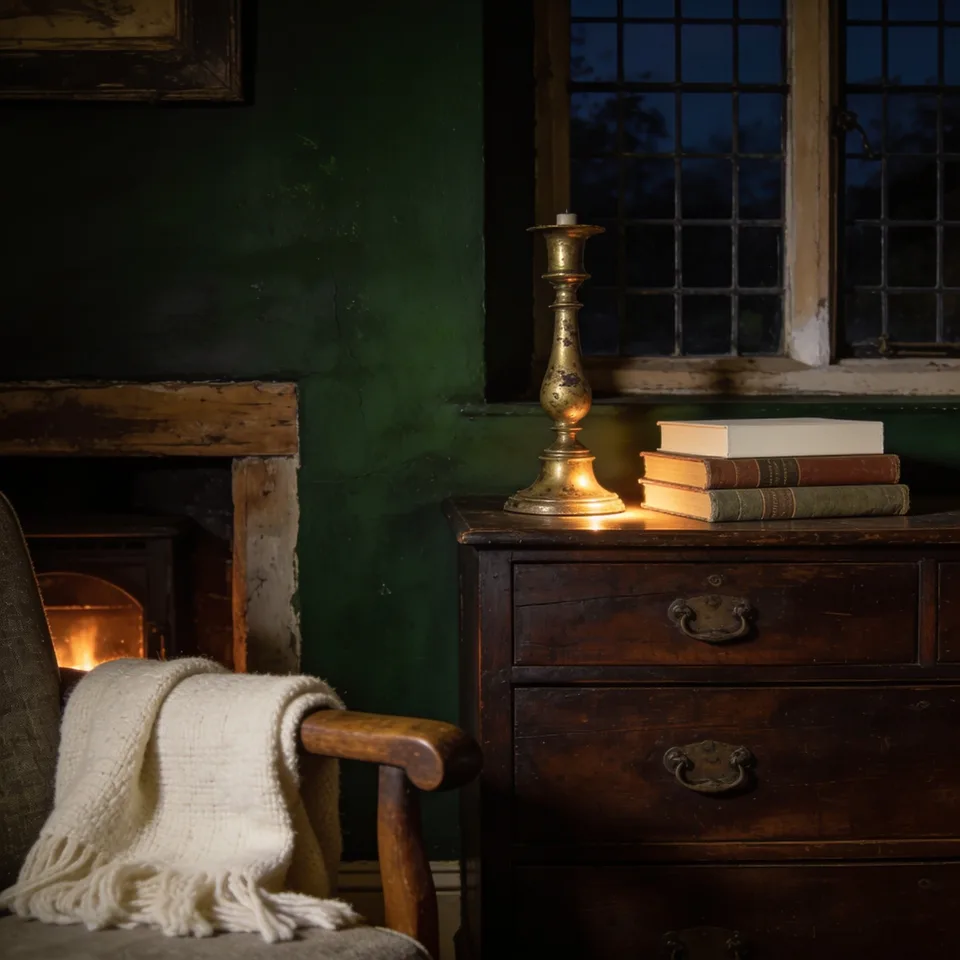
Past dusk, a deep-walled room is read by texture as much as by color, which is why textiles do more of the warming here than anywhere else. Smooth surfaces disappear into a dark room at night; pile does not. A wool throw over the chair arm, a worn velvet cushion, a rug with some age underfoot — each catches the lamplight along its nap and keeps its shape after the walls have given theirs up, so the room stays legible and goes soft at the same time. Cream wool earns a particular place: against green-black it is the loudest quiet contrast the room can hold, warm-white rather than paper-white, and the meeting flatters both — the wall looks deeper for it, the wool looks warmer. It can gather slowly — the same migration the room makes on its own as autumn comes on, throws drifting in from other rooms, heavier weave coming out of the chest — only in a dark room the textiles are not seasonal trim. They are the insulation the eye believes in.
Leave one pale surface pale
The dark room keeps its nerve by keeping one exception. A ceiling in soft white, a limestone mantel, a deep windowsill, a chair slipcovered in undyed linen — one pale surface, held on purpose, does two jobs at once. By day it takes what light the window brings and lends it around. And at every hour it stands as proof of intent: a room dark on every surface can read as a room nobody got around to lighting, while a room dark to the picture rail under a pale ceiling reads as a room somebody finished. The dark has to look chosen, and the pale surface is the signature on the choice. By the fire it is the hearthstone — the cup lands there, the light pools there, and everything deep around it looks deeper for the company.
Lamps in pools, not a wash
Dark walls swallow light rather than returning it, which is why the ceiling fixture — the pale room's workhorse — fails here twice over: glare at the bulb, gloom in the corners, the room lit the way a flash photograph lights it — all surface, no depth. A deep room runs on pools instead. Three or four small lamps at sitting height — beside the chair, on the dresser, one low by the door for coming in — each holding its own warm circle, with the dark allowed to stand between them. The between is the point; the unlit stretches of wall are where the depth lives. The darker kitchen arrived at the same arrangement by its own road — lamps for the evening, the big light kept for cleaning — and the sitting room has even less cleaning to excuse it. Warm bulbs, modest wattage, more lamps rather than brighter ones — and no face in the room ever lit from directly overhead.
The small room, taken at its word
The standing advice for a small, dim sitting room is to fight it: white paint, mirrors, a campaign to talk the room into being a different room. But a small room with one modest window cannot be argued into brightness it never receives — painted white it does not become light; it becomes gray and stays gray all day. Painted deep, the same room stops apologizing. Dark walls blur their own corners, the eye loses the edges and gives up measuring, and the box becomes a burrow; smallness turns from the problem into the very thing the color is for. The old cottages had this room and a name for it — the snug — never a large room that failed, but the best seat in the house from October to March. A small dark cottage living room is not a compromise waiting on an extension. It is the house's deepest pocket, and it asks only to be lined.
One honest evening
Before any color is committed to: paint a board the size of a tea tray, stand it on the mantel where the firelight lands, and come back at nine with only the lamps lit. If the dark leans brown and the brass beside it warms, the room has already said yes.
Common questions
Will dark walls make a small living room feel smaller?
Not if the undertone is warm. Brown-black and umber recede and read as depth, while blue-black reads as cold and pushes the walls in. A small room painted a warm dark loses its corners in shadow, which makes it feel larger rather than tighter.
What colours work against a dark cottage wall?
Brass, cream wool, unpainted wood and firelight. The wall is the quiet part, and everything set against it should carry warmth of its own rather than contrast for the sake of it.
Should the whole room be dark?
No. Keep one pale surface pale, whether that is a ceiling, a mantel or a run of curtain. Without it the eye has nowhere to rest and the depth stops reading as depth.