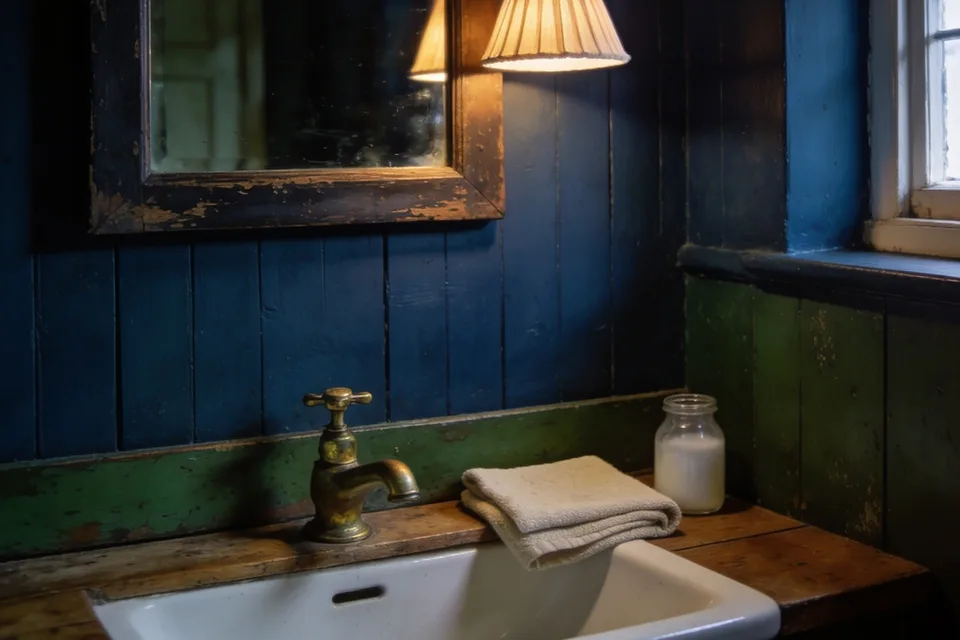
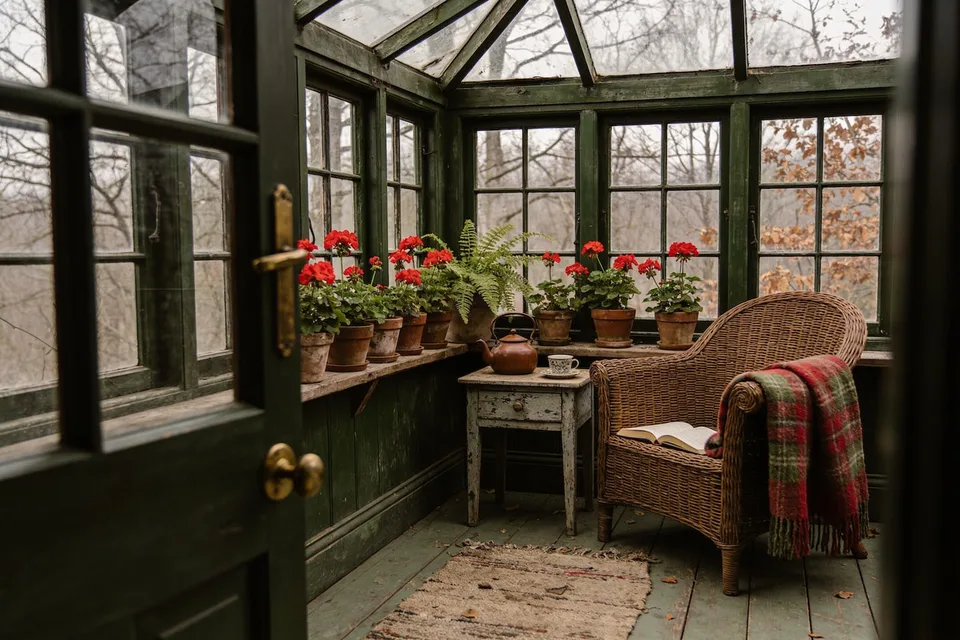
 Cottage at Home
Moody cottage decor: why the darker house feels kept
Moody cottage decor is depth, not gloom — deep walls, wool, lamplight, and worn brass — the room-by-room case for a darker house that feels kept.
In this guide
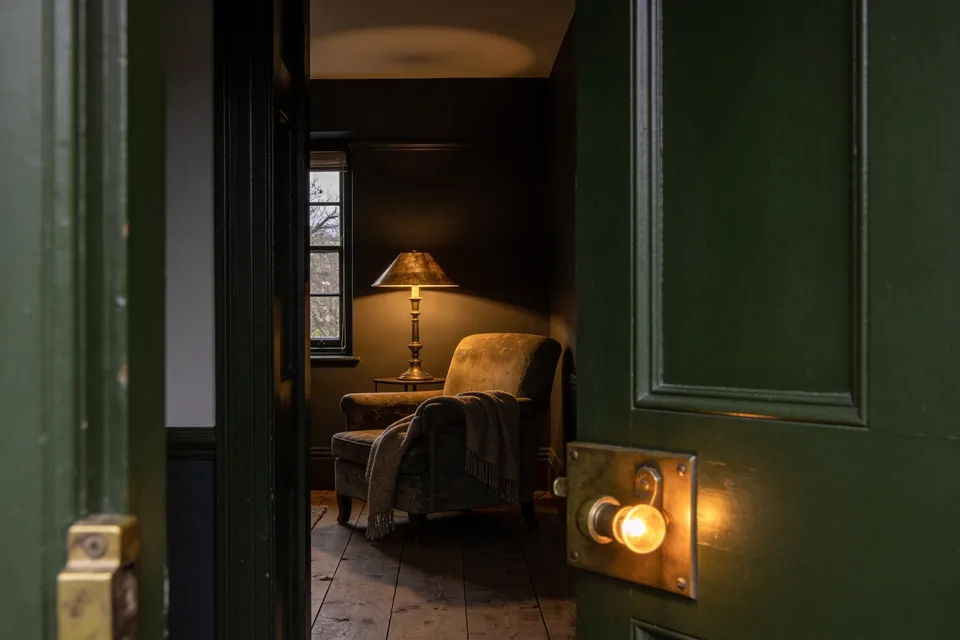
The sitting room went over to deep green two autumns ago, and by half past four the walls have gone the color of the hedge at dusk. One lamp is lit beside the chair, holding a circle of wool and the open pages of somebody's book; the door latch keeps its brass shine only where hands have landed on it for years. People coming in from the gray outside stop a moment in the doorway. What they say is never that the room is dark — they say it looks warm in here.
Kept, not dark
That pause in the doorway is the whole case for moody cottage decor, and it deserves to be made slowly, because the pale room has had the last decade to itself. Pale rooms photograph well. White walls bounce every scrap of daylight until the picture glows, and a camera is a daylight instrument — it votes for the room that feeds it, which is why the listings run wall to wall in cream. But nobody lives in a house at the hour it photographs best. A house is lived in at seven on a February morning and nine on an October night, under lamps — and at those hours the white room goes flat and gray while the deep room settles in and holds.
Depth reads as time. A wall in umber or moss looks as though it has been that color longer than anyone can remember, and it takes wear the way old furniture does — scuffs and shadows sink into it, where on white every mark stands out like an accusation. Deep color is generous to old things for the same reason: the dented brass and the dark oak that look tired against a bright wall look inevitable against a deep one. The difference between a dark room and a moody one is not the paint. It is whether the darkness has anything to hold — and a lived-in house has plenty. The decorating trade has a wider name for the look this belongs to: old world decor, the deep paint, worn wood, iron and earthenware that English cottages have always shared with French farmhouses and Tuscan villas. The cottage branch of it is the one a small house can actually reach.
Walls, and the courage of one small room
The change usually starts in a single room, and there is a long argument — made properly in the dark cottage kitchen — for letting it be the kitchen, where steam, brass, and the evening kettle give deep green its best stage. But any small room will do — deep paint is at its most persuasive in exactly the rooms the pale doctrine says it will shrink. It does not shrink them; it dissolves their corners, so the walls stop announcing where the room ends, which is most of what cozy has ever meant.
Choose colors with brown or gray ground into them — moss, bottle green, umber, clay, the browned reds — rather than anything that would read bright on a chip. The rooms this sensibility descends from ran to those shades partly because they forgave smoke and handling, and the English cottage kitchen still keeps its painted cupboards deep for the same unsentimental reason. Then test at home, because all of this depends on your light: paint a board, stand it against the wall, and look at it at breakfast and again by lamplight. North light mutes a color a full shade; a west window warms it at exactly the hour it matters.
Cloth with some weight to it
Deep walls change what the textiles are asked to do. On white, cloth is the only color in the room and has to shout; on moss or umber it can relax into pattern and wear — the plaid gone soft, the floral faded a shade, the blanket mended at one corner. Wool earns its place twice over here: it holds lamplight with a depth cotton never quite manages, and it drapes as though it has lain on that chair arm for years, which it soon has. Heavier curtains finish the argument at dusk, when drawing them turns the window from a gray hole back into a wall.
Lamps, and the dark they leave alone
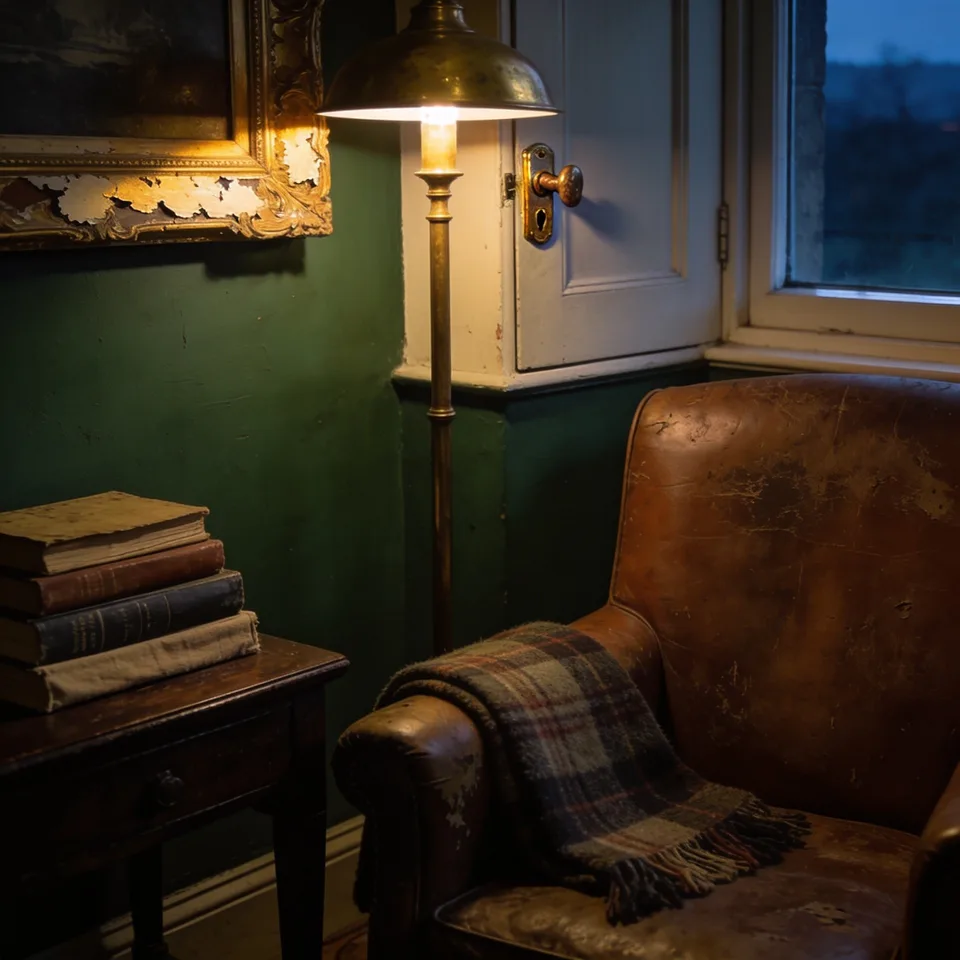
The overhead switch is the moody room's undoing. It lights every corner evenly, and even light hands the room straight back to gray. Lamps instead, plural and low: one by the chair, one on the shelf or the sill, each keeping a warm pool with the room allowed to go soft between them. Unevenness is the point. A room lit evenly is a diagram; a room lit in pools is an evening. Warm bulbs, shades in paper or cloth rather than bare glass, and nothing overhead after supper unless something has been dropped.
Brass and oak, worn where the hands go
Deep walls push old surfaces forward the way a dark cloth flatters what is laid on it. Brass is the moody room's quiet jewelry because it refuses to stay uniform — it goes dim where nobody touches it and bright where everybody does, so a latch, a lamp stem, a drawer pull carries the record of its own use. Dark oak and walnut, which vanish against white, step out of the wall and show their grain. This is why the whole approach leans thrifted and handed-down: a surface manufactured to look fresh has nothing to say in this light, and things that have already lived have everything.
The shelf life of objects
A moody room also edits what stands about in it. Against deep walls every shelf reads like a still life, so whatever is up there is plainly on show — and the objects that survive that scrutiny are the used and the loved, not the bought-to-fill. The kitchen has known this longest: an open shelf keeps its dignity because everything on it gets taken down and put back in the course of ordinary cooking, which is an arrangement no styling can fake. And the objects that hold a deep room together best are the ones with their own past — the bowl, the tin, the handed-down things that were never chosen to match and belong together anyway. Depth on the walls, depth on the shelves; the room agrees with itself. The pictures can agree too: a print matted bright white opens a pale hole in a deep wall, which is why the six moody florals in our own Etsy shop, the hollyhock and the poppy among them, are drawn on dark grounds, made to hang against moss or umber without breaking the surface.
When autumn reaches it
A moody house is the one autumn does not have to redecorate. The season arrives by degrees — the amber autumn, light first, then color, then texture — and the deep room meets it halfway, because the walls already hold lamplight and the wool is already out. By October the kitchen is doing autumn on its own, steam on the glass and supper ending in the dark, and the rest of the house simply keeps pace. A pale room borrows the season with a shelf of pumpkins and gives it back in November. The deep room was dressed for it all year, which is the surest sign the color was right. The same holds through Halloween: a house already lit by candle and lamp against deep walls has no use for a strobe in the shrubbery.
Tonight, one switch
The argument can be tested for nothing. Tonight at dusk, leave the overhead off in whichever room the evening happens, light the lamps, and let the corners go where they want to go. Sit through one cup of tea and watch what the room does with its own shadows. If it feels held rather than dim, the paint board can come next; the house has already voted.
Common questions
Does dark paint make a small room look smaller?
No. Deep paint is at its most persuasive in exactly the rooms the pale doctrine says it will shrink — it does not shrink them; it dissolves their corners, so the walls stop announcing where the room ends, which is most of what cozy has ever meant. Depth is also kinder to a hardworking room than white: scuffs and shadows sink into a wall of moss or umber, where on white every mark stands out like an accusation, and a wall in a deep color looks as though it has been that color longer than anyone can remember. The change usually starts in a single room, and any small room will do.
How do you choose a moody paint color?
Choose colors with brown or gray ground into them, moss, bottle green, umber, clay, the browned reds, rather than anything that would read bright on a chip. The rooms this sensibility descends from ran to those shades partly because they forgave smoke and handling. Then test at home, because all of this depends on your light: paint a board, stand it against the wall, and look at it at breakfast and again by lamplight. North light mutes a color a full shade, and a west window warms it at exactly the hour it matters.
Why does a dark room feel warmer than a white room?
Because nobody lives in a house at the hour it photographs best. White walls bounce every scrap of daylight until the picture glows, and a camera is a daylight instrument that votes for the room feeding it — but a house is lived in at seven on a February morning and nine on an October night, under lamps, and at those hours the white room goes flat and gray while the deep room settles in and holds. Depth reads as time, takes wear the way old furniture does, and is generous to old things: the dented brass and the dark oak that look tired against a bright wall look inevitable against a deep one. People coming in from the gray outside never say the room is dark; they say it looks warm in here.