 Cottage at Home
Disclosure: some links below are affiliate links — buy through one and we may earn a small commission, at no extra cost to you.
Cottage Halloween decor: a gentle October in a kept house
Cottage Halloween decor kept gentle — uncarved heirloom pumpkins, dried stems, old brass and candlelight, and one dark gesture done well for a quiet October.
In this guide
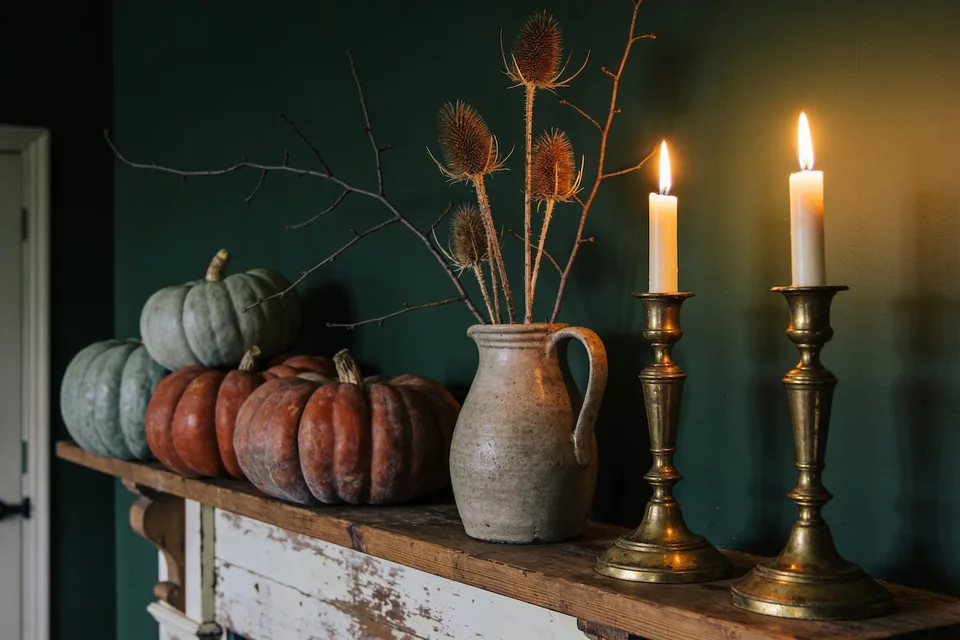
By the third week of October the dark arrives before the dishes are done. On the deep sill of the kitchen window three pumpkins sit where the geraniums stood all summer — one sage, one rust, one nearly gray, none of them carved — and behind them the last of the light goes down the color of cider. A candle has been burning in the old brass stick since half past six. Nothing in this room is pretending to be haunted, and the room, at this hour, is a little haunted anyway.
The case for a gentle Halloween
The work of cottage Halloween decor is mostly to stop drowning the season out — to let the house go quiet and dim enough that October can be heard. There is a version of this holiday that arrives by the aisle: inflatable spiders, styrene tombstones, a strobe in the shrubbery, everything orange the exact orange of a traffic cone. A kept house declines most of it — not out of superiority, but because it has no need. October is already the strangest month the house owns. The dark comes a little earlier every evening, the wind finds the loose casement and worries it, the ash tree lets go of its leaves one at a time; the season does its haunting honestly and asks nothing for it.
That is what a gentle Halloween means here: the season honored, not costumed. It is not a separate holiday hauled in from the garage in a bin. It is the darkest fortnight of the amber autumn the house has been keeping since September, and it asks only that everything already underway go one shade deeper — the stems drier, the light lower, and one wry black gesture allowed in at the door.
Pumpkins that keep their faces
Begin with the pumpkin, and begin by not cutting it. A carved pumpkin is a tenant of about a week — it grins, it softens, it folds in on itself quietly some night early in November — while an uncarved one is harvest rather than holiday, and will hold its color on a cool porch for months. The heirloom sorts were bred for exactly that stay: the sage-green and slate-gray kinds, the flattened rust-red kind that sits like a settled cushion, the buff ones the color of pie crust. Two or three of those, clustered, do more than a dozen of the bright carving sort.
The keeping rules are short. Cluster them in odd numbers and unequal sizes, the way things gather when nobody arranges them. Keep the stems on — a pumpkin without its stem reads as bought, and one with it reads as brought in from somewhere. Stack them where the shapes allow it, a small gray riding a broad rust. And let them claim the flat places the house already has going quiet: the end of the mantel, the deep windowsill, the second porch step, the seat of the hall chair nobody sits in.
Dried things do the spooky work honestly
Everything the decorations aisle manufactures — the reach, the rattle, the crooked silhouette — the outdoors has already made better and is giving away by October. Teasel is the great one: armored, architectural, faintly menacing on its long stem, and it will stand in a stoneware jug untouched until spring. Poppy heads rattle like something out of an old story. Allium dries into gray starbursts, hydrangea goes the brown of old paper, and a few bare branches cut shoulder-high from whatever the yard can spare make the reaching shapes the season is famous for. One walk with kitchen scissors in a coat pocket gathers the lot.
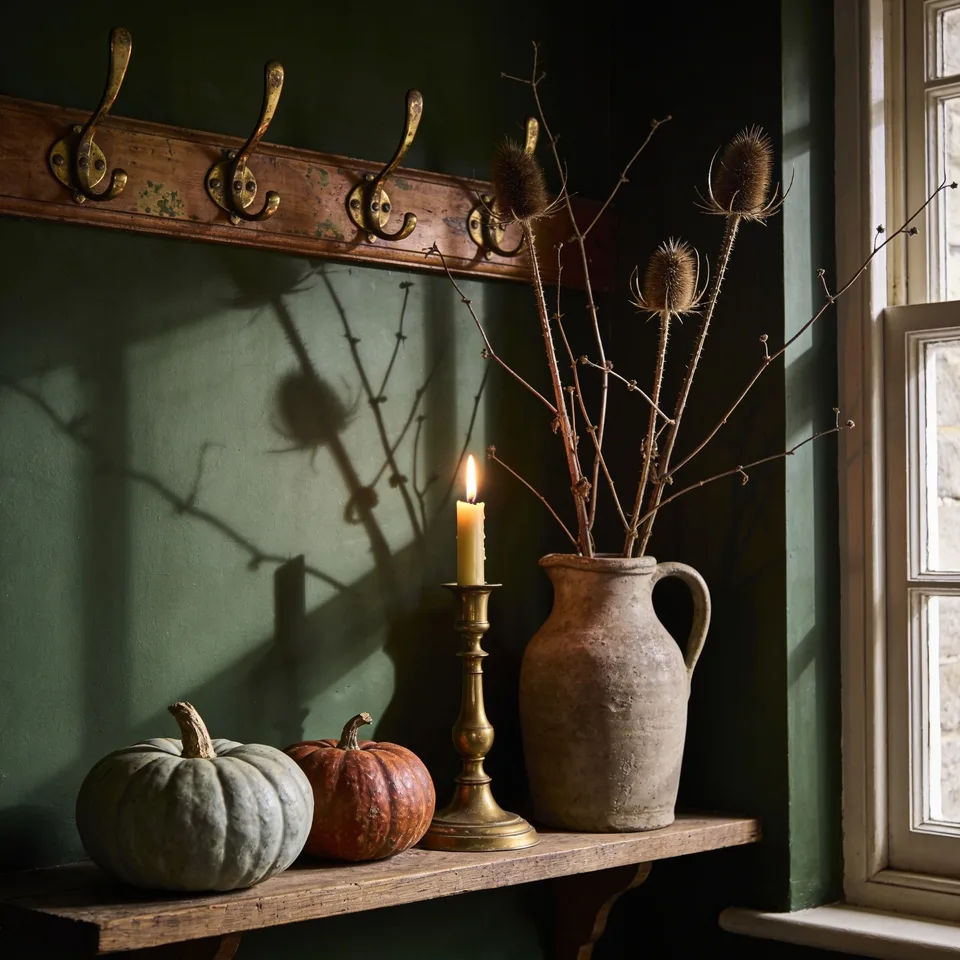
Then set them where the light will find them, because dried stems are really machines for making shadows. A jug of teasel and branch beside a candle throws its long crooked shadow up the wall, and the shadow stirs whenever the flame does. No bought cobweb has ever done as much.
Candlelight and brass, the only special effects
The entire special-effects department of a gentle Halloween is a lit flame in old metal. Brass candlesticks — the handed-down kind, gone soft and unpolished at the grip — carry October better than anything made for the holiday, because candlelight is the original effect: it moves, so every shadow in the room moves with it, and the stillest jug of stems breathes a little. Light them at dusk, which by late October is barely past six, and leave the overheads off. A sitting room that has already gone over to lamps for the season needs nothing added but the flame; a house that keeps darker walls the year round discovers that its deep greens and near-blacks were built for exactly this week. Black taper candles in the old brass, if they can be found, are permitted their small joke.
One dark gesture, done well
What separates a kept October from a store display is restraint, and the rule is one dark thing, done well. A crow print in an old frame, hung where a botanical hung in July. A length of narrow black ribbon tied at the neck of the jug, or a black bow on the door knocker. The old paper Halloween keeps this same company: the 1920s sort, paper moons and arch-backed cats, vintage prints that were gentle the first time around and have only grown kinder with age; one of those, framed as though it had hung there for decades, is plenty. The six we hang here every October are set out one at a time, with the wall each print keeps and the frames worth hunting for them; from the first of October the set itself is free at the printables door, for an email address. Our own Etsy shop keeps October in the same spirit: six studies of the gentle sort, the turnip lantern, the black cat, the besom broom among them, and the one-gesture rule holds for ours too, so print whichever the house likes best and let the other five wait for other Octobers.
One works where ten cannot, because a single dark gesture in a warm room reads as wit — the house raising an eyebrow — while a roomful of them reads as effort, and effort is the one thing October should never appear to be making. Choose the crow, or the ribbon, or the print. Not all three.
What comes down on the first of November
The morning after, the ribbon comes off and the crow goes back to the cupboard; the whole undoing takes five minutes, which is one of the quiet arguments for having kept it this way. The pumpkins were never Halloween — they were harvest — and they stay as long as they stay sound, which on a cold porch can carry them into December. The dried stems keep their jug all winter; teasel in February looks as much at home as teasel in October. And the candles-at-dusk habit does not come down at all — it simply carries on into the long dark the rest of the year's keeping was building toward. A gentle Halloween leaves no hole in the house when it goes. The season closes over it like water.
Begin at the window the street sees
Tonight, one uncarved pumpkin on the sill of the window that faces the road, and one candle in a brass stick beside it, lit when the dark comes down. Anyone passing in the early evening will read it at a glance: this house is keeping October, gently, and nothing in it means any harm — except perhaps the teasel, which has its own ideas.
Common questions
Should you carve pumpkins or leave them uncarved?
Leave them whole if you want them to last. A carved pumpkin is a tenant of about a week — it grins, it softens, it folds in on itself quietly some night early in November — while an uncarved one is harvest rather than holiday and will hold its color on a cool porch for months. The heirloom sorts were bred for exactly that stay: the sage-green and slate-gray kinds, the flattened rust-red kind that sits like a settled cushion, the buff ones the color of pie crust. Two or three of those, clustered in odd numbers and unequal sizes with their stems left on, do more than a dozen of the bright carving sort.
What dried plants can you use for Halloween decor?
Teasel first — armored, architectural, faintly menacing on its long stem, and it will stand in a stoneware jug untouched until spring. Poppy heads rattle like something out of an old story, allium dries into gray starbursts, hydrangea goes the brown of old paper, and a few bare branches cut shoulder-high make the reaching shapes the season is famous for. One walk with kitchen scissors in a coat pocket gathers the lot. Then set the jug beside a candle, because dried stems are really machines for making shadows: the long crooked shadow climbs the wall and stirs whenever the flame does, and no bought cobweb has ever done as much.
When should Halloween decorations come down?
The morning after, mostly — and the whole undoing takes about five minutes. The ribbon comes off the door and the crow goes back to the cupboard on the first of November. But the pumpkins were never really Halloween, they were harvest, and they stay as long as they stay sound, which on a cold porch can carry them into December. The dried stems keep their jug all winter, since teasel in February looks as much at home as teasel in October, and the candles-at-dusk habit does not come down at all — it simply carries on into the long dark. A gentle Halloween leaves no hole in the house when it goes.