 Cottage at Home
Disclosure: some links below are affiliate links — buy through one and we may earn a small commission, at no extra cost to you.
Winter decor after Christmas: what stays up, what goes back in the box, and what only comes out now
Winter decor after Christmas the cottage way: what stays up when the tree goes out, what goes back in the box, and the few things that only come out in January.
In this guide
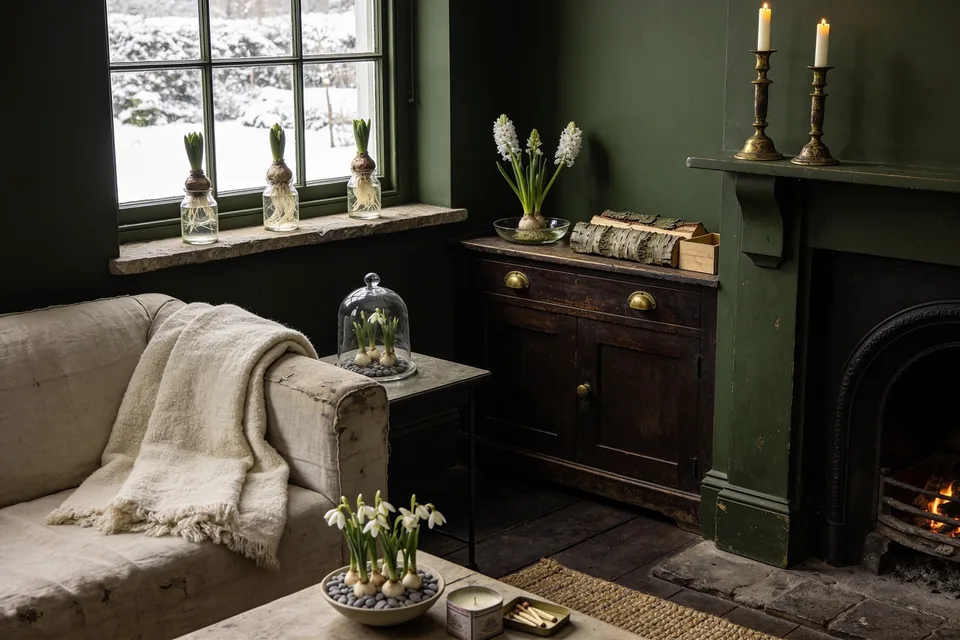
The tree goes out on a Tuesday, usually, and always in the afternoon. It comes down the hall shedding, out the front door, and the room it leaves behind is the flattest room of the year. The corner where it stood is a rectangle of clean floor. The mantel is bare where the garland was pinned. The house smells faintly of a fir that is no longer in it, and outside it gets dark at ten past four.
Search for winter decor after Christmas and you will be shown a product roundup: forty-five ideas, a white and silver scheme, snowflakes to buy in January because the ones you bought in December were the wrong ones. What almost nobody writes down is the actual sequence of that afternoon, which is a question about subtraction, not shopping. What comes down. What stays. What has been waiting in a cupboard since October for exactly this week. The Christmas gallery wall covers how the December prints come off the wall without leaving a mark, and it is worth reading alongside this. This page is about the room around them.
What winter decor after Christmas actually is
Winter decor after Christmas is what a room looks like when the Christmas layer is lifted off and the winter underneath is allowed to show: the greenery that was standing in water, the candles moved lower and closer, wool left out where somebody sits, and one living thing on the sill. It is subtraction with a single addition.
That is the whole method, and it is worth being plain about why it works. A cottage room in December is a good winter room with a holiday laid on top of it. The dark wood, the low light, the wool, the brass, the things that have been in the family a while, all of that was working before the tree arrived and will go on working after it leaves. What December added was quantity: more candles, more green, more small bright objects than any of these rooms would carry the rest of the year. Take the addition away and you are not left with nothing. You are left with the room that dark cottage living rooms are built on all year, which in January has the enormous advantage of matching the weather outside the window.
The mistake the roundups make is to treat January as a decorating gap that has to be filled with a new scheme in white and silver. Fill it and you have a second holiday, one nobody is celebrating, and it will be as tiring to look at by the first of February as the tinsel was by the twenty-seventh of December.
The day the tree goes out, in order
Undress the room in the order things will spoil: the tree first, on the day it stops drinking, then anything cut and dry, then the small bright things, and the greenery that is standing in water last of all. Doing it in that order means one afternoon's work instead of three, and nothing sits about looking dead.
The tree tells you when. A cut tree in a warm room drinks steadily for two or three weeks and then stops, and the day the water level in the stand holds still overnight is the day the tree is finished, whatever the calendar says. After that it is dropping needles into the carpet for nothing. Take the lights off first, then the ornaments, then the tree, and take it out through the nearest door rather than the one you came in by, with a sheet under it if the hall is carpeted.
Then everything cut and dry, in one pass with a bag: the pinned garland above the hearth, the holly on the picture rail, the mistletoe, anything that crumbles when you take hold of it. Then the small bright things, which is the part that takes longest because each one has to be wrapped. Last, and only last, the greenery that has been standing in water, because most of it is still perfectly alive and some of it is going to stay.
There is a version of this afternoon where the room is stripped in an hour and left bare and you feel it for a week. The way to avoid that is to put the January things out as you go, on the same afternoon, in the same trip. The mantel that has just lost a garland gets the cedar and the box laid along it before you sit down. The corner that has just lost the tree gets the chair moved back into it. A room re-dressed in one afternoon reads as a season changing. A room stripped on Tuesday and re-dressed on Saturday reads for four days as a house where something has gone wrong.
What stays up
Three things stay: any greenery that has been standing in water, every candle you own, and wool. None of these belongs to Christmas, and that is exactly the test. If it would look strange on the tenth of February, it goes; if it would look ordinary, it stays.
Greenery standing in water is the one most people throw away by mistake. Cedar, fir, box and bay cut in December and stood in a jug or a shallow dish will hold their color for weeks in a cool room and keep holding it long after the pinned stuff has browned. It stays because it is not a decoration at that point, it is a plant. What it needs is the red taken out of it. Pull out the holly with the berries on, pull out anything with a ribbon, and what is left is a low run of dark green on the mantel that says nothing at all about December.
The candles stay, and they move. This is the single change that does most for the room and it costs nothing. Candles in December stand on the table and the mantel because that is where people gather; in January they want to be beside the chair you actually sit in, at the height of the book you are reading. A lit taper at elbow height at four in the afternoon does more for a cold room than a whole shelf of them across the room at eye level. The candlesticks themselves are the same brass ones that did the Christmas table three weeks ago, and nobody looking at them in January will think of it.
Wool stays, and it stays out. A thick undyed blanket over the arm of the sofa, a sheepskin on the seat of the wooden chair, the heavy curtain that was pulled across at five in December and goes on being pulled across at five now. A blanket that is put away is decoration and a blanket that is out is warmth, and January is the month for the second kind.
What goes back in the box, and how
Everything else goes back, and the packing is worth twenty minutes of care because you are writing a note to yourself for next December. Ornaments wrapped singly, candles sorted by length rather than color, greenery hooks kept in one tin, and the box labelled with what is actually in it rather than with the year.
Old glass ornaments want wrapping singly in paper and packing in something rigid. The thin printed papers from the year's parcels do this better than tissue and cost nothing. What matters more than the material is that no two pieces of glass touch each other, because the damage that happens in the loft is not dropping, it is a season of small vibrations with one bauble resting against another.
Candle ends are worth keeping and worth sorting now rather than in December. Tapers burnt to different heights, pulled out of eight different holders on the same afternoon, are almost impossible to sort a year later; sorted into a lidded box by length as they come out of the sticks, they are a working supply of short candles for the deep winter, when a two inch stub in a low holder is often exactly right. A vintage tin candle box with a lid keeps them straight and keeps them out of the light, which is what makes old candles droop.
The one thing worth writing down is where things went. Not an inventory, just a line on the lid of each box in pencil: mantel garland hooks, picture rail wire, the small brass hooks for the hall. Next December that line saves the half hour everybody loses.
What only comes out in January
A few things exist only for this month: bulbs forced on the windowsill, box or another plain evergreen where the holly was, and bare branches cut in February and brought in to open early. All three are alive, all three change while you watch them, and that is precisely what a January room is short of.
Forced bulbs are the heart of it. Paperwhite narcissus need no chilling at all: set the bulbs shoulder to shoulder in a bowl of pebbles with water just touching their bases, put them somewhere cool and bright, and they will be in flower in four to six weeks, which from the first week of January lands them in the middle of February. Hyacinths are the other classic, grown singly in a hyacinth forcing vase, the pinched glass shaped to hold one bulb above water with the roots going down into the neck. The commercially chilled bulbs sold for this are the ones to buy, because an unchilled hyacinth will make leaves and no flower. What makes them worth the sill is not the bloom at the end. It is the fortnight of watching a white root reach down through clear glass in a month when nothing outside is doing anything at all.
A glass cloche over a bowl of bulbs holds the humidity around the shoots and, more usefully, makes one small object on a side table read as something deliberate rather than as a bowl of onions in gravel.
The evergreen swap is the old custom and it is a good one. Herrick's Candlemas poem tells the house to take down the rosemary, the bays, the mistletoe and the holly, and then to put up box in their place, so the room is not stripped bare but re-dressed in something plainer that will hold until spring. Box, yew, ivy, a few cut stems of laurel: all dark, all matte, none of them saying December. A handful in a stoneware jug on the kitchen table is January's version of the thing that was on the mantel in a red ribbon a fortnight ago.
Then, late in the month or early in the next, cut branches. Forsythia, quince, pussy willow, cherry: bare wood cut when the buds have swelled, stood in deep water in a warm room, will open indoors weeks ahead of the garden. They are the only decoration in the house that is a forecast.
The light, which is the real subject
The reason January rooms feel bleak is not the missing tinsel; it is that the ceiling light is now doing all of the work. Fix that before you move a single object. Two lamps at the height of a seated person's shoulder, a candle at elbow height, and the overhead switched off will change the room more than anything you can put on the mantel.
This is the same argument the house makes about moody cottage decorating in every season, and January is when it pays best. The days after the solstice are technically lengthening, and the coldest and darkest-feeling weeks arrive anyway, in the second half of the month, once the holidays have stopped propping up the evenings. What a room needs then is not brightness. It is small pools of warm light with dark between them, which is why a cottage in winter is at its best in the hours it is least well lit.
One practical note that costs nothing: clean the windows in the second week of January. Winter light is weak, it comes in low and sideways, and a film of autumn on the glass takes a surprising amount of it. It is the most boring advice on this page and it is the one thing that reliably makes a difference by the following afternoon.
Begin with the mantel
This afternoon, take the red out of the greenery on the mantel. Pull the holly with the berries, pull the ribbon, and leave the cedar and the box lying where they are with their stems back in water.
That is a five minute job, and it turns the most Christmas-looking surface in the house into a winter one without emptying it. If the room still looks right on Thursday, the tree can go on Friday and the rest of it will follow easily. If it looks bare, you have learned something useful about how much of December that room was carrying, and it costs one trip to the hedge to put a little more green back.
Common questions
What do you put up after Christmas decorations come down?
Very little that is new, and three things you already have: the greenery that was standing in water, the candles moved to where the dark now falls, and wool left out where somebody sits. Then one living thing on the sill. The rule for the whole month is that January decorating is subtraction with one addition. You take the Christmas layer off a room that was already good underneath, and you add one thing that is alive and changing. The old custom is on your side here. Herrick's Candlemas poem tells the house to take down the rosemary, the bays, the mistletoe and the holly, and then to put up box in their place, so the room is not stripped bare but re-dressed in something plainer that will hold until spring.
When should you take down Christmas decorations?
Twelfth Night, the fifth or sixth of January, is the date most houses keep, and the older custom held the greenery until Candlemas on the second of February. Either is defensible and the cottage argument is for the later one. Choose by what the greenery is doing rather than by the calendar. Anything cut and standing in water is still alive and can stay; anything cut, dry and dropping has finished and should go tonight, whatever the date. A wreath on the door in a cold porch will often outlast both dates, and a garland pinned dry above a warm hearth is usually done by the twenty-eighth of December. The tree comes out first, on the day it stops drinking.
How do you make a room feel warm in January without Christmas decorations?
Move the light lower and closer, and leave one soft thing out. The room does not need more objects in it; it needs the same objects lit from a different height. Candles in December stand on the table and the mantel because that is where people gather; in January they want to be beside the chair you actually sit in, at the height of the book you are reading. A lit taper at elbow height at four in the afternoon does more for a cold room than a whole shelf of them across the room at eye level. Then one thick wool blanket over the arm of the sofa, not folded into a cupboard, because a blanket that is put away is decoration and a blanket that is out is warmth.