 Cottage at Home
Disclosure: some links below are affiliate links — buy through one and we may earn a small commission, at no extra cost to you.
Winter kitchen decor: the one warm room, and what it holds in the lean months
Winter kitchen decor for a cottage kitchen in January and February: the warm room the house retreats to, what comes back onto the shelves, and the season's still life.
In this guide
By the middle of January the house has quietly given up on most of itself. The front room is cold until somebody lights the fire. The hall is a place you pass through with your coat still on. And everybody, without deciding to, ends up in the kitchen at four in the afternoon with the oven door open and the kettle going, because it is the one room that was already warm.
Search for winter kitchen decor and you will be shown a styled January kitchen photographed once: white, cleared, a single sprig in a jug, three matching canisters. It is a beautiful room and nobody has ever made a stew in it. This page is about the other kind of winter kitchen, the one that is warm because it is used, and what it actually holds in the lean months between the holidays and the first green thing in the garden. It is the far end of the year from the same kitchen in autumn, and it is the same room.
What a winter kitchen is
A winter kitchen is the house's warm room in the months when the rest of it is expensive to heat: the everyday crockery back on the shelves once the seasonal things are packed, the season's own colour in a bowl, and the work of the year in jars. The single rule is that everything on show in a winter kitchen should be either warm, edible, or in use by Thursday.
That rule does a lot of work, and it is worth taking seriously, because it decides everything else on this page. A winter kitchen is short of two things: daylight and growing things. It is not short of objects. The mistake is to answer the shortage with more objects, which is what the January roundups sell, and the result is a room with a decorative layer that gets in the way of a room whose whole appeal is that it is being used.
What answers the shortage instead is warmth you can see, colour that came in a shopping bag because it is in season, and the visible evidence that this room has been working all year. The house makes the same argument about what belongs on open kitchen shelves in every month; winter is when it is easiest to keep, because there is nothing seasonal competing for the space.
The shelves, once the evergreen is packed
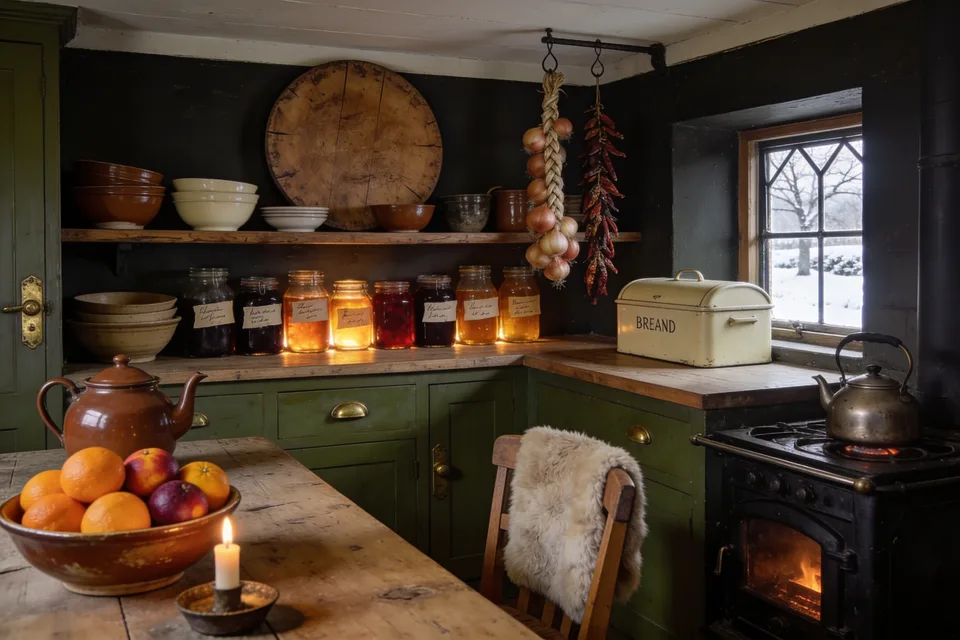
Put back the everyday things, in the order you reach for them. The winter shelf is almost entirely useful: the brown teapot at the front, the mixing bowls stacked, the jars you opened this week, the boards leaning where they can dry. What makes it look right in January is not arrangement. It is that the low light is now falling on brown and cream glaze instead of on tinsel.
There is a particular pleasure to this afternoon, and it is worth doing it deliberately rather than by drift. When the December things come off the shelf, the objects underneath have not been seen properly for six weeks, and a stack of old ironstone or a row of tins that had become invisible in November is briefly new again. Put them back closer to the front than you had them. Winter is the season for the working things to be the visible ones.
An antique wooden bread board is the object that does most for a winter shelf, propped at the back where it can dry after use. The old ones are round, cut from a single piece of sycamore or beech, and often carved around the rim with a wheat pattern or the word BREAD, because they were made for a household that ate a loaf a day and cut it at the table. They are among the cheapest genuinely old kitchen objects still easy to find, they go on being used, and the pale scored wood is one of the few light-coloured things a moody kitchen can carry without looking scrubbed.
Then leave gaps. A winter shelf that is full to both ends reads as storage; the same shelf with two hands' width of empty at one end reads as a kitchen where somebody took something down this morning.
The season's still life: citrus, and it is not decoration
Put a bowl of citrus where the light falls, and buy it to eat. Winter is when citrus is actually in season, which is the reason a bowl of oranges looks right on a January table and a bowl of them looks wrong in July, and it is the one piece of colour a winter kitchen gets for the price of the week's shopping.
The timing is the part worth knowing. Seville oranges, the bitter ones that marmalade is made from, have a genuinely short season: they arrive in the shops after Christmas and are gone again by the end of February, which is why marmalade is a January job in so many houses and why the smell of it is a winter smell rather than a summer one. Blood oranges run through the same weeks. If you have ever wondered why the old cookery books put marmalade in January, that is the whole answer: the fruit is only there then.
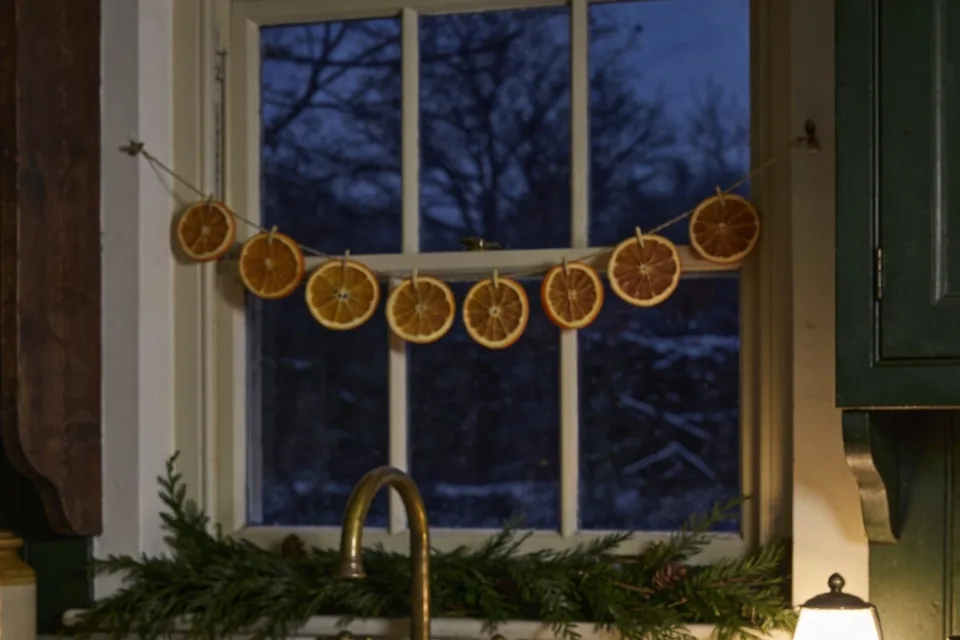
So the bowl on the table is not styling. It is this week's fruit, in the room where it will be eaten, and it happens to be the brightest thing in the house. Peel dried on the rack above the stove keeps the smell in the room for another week and goes into the fire afterwards. A stuck-with-cloves orange, which is a Christmas object in December, becomes just an orange again by the third week of January and can go in the bowl with the rest.
If the marmalade does get made, the jars are the next month's decoration, and they were free. A vintage marmalade jar, the small white stoneware kind with black lettering that Dundee marmalade was sold in for a century, holds one batch and sits on the shelf between times looking like what it is.
What the autumn left: jars, and the argument for showing them
The preserves are the winter kitchen's best decoration and they were made in September. Put them at eye level rather than in the cupboard, because a shelf of jars in low winter light does something no bought object does: it shows the year the room has had.
This is the payoff for the autumn work, and it is worth arranging as such. Chutneys, jellies, the pickled things, whatever the garden and the hedges gave: the colours are all in the winter palette already, amber and dark red and brown, and they are lit from behind if the shelf is near the window. Turn the labels out. Handwriting on a label is the one piece of typography in this house that nobody can buy.
They also earn their place by the rule: they are edible, they are in use, and by March there will be visible gaps in the row, which is a better record of a winter than any photograph. The same instinct governs how the house treats the pantry all year, and January is the month the pantry has the most to say.
Dried things belong here too, and belong on hooks rather than in bags: bay picked in the autumn, chillies threaded on a string, a plait of onions or garlic hanging where the air moves. They are stores, they look like a season's work, and they cost nothing to display because they are where they need to be anyway.
Warmth you can see
Give the room one visible source of warmth and one soft thing, and stop there. In a kitchen, warmth is mostly not decorative: it is the oven, the kettle and the people. What decorating adds is a place to sit and something warm-coloured to look at while the oven does the rest.
The chair is the part most kitchens get wrong. A kitchen in February wants one chair that somebody will actually sit in for half an hour, not four pushed under a table, and it wants a cushion or a sheepskin on it. That single change is what turns the warm room into the used room. The cottage kitchen at its most lived-in is built on the same observation.
Then the small warm-coloured things, which in a kitchen are almost all metal: copper, brass, well-blackened iron. A vintage brass trivet on the table under a hot dish is the sort of object that does two jobs, and it catches the one low sun that comes through a kitchen window in the middle of the day. Candles work here too, and they work better on the table than on the windowsill, because a kitchen window in winter is a black rectangle after four o'clock and a candle in it lights the reflection rather than the room.
One practical note about a cold kitchen and bread: dough rises slowly in a room under about eighteen degrees, so the old trick of putting the bowl near the stove is not folklore, it is the reason winter loaves take a long afternoon rather than a morning. An antique enamel bread bin keeps the result from going stale in a room that is warm and dry from cooking, which is the one way a cottage kitchen is hard on bread.
The light, and the window
Winter kitchens are dark in the middle of the day and pitch dark by five, and the fix is the same one the whole house uses: work with two low lights instead of one high one. A lamp on the counter at the end where you actually chop, and a candle on the table, will beat any ceiling fitting in the house.
A kitchen makes this easier than other rooms because it has a real task light already, over the sink or the stove, which can stay on while everything else goes off. That combination, one bright pool over the work and one warm pool over the table, is what a cottage kitchen looked like for two hundred years before wiring, and it is still the most comfortable way to be in a small dark room at six in the evening in February.
Keep the window clear. A winter kitchen window is worth more empty than full: the light coming through it is scarce, low and only there for a few hours, and a sill crowded with jars takes a surprising amount of it out of the room. Two things on the sill is plenty, and both of them should be short.
Begin with the fruit
This week, put a bowl of whatever citrus is in the shops on the kitchen table, in something brown or cream that you already own, and leave it where the light lands.
It costs the price of the fruit, it is the only bright thing the room needs, and it will tell you within a few days whether the rest of this page is worth doing in your kitchen. If the bowl empties, the room is being used, and everything else here is just making that easier to keep up.
Common questions
How do you decorate a kitchen for winter?
Mostly by putting back what December pushed aside, and by letting the working things show. A cottage kitchen in winter is not decorated so much as occupied. The single rule is that everything on show in a winter kitchen should be either warm, edible, or in use by Thursday. The greenery goes, the everyday crockery comes back onto the shelves, and the season's own colour arrives in a bowl: citrus, which is at its best in the coldest weeks of the year, and the jars of preserves that were filled in September. Nothing on that list was bought to be looked at. That is the whole difference between a winter kitchen and a styled January photograph, and it is why the room goes on working through February.
What do you put on kitchen shelves in winter?
The things you reach for daily, kept where you reach for them, plus one bowl of something in season. Winter is the one time of year when the shelves are allowed to be almost entirely useful. What earns a place is what earns it in every other month too: the brown teapot, the mixing bowls, the jars you opened this week. The change winter makes is that the pretty seasonal things have gone back in the box, so the everyday objects are suddenly visible again, and a shelf of well-used brown and cream crockery in low January light is a better-looking shelf than the same one wearing tinsel. Add citrus in a bowl and stop.
Why does a kitchen feel like the warmest room in winter?
Because it usually is, and for a reason nothing to do with decorating: the oven, the kettle and the people are all in it. A cottage kitchen in January is warm before anybody decides to make it cosy. An oven on for an hour heats a small room in a way no radiator does, the kettle goes on every hour of a cold afternoon, and cooking puts moisture into air that winter heating has dried out. That is why the house drifts in here after dark in the lean months and why the chair by the kitchen table gets more use in February than the sofa does. The decorating job is only to make the room worth sitting in once people have arrived.