 Cottage at Home
Disclosure: some links below are affiliate links — buy through one and we may earn a small commission, at no extra cost to you.
Cottage kitchen open shelving: the working shelf, not the styled one
Cottage kitchen open shelving ideas for the shelf you cook from — what earns a place, where it hangs, and the week test that settles it.
In this guide
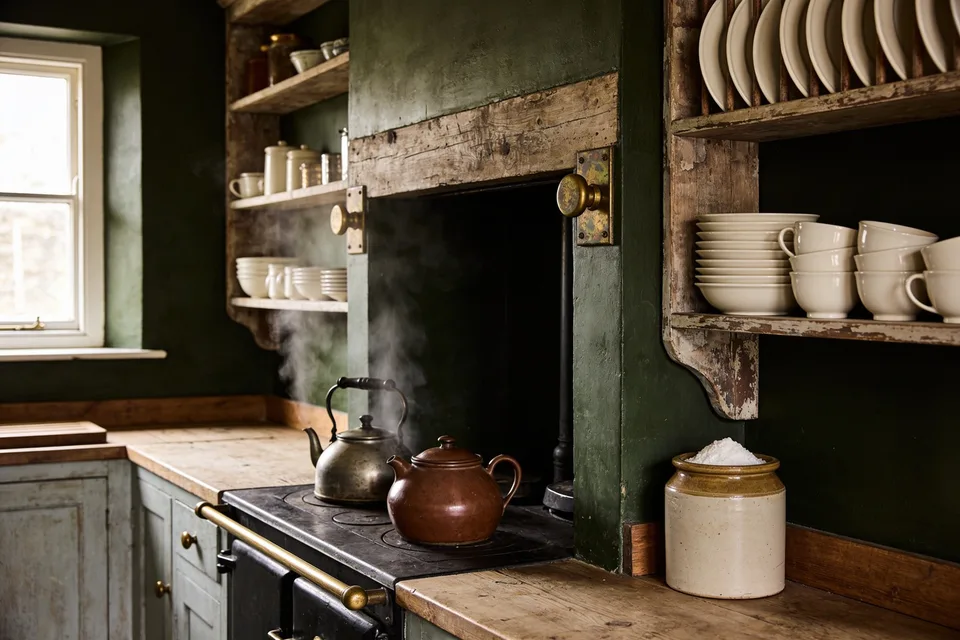
Supper is already underway when the hand goes up — no glance, half a turn from the stove — and comes down with the salt crock, which has lived at the end of that shelf, at exactly that height, through years of exactly this moment. Beside it the everyday plates wait in the stack the last washing-up left them in, and there is a gap where the yellow bowl should stand, because the yellow bowl is on the counter holding batter. Nothing on that shelf was arranged. All of it was put back.
There are two kinds of open shelf, and in a photograph they can pass for one another. One is styled: composed once, then defended daily against the life of the room. The other is working: settled by the cooking, restocked by the washing-up, styled by nothing but use. In a kitchen that cooks every day, only the second kind survives — and it happens to be the easier of the two to have. Most of what goes wrong with open shelving in a cottage kitchen is the first kind quietly pretending to be the second, so it is worth being plain about the difference before any brackets go in.
Two shelves that look alike, and are not
The styled shelf is easy to name once it has been noticed. Objects stand apart so each can be seen. A plant trails over cookbooks that never get cooked from. There is a pitcher that holds nothing, a stack of bowls in a size nobody bakes with, a small forest of candlesticks — and the whole arrangement asks to be looked at while quietly refusing to be touched. The room obliges. Supper routes around it to the drawers where the real tools went, and within a season the shelf has become a picture hung where storage used to be.
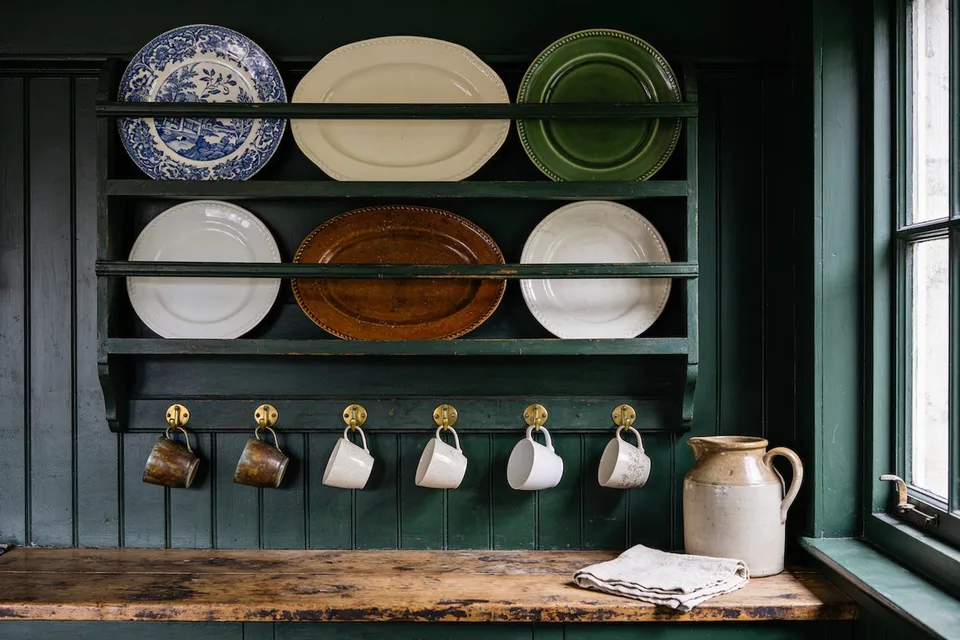
The working shelf reads differently, and by opposite tells. Things touch, and stack, and lean. The plates sit in the tower the draining board built. There is always one gap — the bowl away on duty, the teapot down at the table — and the arrangement shifts a little every day because the kitchen, not a stylist, is doing the arranging. It is never finished and never wrong, and nobody dusts it, because nothing on it stands still long enough.
The difference between the two is not taste. It is whether the shelf tells the truth about the room.
The week test
What earns a place in the open is settled by one question: will the hands come for it inside the week? Daily is better; weekly is the line. The everyday plates and bowls pass without discussion. The mugs pass, the salt passes, the oil and the brown teapot pass, and so does the big bowl that truly holds the onions. The roasting pan that works one Sunday a month does not, and neither does the good china, and neither does anything whose first job is to be seen. Cupboards exist precisely for the loved-but-seldom, and there is no shame behind a closed door.
The week test also answers the objection every open shelf meets sooner or later — dust, and its kitchen cousin, grease. A shelf of weekly things cleans itself: each piece cycles through the sink and comes back, so nothing sits long enough to grow a film. Dust on an open shelf is not a housekeeping failure; it is a diagnosis. It means the things beneath it are storage pretending to be use, and the cure is not a cloth but a cull.
Run the test honestly and most of what we keep in the kitchen and pantry sorts itself: used things step forward into the air; occasional things go behind doors to wait their turn. They come back out for one stretch of the year, and the dresser is where they land: the hutch as the house's second pantry, from the end of October to Twelfth Night.
Things live where they work
An open shelf is not one place. It is a set of neighborhoods, and the rents differ. Prime ground is whatever the hands can reach flat-footed — eye level down to the counter, within a step of sink or stove — and prime ground goes to the daily things, at the exact heights the reach likes them. The tier above is for the weekly: the mixing bowls, the jug that pours for company. Above that is cupboard-in-the-air, and it is where open shelving most often goes wrong — the top shelf fills with things too pretty to put away and too idle to stay clean, which is the styled shelf sneaking back in at altitude. Better a short run of shelves fully used than a wall of them half performing.
Two placements do most of the work. The everyday stack lives nearest the sink, so that putting-away is the whole act of styling — plates travel from rack to shelf in one motion, and supper restocks the display every evening. And the cooking things live within a turn of the stove, but beside it, not over it. Directly above the burners a shelf stands in the rising fog of frying, and whatever lives there needs washing whether it worked or not; give that stretch of wall to the hood, or to nothing, and hang the shelf an arm's length away where the air is calmer.
The shelf itself, and the wall behind it
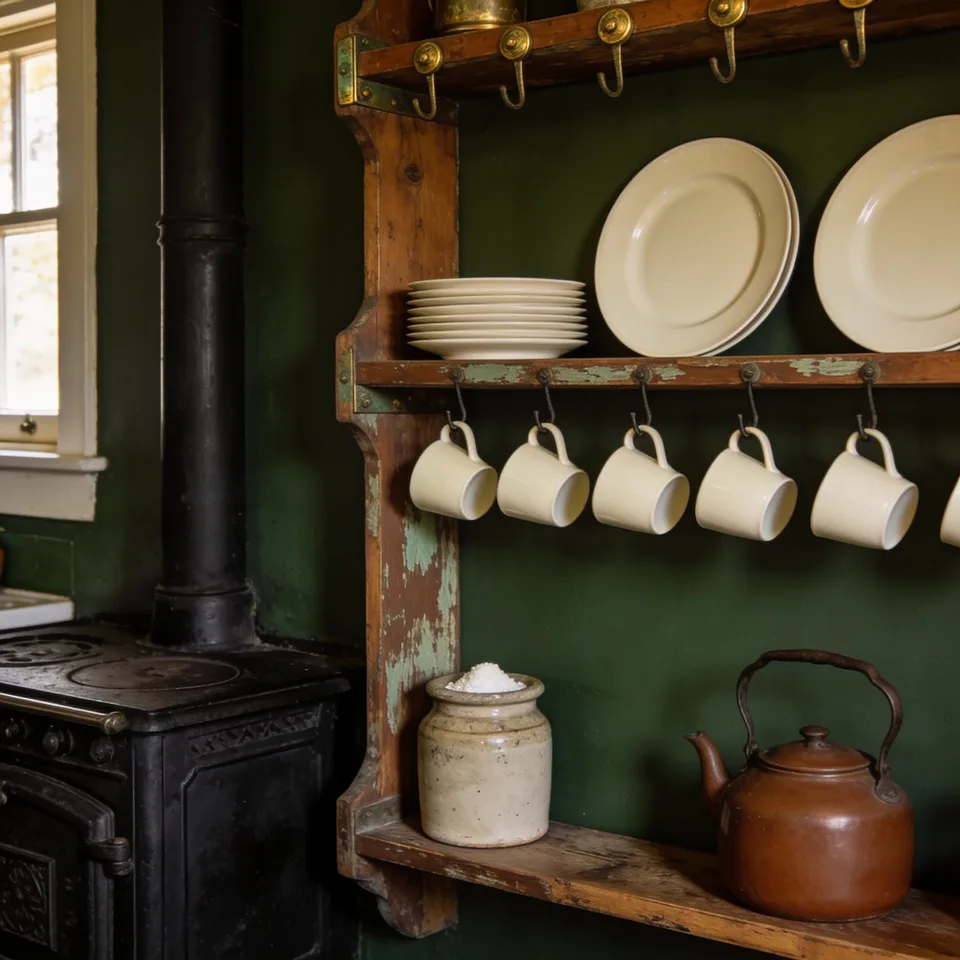
As a piece of furniture the working shelf is plain and a little overbuilt. A thick plank reads better than a thin one and carries more than it will ever be asked to; wood with some age in it — oak, elm, an old board sanded kind — arrives already seasoned; new pine can be painted the color of the wall and left to let the objects do the talking. Depth is a dinner plate and hardly more, somewhere near ten inches: shallower and the stacks overhang, deeper and things hide behind things, which is how a shelf silts up with the unused. Brackets should look equal to their work and be fixed into the solid of the wall, because plates are heavy and the years only add to them.
The wall behind matters nearly as much as the plank. Cream stoneware and worn wood stand forward against depth and vanish against builder's white; the same row of everyday things looks kept in front of moss or umber, and merely left out in front of pale gloss. If the kitchen is heading darker anyway, the dark cottage kitchen is the full route — paint chosen against your own light, lamps instead of glare — and open shelves are among the first things in the room to repay it.
One idle thing per shelf
After all this insistence on use, one allowance. A working shelf can carry exactly one thing that does nothing: a jug of dried stems, a small picture leaned at the end of the row, the chipped enamel pitcher that has retired from pouring. The jug does its best work from September on, when a walk fills it for nothing — an amber autumn follows that whole slow turn of the season through the house. One idle thing on a working shelf reads as affection; two begin an argument that the styled shelf eventually wins. The allowance is per shelf, not per kitchen — three shelves, three small idlenesses, which is about the right dose for a room.
The best candidates are old things with their service behind them. A piece with real wear keeps a shelf honest even in retirement — the worn place says the object has already done a lifetime of the very work the shelf is for. Finding such pieces, and knowing which can still work and which should merely preside, is its own subject, taken up in vintage cottage kitchen decor; the short rule is to let the pitcher's chip face the room, because the chip is the proof of service. As for the small leaned picture, our own Etsy shop keeps six drawn studies of exactly this shelf's kind of thing, the herb bundle and the heirloom carrots among them; print one at home, stand it in a thrifted frame at the end of a row, and the shelf has its one honest idleness.
Empty it, then let the week fill it
Begin with a bare plank, which is the one styling trick this whole subject contains. Tonight, take everything down and put back nothing. Then cook the week, returning each thing to the shelf as it earns its way up — the plates after the first supper, the salt by Tuesday, the teapot the first time the pot is wanted. After seven suppers the shelf will have arranged itself, at the heights the hands like, into exactly what the room uses — and whatever is still sitting in the box goes behind a door, unmissed. The shelf will look right because it is right, which was always the difference.
Common questions
Do open kitchen shelves get greasy and dusty?
The ones nobody uses do. A shelf you cook from turns over constantly, so the pieces on it are washed and put back rather than left to gather. That is the practical argument for keeping a working shelf rather than a styled one.
How do you decide what goes on an open shelf?
The week test. Empty the shelf, then let a normal week put things back on it. What returns has earned its place; what never comes out of the cupboard was never shelf material, however good it looks.
Can an open shelf hold anything that is purely decorative?
One thing per shelf. A single idle object reads as a house rather than a warehouse, and more than one starts the drift toward a shelf arranged for a photograph.