 Cottage at Home
Disclosure: some links below are affiliate links, and if you buy through one we may earn a small commission, at no extra cost to you.
Cottage kitchen table: the one surface the whole day crosses
A cottage kitchen table is chosen for what happens at it from breakfast to the lamp going on. The size that fits, the chairs, the wood, and what lives on it.
In this guide
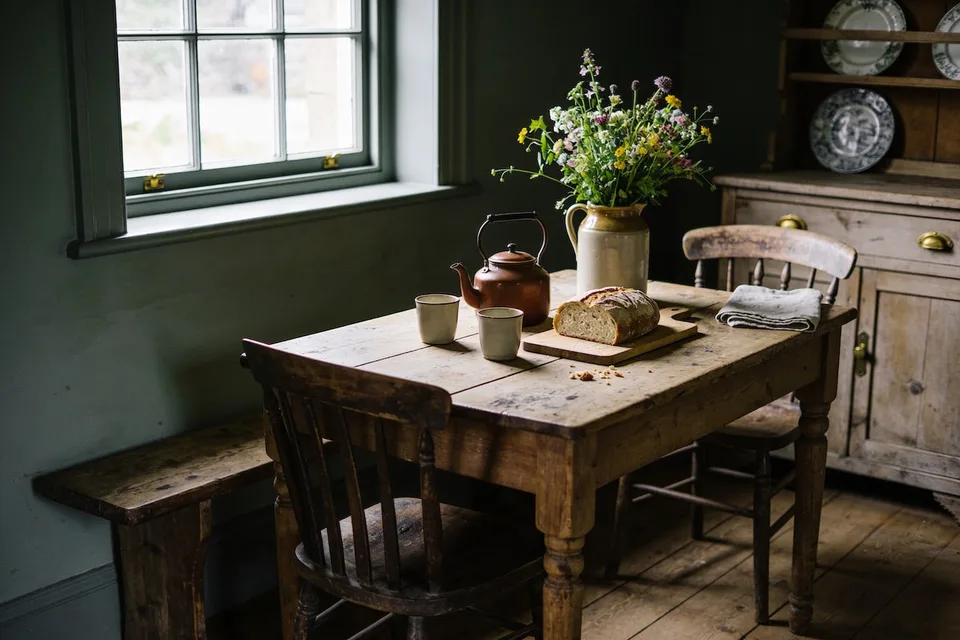
The kitchen table in this house has a burn mark from a pan that should have gone on a board, and a ring where a jug stood through a whole summer. Breakfast happens at one end of it and the post piles up at the other. A cottage kitchen table is chosen for all of that, and this page is about how.
What a cottage kitchen table is, and why it isn't a dining table
A cottage kitchen table is a plain wooden table in the kitchen itself, used from breakfast until the lamp goes on at night. Meals are eaten at it, but so is everything else: the post, the list, the bread board, the homework. A dining table waits for supper. A kitchen table is busy all day.
That difference decides most of what follows. A table used all day needs a top that doesn't mind a hot mug or a wet cloth, chairs that are comfortable for an hour and not only for a meal, and a place in the room where the light is good in the morning. It rarely needs to seat eight.
If the house has a separate dining room, the two can stay different. The vintage dining room is for the long evening meal. The kitchen table is for the rest of the day.
Seven in the morning: one end, one cloth, the kettle within reach
In the morning the kitchen table is used from one end. That end is the one nearest the kettle and the window, with a folded cloth, the teapot, a board for the bread and two cups. Nobody lays the whole table at seven, and the rest of the top stays clear for whatever the day brings to it.
It helps to decide which end is the breakfast end and keep it that way. The cloth lives there, folded, rather than being put away every morning. The butter dish can stay under a cover. The chair at that end becomes somebody's chair, and that is how a table starts to look lived at.
If the kitchen has a sunny window, push the table so that end catches it. Morning light across an old wooden top does more for a kitchen than anything you could buy for it.
Midday: the post, the list, and the working end
By midday the kitchen table becomes a working surface. The post lands on it, the shopping list is written on it, pastry is rolled out at the end away from the window, and a bag of apples waits there to be dealt with. A good cottage kitchen table has room for one job at each end at the same time.
This is the argument for a table a little longer than the household strictly needs. Two people can use it at once, one cutting vegetables and one writing a letter, without either of them clearing up for the other.
Keep one thing on the table that belongs to the working end: a jar of pencils, a small dish for keys, or the bread board standing on its edge. It marks that end as the one for work, and stops the post from spreading over the whole top.
Round, long, or against the wall: the size that fits a small kitchen
Measure the room before you choose the table. Allow about 90 cm (36 inches) between the table's edge and the nearest wall or counter, so a chair can be pulled out and someone can still get past. Then subtract that from the floor on every side you will sit, and the space left is the largest table the kitchen can take.
A round table of 90 to 105 cm (36 to 42 inches) across seats four and is easy to move around in a small room, because there are no corners to catch a hip. A long narrow table suits a galley or a kitchen with one long wall. A table pushed against the wall gives up one side and seats two or three, and in a very small kitchen that is often the right trade.
Allow about 60 cm (24 inches) of edge for each person who sits there regularly. A drop-leaf table solves the small kitchen neatly: leaves down for most of the week, one leaf up for guests. A vintage drop leaf table in painted pine or oak turns up second-hand more often than people expect.
Chairs that don't match, and a bench along the wall
Cottage kitchen tables rarely come with a matching set of chairs, and they look better without one. Choose chairs that are the same height at the seat and roughly the same colour of wood or paint, then let the backs be different. Two or three kinds are enough to look gathered rather than random.
Wooden chairs with spindle backs have stayed in kitchens for two hundred years for good reasons: they are light enough to pull out with one hand, they wipe clean, and they are comfortable for longer than they look. A vintage Windsor chair at the head of the table is a good first one to find.
A bench along the wall side seats more people in less floor than chairs do, and children like it. Put a cushion or a folded blanket on it if it is sat on for long. The moody dining room makes the same case for chairs gathered over years rather than bought in one go.
Wood that takes the wear: scrubbed pine, oak, and the oilcloth question
The best top for a cottage kitchen table is one that looks better for being used. Scrubbed pine softens and pales with every wipe, and its marks read as history. Oak is harder and darker and wears more slowly. A painted base with a bare wooden top is the classic cottage table, because paint hides the legs' knocks and the top can be scrubbed.
A glossy lacquered top is the one to avoid. It shows every ring and scratch as damage, and it can't be sanded back without losing the finish. An oiled or waxed top can be touched up with a cloth.
If you buy second-hand, check three things before you pay. Press down on each corner to find a wobble; a loose leg is easy to fix. Look under the top to see whether it is solid wood or a thin veneer, because a lifting veneer is hard to live with. And sit at it on the chair you mean to use, since older tables are sometimes lower than modern chairs.
An oilcloth over a precious top is an old answer that still works: it wipes clean and comes off for supper. A vintage oilcloth tablecloth in a small print looks right in most cottage kitchens.
What lives on it between meals, and what doesn't
Between meals a cottage kitchen table holds very little: a jug of whatever is in the garden or the hedge, a bowl of fruit, and perhaps the teapot. Everything else goes back to the shelf or the dresser. A table that is cleared to three things between meals is ready for the next job the moment it arrives.
The jug does most of the work. It gives the table a centre, and changing what is in it is how the table follows the seasons without anything being bought. The cottage fall table goes further into how a table carries the autumn between meals.
What doesn't live on it: the fruit bowl that has become a place for batteries and receipts, the pile of post from last week, the appliances that have nowhere else to go. Give each of those a home off the table, on the dresser or a hook by the door, and the table stays a table.
Supper, and the lamp that ends the day at it
At supper the whole table is used, and the light over it matters more than anything laid on it. A single warm light hung low over the table, or a small lamp at one end, gathers people to it. A bright overhead light across the whole kitchen makes the table feel like part of a workroom rather than a place to sit.
Keep the bulb warm, 2700K or lower, the same rule that runs through a moody cottage kitchen. Candles on a weeknight are a small thing that changes the meal, and two plain ones are enough.
After supper the table goes back to one end again: the lamp, a cup of tea, a book or the crossword. That last hour is when a kitchen table earns its place in the house.
This week: clear one end and eat breakfast there
This week, clear one end of your kitchen table completely and eat breakfast there every morning. Fold a cloth at that end, put the teapot or the coffee within reach, and leave it set between days. By the end of the week you will know which end of the table is the breakfast end, and where the light falls.
If the table has become a place where things are left, take everything off it once, put back a jug and nothing else, and see how long it stays that way. The table in an English cottage kitchen is the room's place to stay, and yours can be too.
Common questions
What makes a kitchen table a cottage kitchen table?
It is used all day, not only at meals. Breakfast is eaten at one end, the post and the shopping list sit at the other, and bread is cut on it. It is usually plain wood, often scrubbed pine or oak, with chairs that don't match and sometimes a bench along the wall.
What size kitchen table fits a small cottage kitchen?
Measure the room before the table. Leave about 90 cm (36 inches) behind each chair so someone can pull it out and another person can walk past. A round table of 90 to 105 cm (36 to 42 inches) seats four in a small kitchen, and a narrow table pushed against the wall seats two or three.
What should you check on a second-hand kitchen table?
Press down on each corner to find a wobble, look under the top to see whether it is solid wood or a thin veneer, and sit at it on the chair you mean to use to check the height. A loose leg can be fixed. A lifting veneer or a table too low for your chairs is harder to live with.