 Cottage at Home
Disclosure: some links below are affiliate links — buy through one and we may earn a small commission, at no extra cost to you.
Vintage dining room decor: the table the decades set
Vintage dining room decor by era rather than mood — cloth ironed for decades, crystal against iron, silver kept bright by use, and a sideboard keeping it all.
In this guide
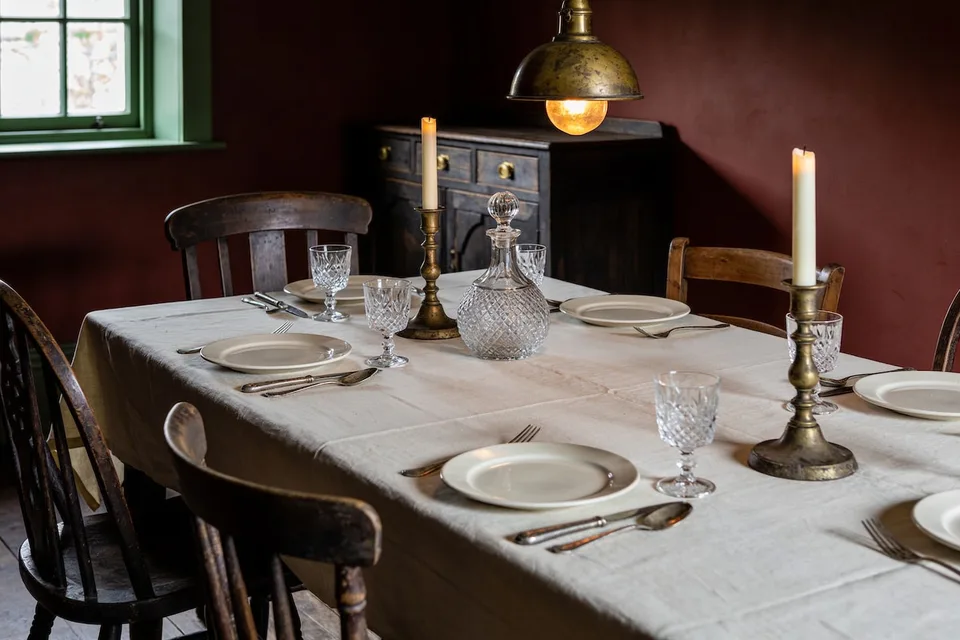
The cloth goes down first, ironed this afternoon and still carrying a little of the iron's warmth, and the table begins collecting its decades. Silver out of the small drawer that sticks — six forks in one pattern, two in another, a ladle nobody remembers arriving. Crystal down from the sideboard, no two glasses cut alike. Cream plates that were somebody else's before they were the house's, and candles standing up in brass. By the time the chairs are drawn in, the newest thing on the table is the bread, the oldest is harder to name, and nobody laying a place could say exactly when any of it came. That is not a failing of the room. It is the room.
The room that keeps time
A dining room wears its dates more plainly than any other room in the house, because the things of the table outlast everything around them. Sofas get recovered and kitchens get renovated, but a fork is never in fashion or out of it, and a linen cloth folds flat through every repainting the house survives. So the table's things are allowed to pile up across generations the way nothing else in a house is — and a dining room furnished in one afternoon, matched from the chairs to the napkin rings, says the one thing this room should never say: that everything in it started at the same time. A vintage dining room is not a style to buy. It is what the room turns into when the good things are kept, and used, long enough to stop matching.
The moody dining room is already written up here — the deep red-brown walls, the one brass light hung low over the wood, the chairs gathered one at a time until no two agreed — and that page belongs to the dark: what the room does after seven, and why its paint is chosen by candlelight. This page walks into the same room by daylight and reads it the other way, by date. Because the first thing the room says in honest morning light is not moody; it is old in layers. The chairs answer to four different decades. The table's rings and its one shallow scorch answer to thirty years of hot dishes. And the sideboard standing behind it all holds things three generations deep, waiting on the meals that call them out.
Cloth that has been ironed for decades
What no new cloth can be sold with is the surface. Linen only truly smooths when it is ironed damp — pressed dry it holds its creases like a grudge — and a cloth ironed damp a few hundred times across sixty years takes on a low sheen where the iron has ridden longest, a polish made of nothing but repetition. The cloth itself goes soft the way old shirts do, and settles onto the wood without being coaxed flat.
Most nights the wood eats bare — the supper table in season makes that case, and this room holds to it — so the cloths live folded in the sideboard's long drawer, the house's older linens together, the table's and the kitchen's in one place, coming out for the meals that want more than bare wood. That drawer is the room's deepest layer of time. A vintage linen tablecloth can be read like a document: a hand-rolled hem was somebody's winter evenings; a machine hem dates a cloth the way a typeface dates a book; drawn threadwork says the work was done partly for the pleasure of doing it. The mending is a record of its own — a corner darned in thread that almost matches, a hem resewn by a later, quicker hand than the one that first turned it.
The once-a-year banquet cloth, creases and gravy-ghost and all, has its own holiday and its own page; the rest of the drawer works more often and shows it more quietly. A cloth does not need a feast to earn its ironing. It needs a Friday.
Crystal against iron
Nobody's cottage ever bought crystal by the service. It arrived — a wedding set worn down by sixty years of washing-up until two glasses were left, and the two glasses coming here; the odd stem carried home from a sale table because it was lovely and alone; a decanter that outlasted everything else on its tray. So the crystal in a room like this is counted in survivors, and it is worked, not kept. The crystal decanter on the sideboard was cut for port and pours water most suppers — a demotion it carries without complaint, the way the kitchen's chipped enamel went over to holding spoons.
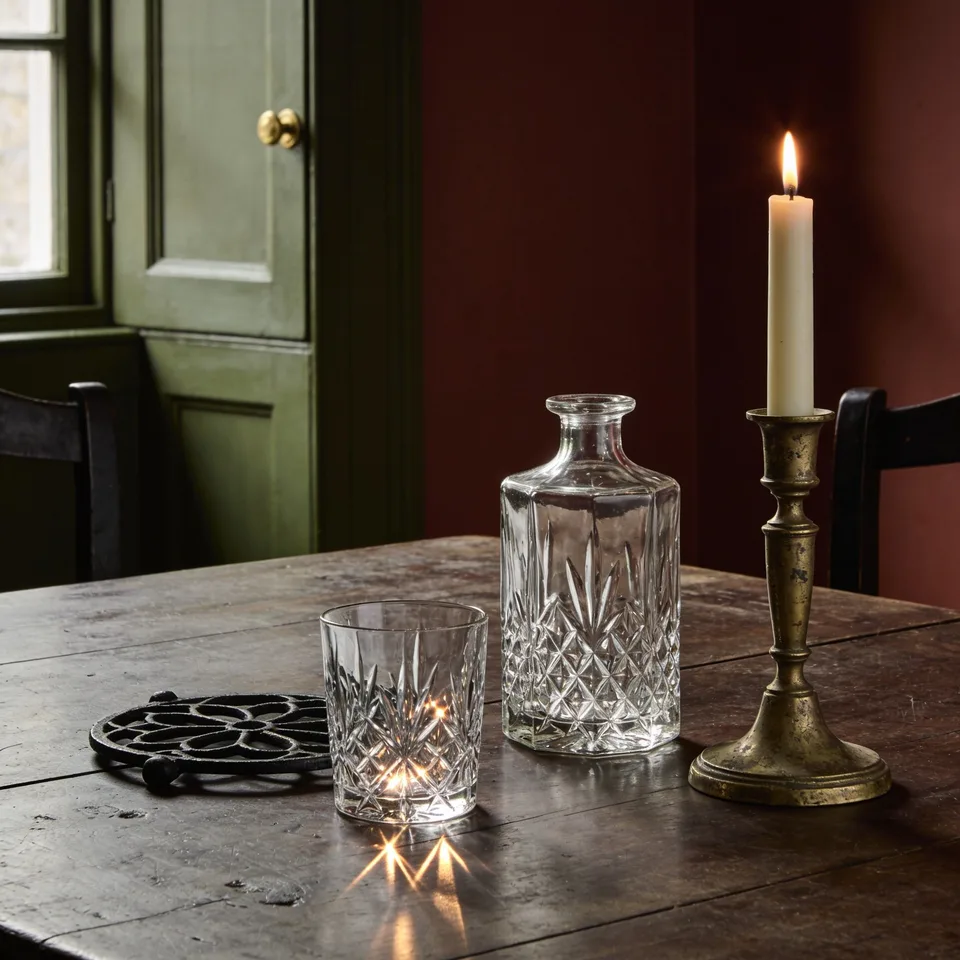
What cut glass is for, in a room lit the way this one is lit, is spending light. A plain tumbler passes a flame straight through and is done with it; crystal takes the same flame and deals it out — small sharp points of it thrown down the cloth and into the shadow, moving whenever the flame moves. One cut glass beside one candle is enough to see the whole effect. A cabinet of it behind glass doors shows nothing at all, which is the argument for using it in one sentence.
And what keeps the crystal honest is the iron. The grand thing against the plain one is the oldest arrangement the cottage knows, and this table states it nightly: the black iron trivet stands where it has always stood, and the one evening it was somewhere else is scorched into the oak beside it. Set the decanter down next to that trivet and neither apologizes — iron that has taken a century of hot pots, crystal that outlasted the household it was cut for. Together they say more about the house than either could alone: that it kept what worked and what survived, and never minded the difference in their stations.
Silver in ones and twos
The silver keeps the same census in a smaller drawer — the one that sticks in wet weather and gives to a knock from the heel of a hand. Nobody here owns a canteen, the boxed service lined in felt and saved for a good that never quite arrives, and nobody needs to: vintage silver flatware gathered in ones and twos costs a fraction of the boxed kind and reads better on the cloth. A matched dozen says one purchase; a drawer in three patterns says three households fed from it, and the serving spoon with a monogram nobody alive can attach to a face is not a mystery to solve. It is the drawer's way of keeping somebody.
Most cottage silver is plate rather than sterling, and the room is better for it. Plate is a skin of silver over a harder metal, and where sixty years of thumbs have ridden — the crown of a fork's handle, the shoulder of the ladle — it wears through to a faint warm brass, which is the spoon's version of the table's rings. Sterling was the big house's metal; plate fed everybody else, and the wearing-through is not a flaw to buff out but the proof of which kind of house a spoon worked in.
The reason to use it daily is written on the metal. Silver tarnishes standing still and stays bright in service — handling and ordinary washing are most of the polishing it will ever need — so tarnish is simply what idleness looks like on silver. A drawer of black spoons is a drawer of things nobody has asked anything of lately. Lay the silver at ordinary suppers and it keeps its own light; the paste and the soft cloth come out twice a year at most, and the dark that stays down in the crevices of the pattern can stay for good, because that dark is what makes the pattern legible.
The sideboard keeps the room's calendar
Half the room's subject stands against the wall behind the chairs. The sideboard is the dining room's memory: the long drawer of linens, the sticking drawer of silver, and below, behind two doors, the shelf of things with one working day a year — the platter sized to the bird and to nothing else, the tureen that comes out when the whole family does. None of that is storage in the sorry sense. Every shelf in it is keeping an appointment, and how an old thing earns that kind of employment — a real job, even a job with one working day a year, and no probation shelf ever — is the whole method of decorating with vintage finds. The sideboard is where the method sleeps between meals.
The everyday plates are not in here; they live next door with the kitchen's working crockery, within reach of the sink and the supper. What the sideboard holds is the occasional layer, and its top is the room's high ground, where the tall working things stand between engagements — the decanter, the candlesticks not currently at the table, a jug of branches when October offers them. Nothing on it is display. Everything on it is waiting for a date it will keep, which, in a room read by era, is what the whole piece of furniture amounts to: the house's calendar, standing where everyone eats.
Begin at the ironing board
The decades have to start somewhere, and they start at the ironing board. Tonight, take the one cloth the house already owns — inherited, thrifted, or plainly new, the method makes no distinction — dampen it, iron it hot until it gives up its creases, and fold it while it is still warm. One ironing looks like nothing, and that is correct; that is what all the other ironings looked like too. But this is the entire mechanism by which a cloth comes to have decades in it — the same small keeping, repeated until it becomes a surface, a sheen, a smell the house would know anywhere. Sixty years from tonight somebody will shake this same cloth out over a table, and every one of those years will have been ironed into it on an evening exactly like this one.
Common questions
How do you iron a vintage linen tablecloth?
Damp, always. Linen only truly smooths when it is ironed damp — pressed dry it holds its creases like a grudge — so dampen the cloth, iron it hot until it gives up its creases, and fold it while it is still warm. One ironing looks like nothing, and that is correct; that is what all the other ironings looked like too. A cloth ironed damp a few hundred times across sixty years takes on a low sheen where the iron has ridden longest, a polish made of nothing but repetition, and the cloth itself goes soft the way old shirts do, settling onto the wood without being coaxed flat.
How do you keep silver flatware from tarnishing?
Use it. Silver tarnishes standing still and stays bright in service — handling and ordinary washing are most of the polishing it will ever need — so tarnish is simply what idleness looks like on silver, and a drawer of black spoons is a drawer of things nobody has asked anything of lately. Lay the silver at ordinary suppers and it keeps its own light; the paste and the soft cloth come out twice a year at most, and the dark that stays down in the crevices of the pattern can stay for good, because that dark is what makes the pattern legible.
Should you use crystal glasses every day or save them?
Use them. Crystal in a room like this is counted in survivors, and it is worked, not kept — the decanter cut for port pours water most suppers, a demotion it carries without complaint. What cut glass is for, in a room lit by flame, is spending light: a plain tumbler passes a flame straight through and is done with it, while crystal takes the same flame and deals it out in small sharp points thrown down the cloth, moving whenever the flame moves. One cut glass beside one candle is enough to see the whole effect. A cabinet of it behind glass doors shows nothing at all, which is the argument for using it in one sentence.