 Cottage at Home
Disclosure: some links below are affiliate links — buy through one and we may earn a small commission, at no extra cost to you.
The moody dining room: deep walls, one low light, and chairs that don't match
The moody dining room is the easiest dark room to get right — deep walls, one brass light hung low over a worn table, and chairs gathered one at a time.
In this guide
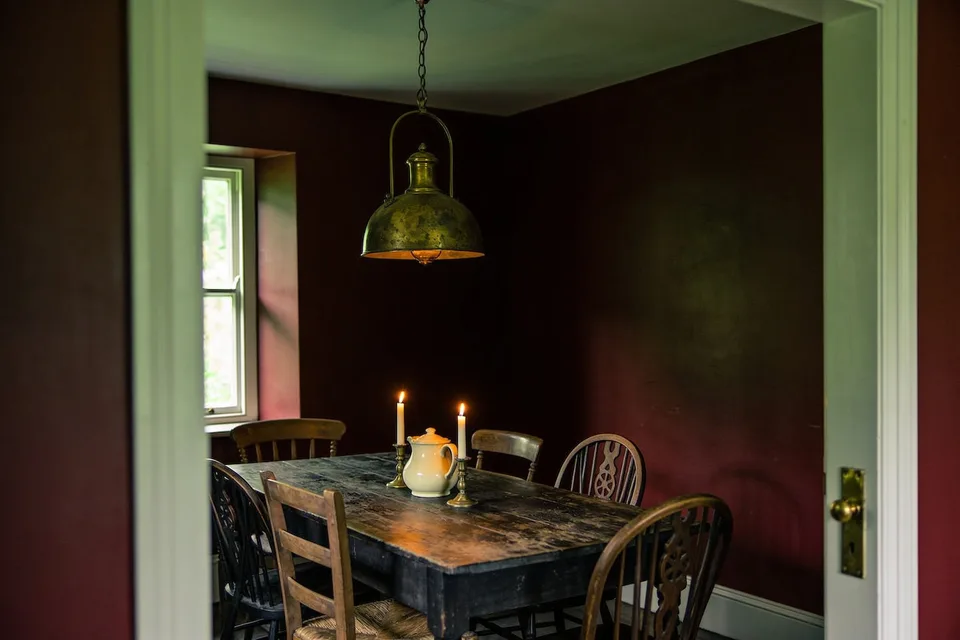
The plates are empty and nobody has moved. The one brass light hangs low enough that its glow lands on the table and stops there — the bread board, the jug, the amber rings the glasses have printed on the wood — while the walls, a red gone brown as an old saddle, stand back in the dark behind the chairs. No two of those chairs agree with each other, and nobody could say where the room ends. This is the moody dining room doing the one job it was given: holding a lit table inside a soft dark for as long as the people around it care to stay.
The room that lives after dark
Most of what circulates as moody dining room ideas leads with nerve, the deep paint offered as a dare. But no nerve is required here, because the dining room is the house's only true night room. The kitchen works all day and has to look honest at noon. The bedroom answers to seven in the morning. The sitting room takes whatever afternoon its window allows. The dining room does its real living between seven and ten, under one lamp and a candle or two, and has no business being painted for hours it never keeps. Deep color, a risk everywhere else by the pale-room doctrine, is simply the truth about how this room is used.
There is a second reason, older than the first: a dining room is a frame around one bright thing. The table is the hearth here — the light belongs on wood and food and hands, and the walls' whole duty is to stand back and let that center burn brighter. The larger case for the darker house, why depth reads as kept rather than gloomy, is made room by room in moody cottage decor; it is easiest to win here, where the room is half dark already every evening it matters.
One brass light, hung low
The fastest way in costs no paint at all: one light, hung low over the table, and the overhead retired. A pendant above a table can hang far lower than a light anywhere else, because nobody walks under a table — let it come down until the rim of the shade rides about thirty inches above the wood, low enough that no bulb shows from any chair, only lit grain and lit food. Hung there, the light stops filling the room and starts furnishing the table. And the faces around it are lit from below, by what the wood gives back — the kindest light a face is ever offered, which is why candlelit tables have flattered people for centuries.
Brass earns the job because it is generous to warm light — a brass shade tones everything that passes it toward honey, and it ages the way the room is trying to, soft rather than dull. The bulb sits on the candle side of warm, dimmed if the switch allows. This is the same trade the kitchen makes at the stove when the lamps take over after supper: general brightness given up for one warm pool, the edges allowed to go soft. The dining room simply makes the trade permanent.
Chairs gathered, not bought
The matching set of six is a showroom idea, and the dining room is older than showrooms. For most of its history a table's chairs accumulated — two from a parents' house, one from an auction, a pair from the neighbor who was moving — and a table ringed by chairs that don't match says this room has been fed from more than one decade. A set bought in an afternoon can only ever say the afternoon.
Gathered chairs still have to sit together, and three quiet agreements hold a mixed set in one family:
- Keep the seats within an inch of each other. Knees make the only agreement that matters at a table; the backs are free to argue.
- Let the woods share a life. Oak, elm, and pine all go amber in the same direction, and two old finishes agree more readily than an old and a new one do.
- Repeat one note somewhere. Two chairs painted the same deep green, or turned legs all around, and the mismatch reads as family resemblance rather than accident.
The fuller case for things that have already lived is made in vintage cottage kitchen decor, and chairs are its easiest chapter — a chair that has been sat in for sixty years has proved the only thing a chair is asked to prove. The same room read by daylight, sorted by date rather than by dark — cloth ironed for decades, crystal counted in survivors, silver kept bright by use — is vintage dining room decor.
A table that earns its wear
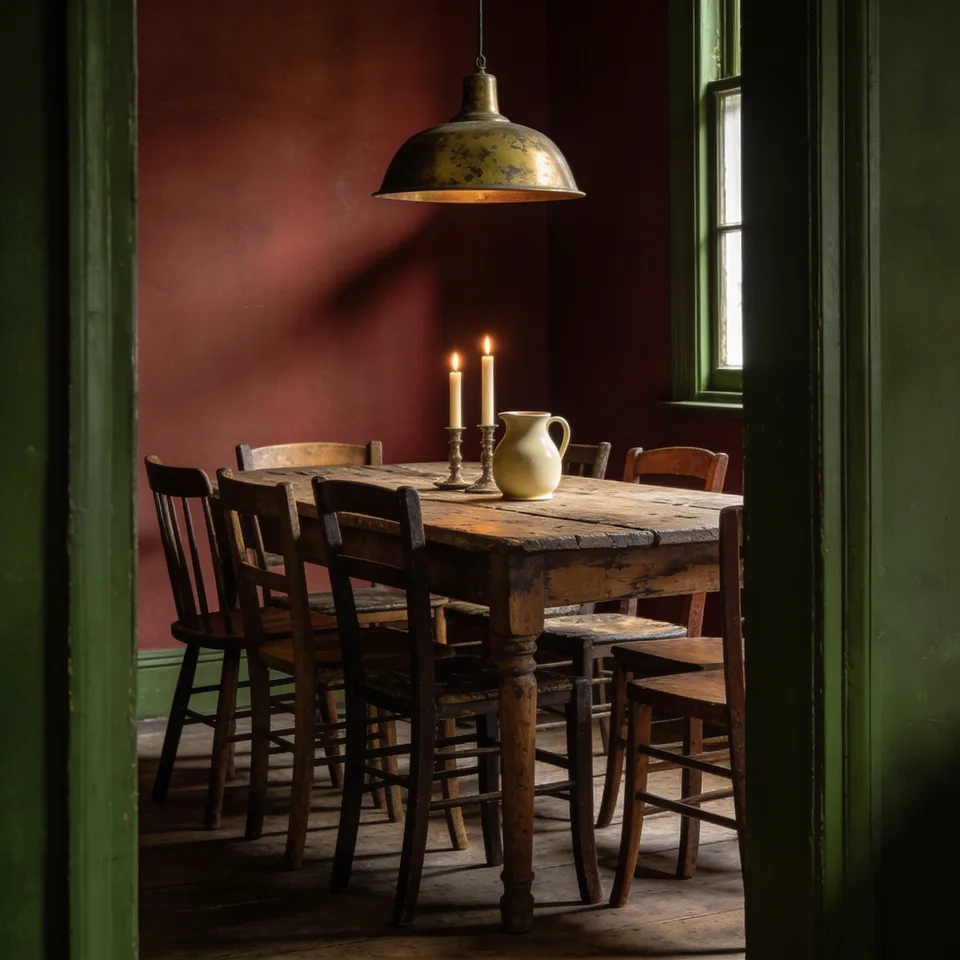
The table is the one piece of furniture whose scars are a record rather than a shame, and its finish decides whether it is allowed to keep them. The hard film most new tables ship under cannot age; it can only be damaged, and every scratch in that plastic gloss reads as damage. Wax and oil work the other way. A mark in waxed elm or oiled oak sinks in and goes quiet, and the finish is mended by feeding it — a rag and twenty minutes, a few times a year — rather than by sanding the history off. Scrubbed pine is the humblest version and maybe the best: a top that expects to be wiped down hard and shows every year of it kindly.
So the rings and the shallow scorch by the trivet stay. A cloth comes out for the meals that want ceremony; the rest of the time the wood eats bare, the low light finding every dent and liking them. Under a pendant hung close, a worn top does more for the room than a perfect one could — the light needs something to read.
Walls deep enough to disappear
The paint comes last, and its job is the opposite of what paint is usually asked to do: at supper, the wall's whole duty is to leave. Choose a color with brown or gray ground into it — the browned reds, umber, bottle green, a near-black that leans green — because those go quiet as the light drops, where anything bright-based hangs on arguing. Then test by the only light that counts. Paint a board, stand it behind a chair, light the pendant and the candles, and look at it from a seat at the table. If the wall still announces itself, go deeper.
When it is right, the walls stop reading as surface and start reading as distance. The room's edges sit wherever the light gives out, the chairs half-emerge, and everything bright left is on the table — which is to say the meal is the room, and the walls have gone to work for it. A picture can hang in that dark without arguing with it: six florals on dark grounds, peony to dahlia, wait in our own shop on Etsy, deep enough to leave with the walls at supper and be found again by daylight.
Rehearse it tonight
The rehearsal costs nothing and settles everything. Leave the overhead off tonight, stand two candles on the table, and eat supper in the small dark room the flames make. That room — the one that appears around the table and vanishes when the big light comes on — is the one the paint and the brass are for. All they do is make it stay.
Common questions
How low should a light hang over a dining table?
Far lower than a light anywhere else, because nobody walks under a table: let it come down until the rim of the shade rides about thirty inches above the wood, low enough that no bulb shows from any chair, only lit grain and lit food. Hung there, the light stops filling the room and starts furnishing the table, and the faces around it are lit from below by what the wood gives back, the kindest light a face is ever offered. Brass earns the job because a brass shade tones everything that passes it toward honey, and it ages soft rather than dull. Keep the bulb on the candle side of warm, dimmed if the switch allows, and retire the overhead.
Do dining room chairs have to match?
No. For most of its history a table's chairs accumulated, two from a parents' house, one from an auction, a pair from the neighbor who was moving, and a table ringed by chairs that mismatch says this room has been fed from more than one decade, where a set bought in an afternoon can only ever say the afternoon. Three quiet agreements hold a mixed set in one family. Keep the seats within an inch of each other, since knees make the only agreement that matters at a table and the backs are free to argue. Let the woods share a life: oak, elm, and pine all go amber in the same direction. And repeat one note somewhere, two chairs painted the same deep green or turned legs all around, so the mismatch reads as family resemblance rather than accident.
What is the best paint color for a moody dining room?
A color with brown or gray ground into it: the browned reds, umber, bottle green, or a near-black that leans green. Those go quiet as the light drops, where anything bright-based hangs on arguing — and at supper the wall's whole duty is to leave, so the room's edges sit wherever the light gives out and everything bright left is on the table. Test by the only light that counts: paint a board, stand it behind a chair, light the pendant and the candles, and look at it from a seat at the table. If the wall still announces itself, go deeper.