 Cottage at Home
Disclosure: some links below are affiliate links — buy through one and we may earn a small commission, at no extra cost to you.
The English cottage living room: filled, not furnished
What makes an English cottage living room read as kept, not styled — mismatched chairs, the fire as furniture, lamplight — and how such a room fills.
In this guide
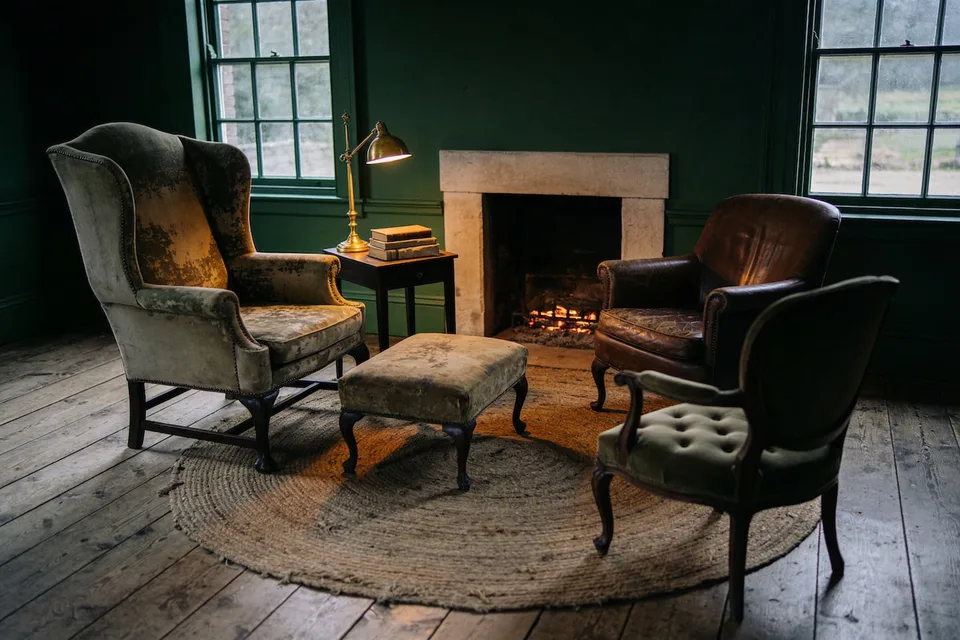
The chairs outnumber the sofa, and no two of them agree. A wing chair holds the warm side of the hearth, overstuffed past any current fashion and worn pale where forearms have rested for forty years; across from it sits a low buttoned chair out of some other house's parlor, and nearer the window a plain wooden one that came in for company a Christmas ago and never went back. The fire is lit because it is evening, not because anyone is expected. Two lamps are on, the corners are not, and on the small dark table a book lies face-down, keeping somebody's place.
Nobody furnished this room. It filled — over years, out of the rest of the house and out of other houses altogether — and the filling is the entire instruction. The law written over the bedroom upstairs — accumulated, not decorated — holds one floor down without losing a word, and it holds hardest here, because the sitting room is the most public room in the house and therefore the one most tempted to be done all at once, in a single scheme, for company. It resists for the same reason the kitchen does. The condition both rooms are after is kept — used daily, tended for years, accumulated rather than installed — and kept cannot be delivered. It can only be begun.
What makes a sitting room read as kept
Stand in the real room and what registers first is not any object. It is the sense that people sit here nightly, near the fire and near each other, and have done for longer than any of the furniture can remember. Go looking for English cottage living room ideas and what comes back is mostly inventory — the inglenook, the beams, roses at a leaded window — and the inventory is not wrong, only beside the point.
That sense has tells, and each one can be built:
- Nothing arrived together. The chairs, the sofa, the tables came from different decades and different houses. A matched three-piece suite says one invoice, delivered on one afternoon, and the room spends years living it down.
- The chairs outnumber the sofa. A sitting room gathers its seats one sitter at a time — a chair for the reader, a chair for the fire-tender, the wooden one that migrates. A long wall of sofa says the seating was calculated once, for an average evening that never comes.
- The fire is furniture. Used, tended, faced. Where every seat points at a screen, the room is a viewing room; the old room faces its own hearth, and the difference shows from the doorway.
- The light is low and local. Lamps at the chairs, switched on early, each holding its own small pool. The overhead, where one survives, is for finding what rolled under the sofa, and nothing else.
Under the tells runs the sitting room's own version of the keeping: the fire laid and the ash carried out, the cushions knocked back into shape, the hearth swept, the lamps lit at dusk before they are strictly needed. Ten minutes of putting-right a day, and no scheme at all.
Chairs first, and the sofa last
Begin with chairs, because the chairs carry the census. Estate sales on this continent are rich in exactly the right kind — the parlors are being emptied faster than anyone can inherit them — and an armchair is the one upholstered gamble worth taking secondhand. Judge the frame, not the cloth: hardwood, heavy to lift, joints that do not rock when a knee goes into the seat. Cloth is a solvable problem — a throw, a fitted cover, in time a proper re-covering — and a chair worn honest often wants nothing but sitting in. So the mismatched armchairs assemble: the high wing for the hearth, since its wings were always draft equipment before they were a shape; something low and buttoned for the mender and the reader; a leather chair gone pale at the arms. A footstool goes between them, owned by everyone, moved nightly, upholstered in whatever it was wearing when it arrived.
The sofa comes last, and it is allowed to be the one honest new purchase in the room. Sofas are the exception to the estate-sale habit — springs go, smells stay, and a sofa cannot be rescued with a throw the way a chair can — so buy it new, plain, and loose-covered: a slipcovered sofa in a cloth that washes, cream or undyed, deep enough to nap on, with nothing about it that will date. Its work is to go quiet under the older company, and a plain cover is how it learns its manners. One new piece, chosen for use, is not a failure of the thrift habit. It is what lets everything else in the room be old.
The fire is furniture
The hearth is not a feature of this room; it is the most used piece of furniture in it. The chairs angle toward it in January and stay angled in July, the way the kitchen's chairs face the table whether or not it is laid. Its keeping is the room's keeping — laid in the morning, lit at dusk, fed and banked and finally swept, the wood basket refilled as a standing errand — and the tending gives the evening a shape no arrangement of furniture can fake. The tools stand ready on the stone: cast brass or iron fireside tools, poker and tongs and brush, bought once and outliving every owner, with the fender holding the line of the hearth. They are working objects, and they read that way, which is why a swept hearth with its tools standing by says more about a household than anything on the mantel above it.
Where there is no fire to tend — and plenty of rooms on this continent have a hearth long sealed, or none at all — the arrangement survives the loss. The room still wants a warm side: the heaviest rug, the most lamplight, the two best chairs angled in toward each other and toward something that is not a screen. A hearth is, before anything else, an agreement about which way the room faces, and that agreement can be kept without a chimney.
Lamplight, and the corners left alone
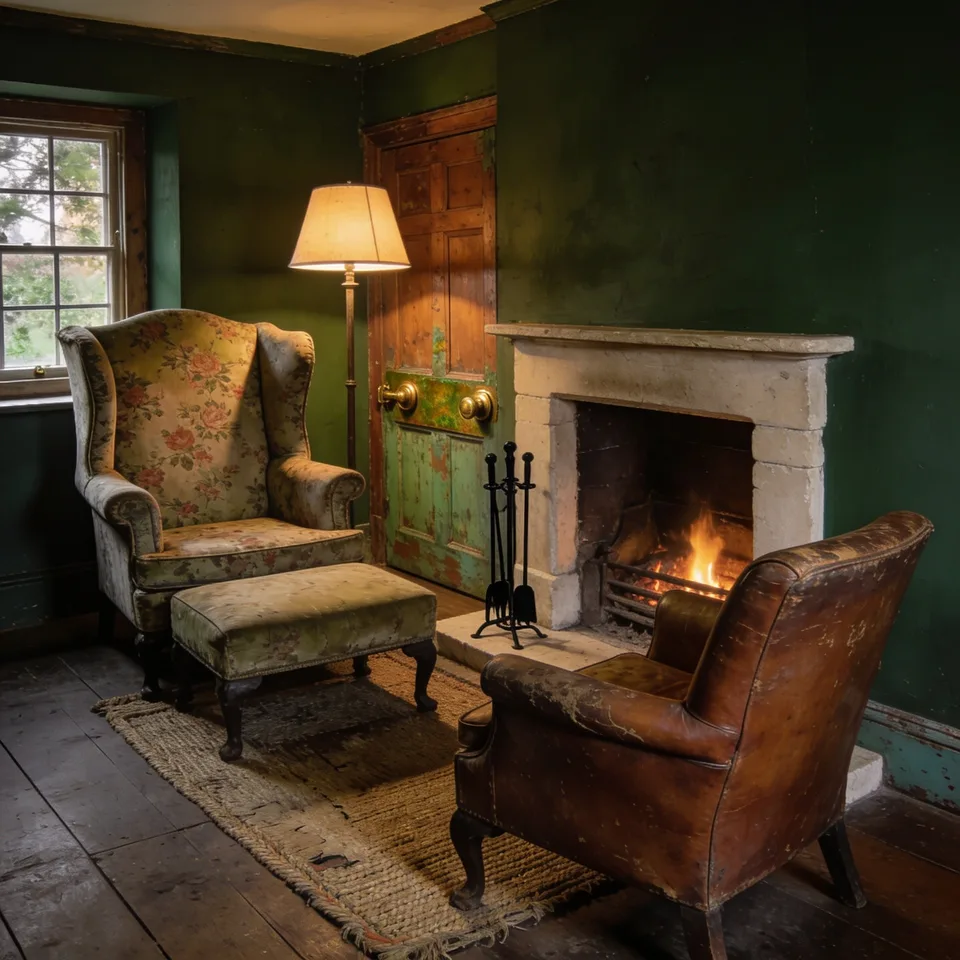
Light in this room follows the seats, because the sitter needs it at the page and nowhere else — a room lit at its chairs says people sit here, while a room lit evenly from the ceiling says it is ready to be shown. The lamps came the way the chairs came, one at a time: a brass lamp at the wing chair's shoulder, a smaller one on the shelf, an oil lamp on the sill that still keeps a trimmed wick for the winter night the power fails. The deep green of these walls takes the lamplight kindly, but whether a sitting room's walls should go dark themselves — the paint, the undertone, the whole argument — is its own subject, made properly on its own page. The lamps do not require it. They require only that the overhead switch be left alone after supper.
The mantel, the table, and the walls
The small residents follow the big ones. Every seat wants a small dark side table at its elbow — lamp, cup, current book — and the tables obey the room's one law by disagreeing: oak beside walnut, a plain stand beside the sewing table that lost its sewing. On the mantel a mantel clock holds the center, wound on Sundays by whoever remembers; its tick does for this room what the kettle does for the kitchen, and gives the hours somewhere to stand. Clothbound books do the rest of the furnishing — shelved where the room has shelves, stacked on tables and sills where it does not — their spines going soft from actual reading, a census of years the way the kitchen's crockery is.
The walls fill last and slowest, a picture at a time, in frames that never met before they were neighbors. None of it has to be inherited to read as though it were: a botanical or an old engraving, printed honestly and framed in thrifted wood, is backdated the day it is hung, and hangs as gladly over a chair as over a flour bin.
How the room fills
A sitting room fills from two directions. From inside the house: things drift toward where the people are, so the good lamp finds the reading chair, the heavier blanket comes down in October, and the sturdiest small table ends up at the fire because that is where cups most need catching. From outside: emptied houses, family attics, the estate sale two towns over — the clock, the footstool, the odd chair — and a steady share of it arrives wrapped and stays, because the things people give a room like this are the things that pass for inherited by spring.
Underfoot and at the door, the same slow arithmetic. A worn wool rug — or a braided one, this continent's own answer, made of rag and thrift from the beginning — lies over the floorboards, and a second lies over the first where the first wore thin, which is not making do; it is how floors were dressed for two centuries. Across the door to the hall hangs a wool curtain with real weight, on the plainest rod, drawn at dusk against the draft the hall sends under the door. And the reason the room can afford its wool and its pale hearthstone at all was settled two doors away, where the weather stops: boots and wet coats never get this far, so the soft things here are free to be soft.
One chair, brought in
Not a purchase — a migration. Tonight, fetch the most underused chair in the house: the desk chair nobody writes at, the bedroom chair buried under clothes, the kitchen's spare. Set it on the hearth's cold side, angled in toward the fire or toward where the fire would be, and put a lamp within reach. Let it stay the week. If by Sunday it has been sat in, it lives here now — and the room has begun doing the only thing it was ever meant to do, which is fill.
Common questions
Is it okay to buy a sofa secondhand?
No — the sofa is the one piece to buy new. Springs go, smells stay, and a sofa cannot be rescued with a throw the way a chair can, so it is the exception to the estate-sale habit: buy it plain and loose-covered, a slipcovered sofa in a cloth that washes, cream or undyed, deep enough to nap on, with nothing about it that will date. Chairs are the opposite case — an armchair is the one upholstered gamble worth taking secondhand — and one new piece, chosen for use, is not a failure of the thrift habit. It is what lets everything else in the room be old.
What should you look for when buying a used armchair?
Judge the frame, not the cloth: hardwood, heavy to lift, joints that do not rock when a knee goes into the seat. Cloth is a solvable problem — a throw, a fitted cover, in time a proper re-covering — and a chair worn honest often wants nothing but sitting in. Estate sales are rich in exactly the right kind, since the parlors are being emptied faster than anyone can inherit them, so let the chairs assemble one at a time: a high wing for the hearth, something low and buttoned for the mender and the reader, a leather chair gone pale at the arms.
How do you arrange a living room with no fireplace?
Give it a warm side anyway. The room still wants one — the heaviest rug, the most lamplight, the two best chairs angled in toward each other and toward something that is not a screen. A hearth is, before anything else, an agreement about which way the room faces, and that agreement can be kept without a chimney. Then let the light follow the seats: lamps at the chairs, switched on early, each holding its own small pool, with the overhead kept for finding what rolled under the sofa and nothing else.