 Cottage at Home
Disclosure: some links below are affiliate links, and if you buy through one we may earn a small commission, at no extra cost to you.
Cottage mantel decor for the whole year: the few things that stay
A cottage mantel that works all year keeps a few things in place and lets each season land on top. What stays, what catches the lamp, and the gap to leave.
In this guide
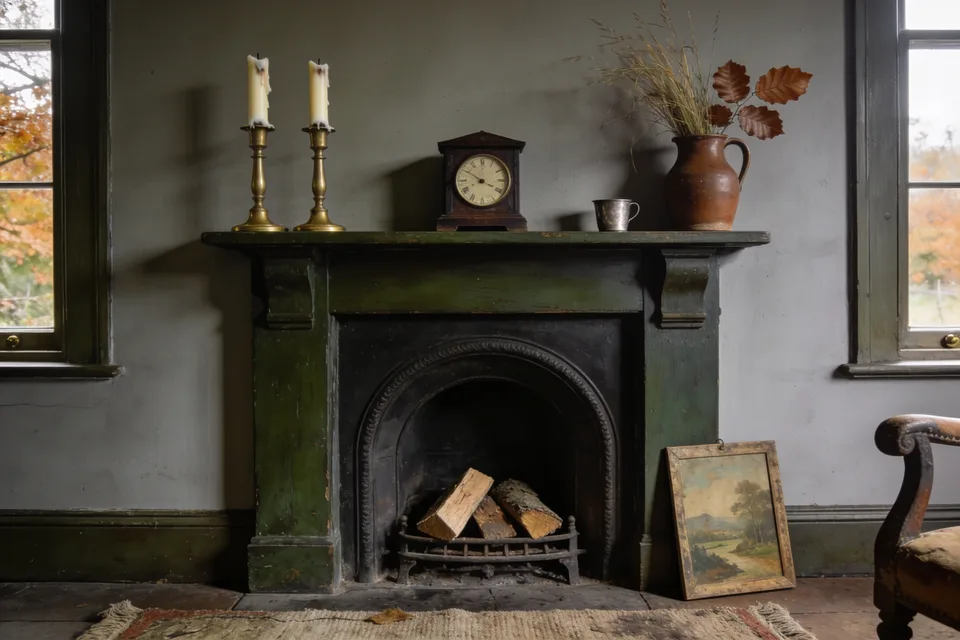
Most cottage mantel pictures are taken standing up, close in, at noon. You'll almost never see yours that way. You see it from the chair, in the evening, with a lamp on and maybe the fire going. So this is about the few things that live on a mantel all year and still look right from there, with each season laid on top and taken off again.
Sit down before you decide anything
A mantel is the one surface in the house you look at while sitting still, so judge it from the chair you use most, in the evening, by the lamps you really turn on. What reads well from there stays. Small dark things vanish after dusk, tall things at the ends carry across the room, and anything shiny finds the lamp.
Try it tonight. Sit where you sit, with the overhead off, and look at the shelf for a minute. You'll usually find that half of what's up there can't be seen at all from the chair, and one thing you'd forgotten about is doing all the work.
What stays on the mantel all year
The things that stay are few: one picture or mirror above the shelf, two candlesticks that don't quite match, one thing with some weight to it, and a stretch of bare shelf. Everything else is a visitor. It arrives with a season, stays a few weeks, and goes back in the box.
The heavy thing can be a brown stoneware jug, a small clock, or a stack of two or three old books. It can sit at one end, or in the middle the way the clock does in the English cottage living room. What matters is that the shelf has something solid on it that isn't going anywhere, so the lighter things around it can change without the whole mantel changing.
The candlesticks don't need to be a pair. One brass and one plain pewter, or two brass ones of different heights, look like they were gathered over years rather than bought as a set. Vintage pewter candlesticks are worth looking for secondhand, because they go soft and grey with handling and sit well beside brass.
Keep the shelf itself plain
Leave the mantel shelf plain: painted wood, bare stone or old oak, and the same colour in every season. It is the stage the rest stands on. A plain shelf lets the few things on it read clearly from across the room, and it means a season can go up and come down without the mantel itself changing.
In a room with dark walls the mantel is often the best place for the one pale surface the eye rests on, as the dark cottage living room piece has it. In a pale room it can go the other way. Either works, as long as you pick one and leave it alone.
What the lamplight finds
In the evening the mantel is lit by lamps and firelight, so choose things that catch a warm light: brass, old glass, pale stoneware, candle wax, a gilt frame. One or two of these are enough. They pick up the lamp and hold it after the rest of the wall has gone dim, which is the hour you'll be looking.
This is also how to choose between a mirror and a picture above the shelf. A mirror doubles the lamplight and makes a small room feel wider, so it suits a room that's dim or narrow. An antique overmantel mirror is worth looking for secondhand; the old glass has a softness that a new one won't have. Before you hang one, look at what it would show from the chair. If it's the ceiling light or the television, a picture is the better choice, and a landscape keeps the eye in the room.
If the fire is lit, keep anything that can burn well away from it, and never leave a candle burning on the mantel when nobody is in the room.
Leave one end of the shelf empty
Keep one stretch of the mantel bare on purpose, at an end or off-centre. A full shelf in September has nowhere to put anything in October, so each new thing gets squeezed in beside the last. A gap gives the season somewhere to land, and it lets the things that stay have room around them.
It also answers the most common worry about a mantel, which is that it looks cluttered. It usually isn't the number of things that does it. It's that nothing has space around it. Take one thing off, leave the gap, and look again from the chair.
A mantel with no fire under it
A mantel without a working fire works the same way. Many rooms have a hearth that was sealed long ago, an electric insert, or no fireplace at all, only a deep shelf on a plain wall. The mantel still tells the room which way it faces, so give it the same few things, and put a warm point below it.
That warm point can be a small lamp set low on the hearth, or a few thick candles standing in the swept, cold grate, as the cozy fall living room piece suggests. A basket of logs does the same job in a room that never burns them. If there's no hearth at all, a lamp on a low table under the shelf does it. The chairs will turn toward it just the same.
How each season lands on it
With the few things in place, a season is one gesture laid on top: a branch or two of turning leaves in the jug in autumn, fir laid flat along the shelf in December, and bare wood again in January. The things that stay don't move. The season goes in the empty end, and it comes out when the season does.
The seasonal pieces go into each one in more detail: the fall turn, Halloween, a cottage Christmas and the plain weeks after it. What they have in common is the mantel under them, which stays the same all year.
Start with the shelf you have
Tonight, take everything off the mantel. Put back one heavy thing, the two candlesticks, and the picture or mirror, then sit down in your chair and look. Leave the rest off for a few days. Most of a good cottage mantel is decided in that one sitting, and you won't need to buy anything to find out.
If you'd like a picture for the space above the shelf, there are a few in our shop.
Common questions
What should you put on a cottage mantel?
Keep a few things there all year: one picture or mirror above, two candlesticks that don't quite match, one heavy thing like a stoneware jug or a small clock, and a bare stretch of shelf. Everything else is a visitor that comes and goes with the season.
How do you keep a mantel from looking cluttered?
Leave one end of the shelf empty. A full mantel has nowhere for the next season to go, so every new thing gets squeezed in beside the last one. With a bare stretch kept on purpose, the few things that stay have room around them and the eye can rest.
Can you decorate a mantel with no working fire?
Yes. The mantel still marks which way the room faces, so the same few things work on a sealed hearth, beside an electric insert, or on a deep shelf over a plain wall. Put a lamp low on the hearth, or thick candles in the cold grate, so there is still a warm point below.