 Cottage at Home
Disclosure: some links below are affiliate links, and if you buy through one we may earn a small commission, at no extra cost to you.
A cottage home office for the hours you actually work in it
A cottage home office gets photographed empty at noon and worked in at eight and five. Where the desk goes, which lamp, what colour, and a desk that shuts.
In this guide
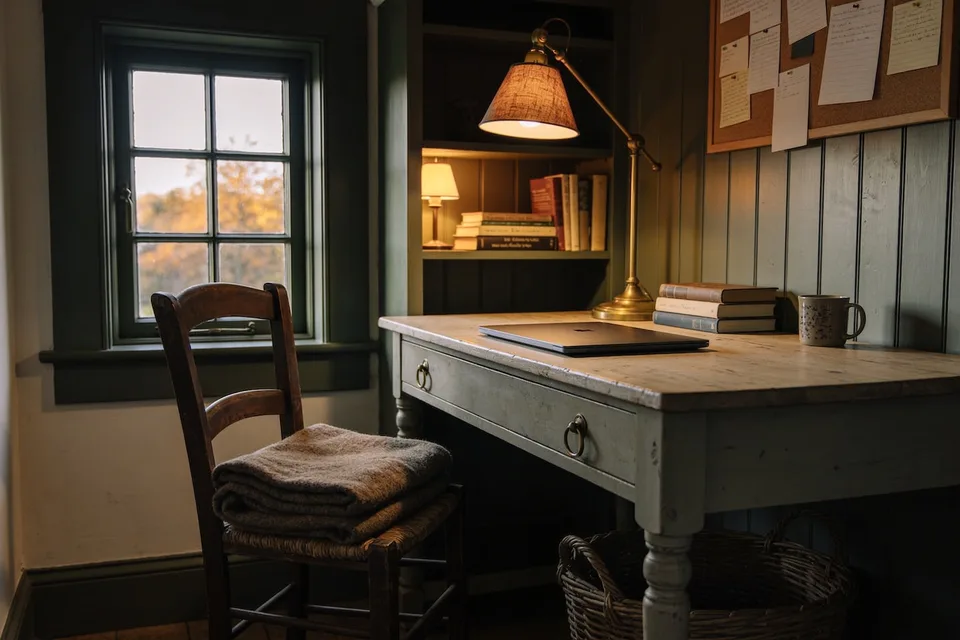
Most pictures of a cottage home office are taken at noon, with the sun pouring in and nobody at the desk. That's the one hour you will hardly ever see it. You'll sit down at eight on a grey morning and still be there at five, when the window has gone dark and the only light is the one you switched on. So this is about furnishing the room for those hours.
Why the photos show noon and you work at five
A cottage home office has to work on a dim morning and after dark, because that is when most of the working day happens for half the year. The photos show the room empty in full sun because it looks best then. Furnish it for the grey hours instead: where the desk sits, which lamp is on, and what colour the walls still are at five.
Try it in the room you have. Sit at your desk late on a dull afternoon with only the lights you'd really use, and look at what you see. The glare on the screen, the dark corner behind you, the wall that has gone the colour of wet cement: those are the things worth fixing, and none of them shows up in a sunny picture.
This room is also where you spend more waking hours than almost anywhere else in the house, sitting still. That's the reason to take it seriously even when it's only a corner of the spare room.
Put the window at your side
Set the desk side-on to the window, so the daylight comes across the work from one side. Facing the window puts your eyes against the brightest thing in the room all day, and sitting with your back to it puts the window in your screen. Side-on, the light falls on the desk, and the view is one turn of the head away.
If you write by hand, the old advice still holds: the light should come from the side opposite your writing hand, so your hand doesn't shade the page. For most people that means the window on the left.
The old cottages had no office, and the letters and the accounts got done at a table with a drawer wherever a window could be spared: the spare bedroom, the end of the kitchen, a corner of the sitting room. That is still the best way to find a place for one. Look for a window with a bit of plain wall beside it rather than a whole empty room. If the only spare room is also where guests sleep, the desk can share it, and the guest room is mostly empty on a weekday anyway.
One lamp at eye height, and the overhead off
The light that makes a small office feel like a good place to be is a lamp on the desk with its shade at about eye height when you sit, so it lights the work in front of you. Turn the overhead off. It lights every corner evenly and flatly, which is fine for finding a dropped pen and hard to sit under for a whole afternoon.
A lamp with a fabric or linen shade gives a softer pool than a bare bulb, and a jointed arm lets you bring it down over a page and push it back for the screen. A vintage brass desk lamp is worth looking for secondhand, because the brass only gets better with handling and a new shade costs little. Have the wiring checked before you use an old one.
Then put one more small lamp somewhere behind you, on a shelf or a side table. Without it the room goes black around the desk after four, and staring from a bright screen into a dark room is tiring in a way you notice only at the end of the day. It's the same idea as lamps in pools in a sitting room: a few warm pools at the height you live at, and the rest of the room allowed to go soft.
A colour that still has colour in it on a November afternoon
Choose a wall colour by how it looks under a warm bulb, because in a cottage office you'll see it by lamplight half the year. Warm greens, ochre, clay and deep brown keep their warmth. Cool blues and grey-blues often look fresh at noon and go flat and cold once the lamps are on, which is the hour you'll be sitting there.
Paint a board the size of a tea tray, stand it behind the desk, and look at it at five with only the desk lamp on. That's the test the room will give it every day from October to March, so it may as well sit it first.
This is a dry room, so flat or matte paint suits the walls, and it won't throw the lamp back at you as glare the way a shiny finish can. The desk top is the one surface that gets touched all day. A painted table is easy to put right when it wears, and bare wood with a little oil in it only looks better for the scratches. Painted boards to shoulder height take the knocks from a chair pushed back without complaint.
A desk that shuts at night
The best small cottage office is one you can close at the end of the day. A desk with a lid, a drop front or a deep drawer lets the laptop and the papers go out of sight at five, and the corner goes back to being part of the house for the evening.
The old answer was a bureau, a chest of drawers with a writing flap that folds down on two slides. An antique bureau desk is worth looking for secondhand, holds a surprising amount, and takes up less floor than a table and a filing cabinet. Check that the slides pull out straight and the flap sits level before you buy one, since that is what you'll lean on every day.
If your desk is a plain table, a basket underneath and a length of cloth over the top do the same job. Put the day's papers in the basket, close the laptop, and fold the cloth over. It sounds too small to matter, but a desk left open all evening keeps the work in the room with you. Keep the wool blanket on the chair, where you'll reach for it at four when the house cools, and one picture on the wall you look at when you look up. If you're choosing one, there are a few in our shop.
Start with the light you work in
Tomorrow, sit at your desk at the end of the working day with the overhead off. Move the lamp until the pool falls on your hands, turn the desk until the window is at your side, and see what the wall looks like at that hour. Most of a good cottage home office is decided in that one sitting, and you won't need to buy anything to find out.
If you'd like somewhere else in the house to settle at the end of the day, a reading corner works on the same light, and so does the English cottage living room.
Common questions
Should a desk face the window in a home office?
Usually not. Put the window at your side instead. Facing the glass puts your eyes against the brightest thing in the room all day, and with your back to it the window shows up in your screen. Side-on, the daylight falls across the desk and the view is one turn of the head away.
How do you make a home office cozy in winter?
Turn the overhead off and put a lamp on the desk at about eye height when you sit, so the light is a warm pool on the work. Add a second small lamp somewhere behind you so the room doesn't go black around the desk, and keep a wool blanket on the chair. Most of the warmth comes from the light and the cloth, so you rarely need to add anything else.
What colour should a cottage home office be?
A colour that still looks like itself under a warm bulb, because you'll see it by lamplight half the year. Warm greens, ochre, clay and deep brown hold up well. Cool blues and grey-blues tend to go flat and cold once the daylight goes, so try a painted board by lamplight before you commit.