 Cottage at Home
Cozy reading nook ideas for small spaces: the nook you already have
Cozy reading nook ideas for small spaces begin with noticing, not building — the window seat, the landing, the chair that fits, the lamp low enough.
In this guide
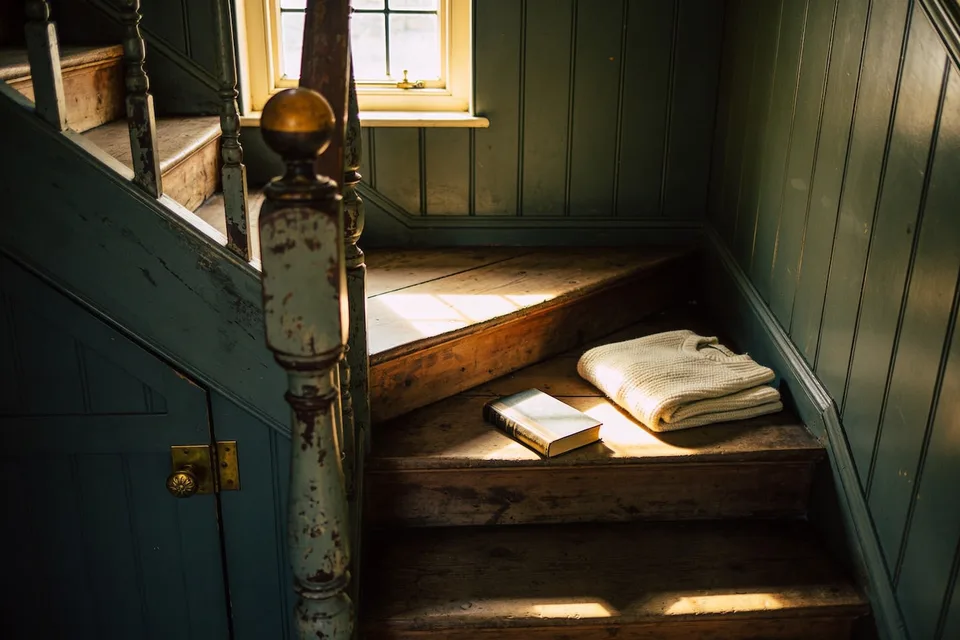
The book is already lying face-down on the stair landing, left by somebody who sat longer than they meant to, because the low sun holds that step until nearly five. A folded sweater has been standing in for a cushion since sometime last fall. Nobody planned this corner and nobody would call it a nook out loud. But the house has been saying it for years, in the only language a house has: the reading place is already here.
Found, not built
Find the place the reading has already claimed, then furnish it from the rooms around it: a chair that fits the corner, a lamp low enough, wool within reach, and somewhere flat for the cup. That is the whole list, and most houses hold every item already, somewhere else, doing less. Most of what turns up under cozy reading nook ideas for small spaces arrives with lumber — window benches framed into alcoves, closets gutted and shelved, built-ins with cushions cut to order. Handsome work, and beside the point in a small house, which has no spare alcove waiting to be framed out. What a small house has instead is a geography of odd, half-claimed places where sitting already happens, and a reader who has already chosen one of them without noticing the choice. So the method here is shorter than a weekend of carpentry.
The finding is the easy part, because the evidence is lying around. Where does the book get left face-down. Which step, which sill, which arm of which chair. Where does the phone reader drift on a Sunday. A house runs this survey on its own all year; all it asks is that somebody read the results.
Where small houses keep them
The landing is the most overlooked room in the house, mostly because nobody calls it a room. It is a yard or two of floor with a window more often than not, halfway out of the household's traffic but never far from it, and warm air gathers there because stairwells breathe upward. A landing wide enough for a chair is a nook already; a landing too narrow for one will still take a cushion the width of the top step.
The end of the upstairs hall does the same quiet work. Halls are built to reach the last doorway and then run on a little farther, and that leftover stretch — often with the window that lights the whole corridor — has usually spent its life holding a basket of things on their way to somewhere else. It would rather hold a chair.
Then there are the warm corners. The chair-width beside the radiator is the best seat in the house from November to March, and the deep sill above a radiator is the closest thing an old small house has to a built window seat — warmth rising past the glass, a ledge for the cup, the weather on the other side losing its argument. And in the bedroom, the corner between the wardrobe and the window is very often empty for no reason anyone remembers, a chair-sized country going to waste a step from where the quietest hours of the house are already spent.
A chair that fits the corner
Fitting the corner matters more than anything the chair cost. A small corner wants a small chair — armless or with low arms, high enough in the back to lean a head against — because the corner itself does half the holding. Two walls at your back is the oldest comfort arrangement there is; the reader wants the room out in front and the wall behind, and a chair that tucks in deep enough to grant that will beat a grander one that sits proud of the corner and blocks the very light that made the spot worth claiming.
Which is why the chair is found the same way the nook was: by audition, not purchase. The bedroom chair that has spent years holding folded laundry. The spare kitchen chair, softened with the cushion off the bench. The little upholstered thing in the room nobody sits in. Carry a candidate to the corner and sit in it through one pot of tea; the chair either belongs or it doesn't, and the house will say which.
A lamp low enough
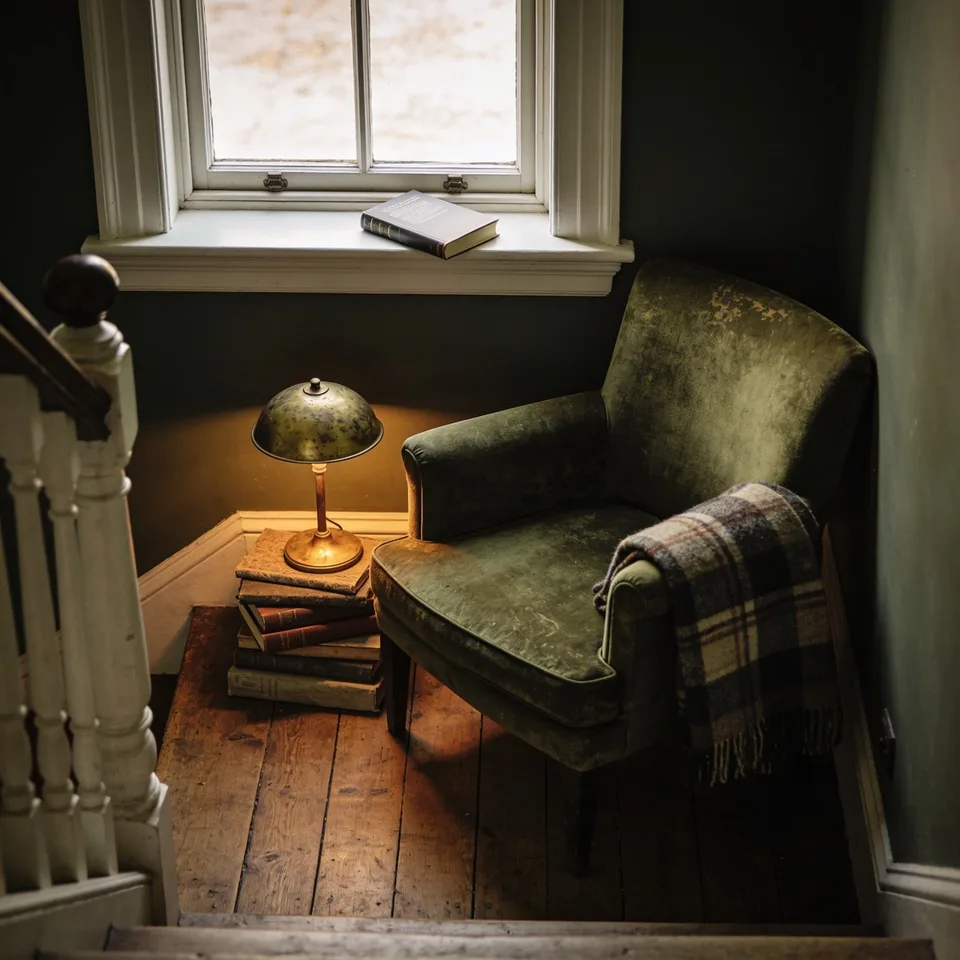
The overhead is the nook's undoing. It lights the whole floor evenly, and a place that is lit like everywhere else is everywhere else — a nook is made by unevenness, one warm pool with the rest of the room allowed to go soft around it. So the lamp comes down to the reader's level: shoulder height in the seated position, close enough that the pool of light covers an open book and a lap and not much more, with a warm bulb in it and nothing brighter overhead. This is the same trade the kitchen makes when it goes over to deep color and lamplight — the lamps doing the living, the overhead kept for cleaning — and it works at chair scale for the same reason. Any small lamp in the house can take the job, carried from a dresser or a desk; from September on, switching it on at dusk simply joins the lamps-first habit the amber autumn runs on, one more corner keeping its own small light against the early evening.
Wool within reach, and somewhere for the cup
The last two furnishings are small enough to carry in one trip, and the nook is not finished until both are in place. The wool goes over the arm of the chair, not folded in a cupboard across the room — within reach of a sitting reader, because nobody gets up for a blanket, they simply read colder and leave sooner. A throw with some weight to it earns the spot twice over: wool holds lamplight the way cotton never quite manages, and it makes the chair look inhabited even when it is empty, which is how a corner keeps its claim.
And the cup needs somewhere flat to land — a windowsill, a stool, the radiator's shelf, a stack of large hardcovers off the bookshelf if nothing better offers. This sounds too small to list and it is the difference between perching and settling; a reader holding a hot mug is a reader half-ready to leave. The tea itself is the kitchen's contribution, carried up from a room that has learned to meet the early dark kindly, and the walk from kettle to chair, cup in hand, is the whole commute the evening asks.
The wall above the chair can take one small picture without troubling the corner's quiet, and the right subjects are already sitting in it: a set of twelve household studies in our own Etsy shop includes the clothbound books, the teacup, and the oil lamp, printed at home and framed from whatever the thrift shelf offers.
Follow the book
This evening, find where the last book was left face-down — that is the house voting. Carry the nearest small lamp there, plug it in, bring the chair that fits and the throw off the bed, and sit until the tea goes cold. If the corner is right, the house knew before anyone did.
Common questions
How much space do you need for a reading nook?
Less than most people assume, because the good ones are found rather than built. A chair that fits its corner, a landing, a deep window ledge, the end of a hallway. If a chair, a lamp and somewhere to set a cup will fit, the nook is already there and only needs claiming.
Where do small houses usually keep a reading nook?
In the leftover places: the turn of a stair, the width beside a chimney breast, the corner a door swings past. These are the spots a floor plan treats as circulation and a reader treats as a room.
What kind of lamp works best?
A low one. Light that arrives from below shoulder height falls on the page and leaves the rest of the room dim, which is what makes a corner feel enclosed. An overhead fixture lights the whole room and dissolves the nook.