 Cottage at Home
Disclosure: some links below are affiliate links — buy through one and we may earn a small commission, at no extra cost to you.
The English cottage laundry room: where the linen comes back
The English cottage laundry room kept in the mudroom's register — a wooden airer on ropes, a line in the garden, labeled jars, a deep sink — and the week's linen coming back to every room it serves.
In this guide
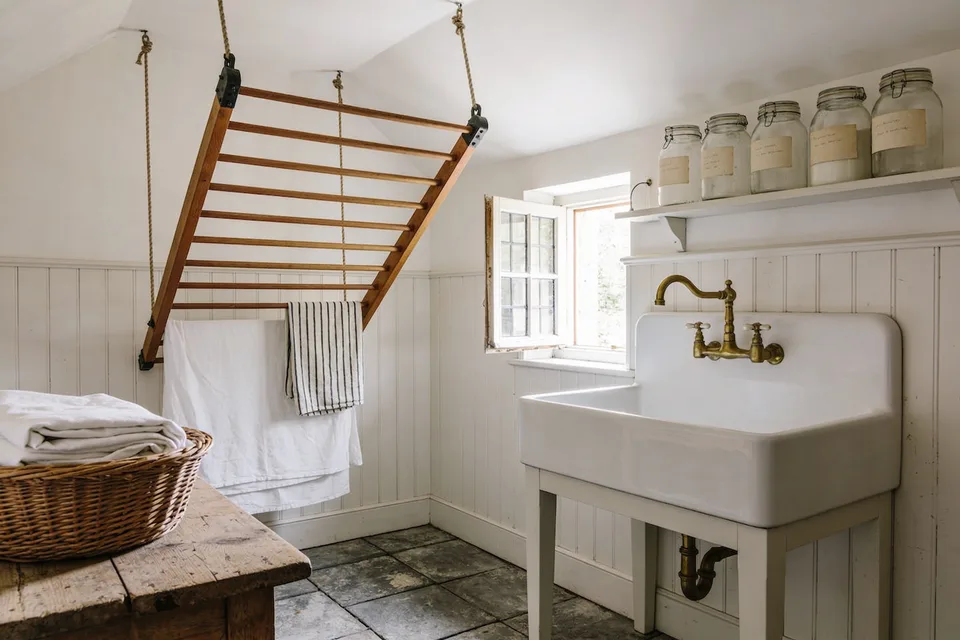
On Monday morning the ticking-stripe bag comes down from the back of the bedroom door, heavier than it looks, and the week starts running in reverse. By nine the deep sink has drawn and let go its first gray water, the window stands open to the garden, and the airer has gone up on its ropes with the early load — white shapes swaying a little in the draft, dripping onto the flags. The room smells of soap and wet stone. Out on the line the sheets are pegged and filling with wind, already at work on their own whiteness. By supper, nearly everything hanging here will be dry, folded, and on its way back to the rooms it serves.
The room that undoes the week
The work itself has not changed its nature. The mudroom stands at the back door and stops what the weather does to the household; this room stands one door along and undoes what the household does to its cloth. Between them they keep every other room honest — the mud halted at one threshold, the week's wear washed out at the next — and they go about it in the same plain register: stone underfoot, things that dry on air, nothing in the room too precious to get wet.
The old cottages mostly did not have this room. Washing happened in the scullery, in the yard, in a lean-to wash-house with a copper in the corner and steam rolling out the door — and it happened on Monday, hard, all day, because the fire under the copper was lit once and the whole week's cloth went through while it was hot. An English cottage laundry room with a door of its own is less an inheritance than a promotion: the same work, finally given the dignity of a room.
Go looking for cottage laundry room ideas and what mostly comes back is containment — the machine boxed into cabinetry, a cubby per child, a painted sign instructing the room to wash and fold. The instinct is to hide the work. The older instinct is to furnish it: give the wash real tools, hung and shelved in plain sight, and the room stops needing hiding at all.
The airer puts the ceiling to work
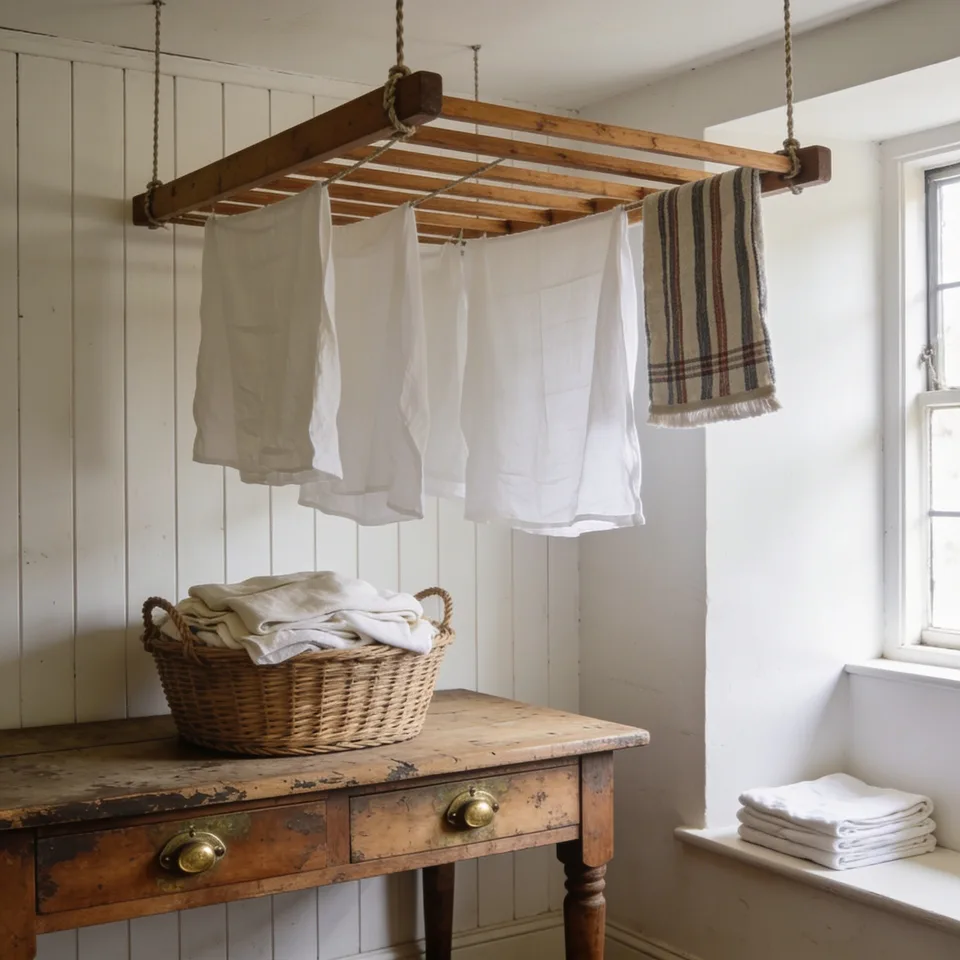
Overhead, the whole ceiling is employed. A vintage wooden clothes airer — long pine laths slung between cast iron ends — rides up on a rope through two pulleys, and the reasoning has not dated: the warmest air in any room is the yard of it under the ceiling, where nobody is standing. Wet linen hoisted into that layer dries overnight for nothing, out of the way of the work below. This one hangs against the room's one warm wall, the back of the chimney the kitchen stove keeps mild from the far side, so a wash pinned up at dusk is dry and breathing by breakfast. The house never bought a dryer; the ceiling had the job first. Where a dryer already hums under a counter, the airer still earns its ropes — for the wool a drum would felt, the linen it would age, and the quiet economy of heat nobody paid for twice.
The machine is not apologized for. It stands beside the sink and does what the copper and the washboard once did, minus the scalds and the raw knuckles, and nobody in this house mourns the difference. But the drum only washes. The room's real subject is what happens afterward, and drying is where the old equipment has kept its job outright.
The airer's standing cousin folds flat against the wall between wash days, and in the worst weeks of February it walks to the sitting room and opens its screen of damp linen a polite distance back from the brass fender, as it has every February since the fire was the only heat in the house.
The line, the wind, and the old bleach
From April to October the garden does the finest work. Sun is the old bleach — slow, even, free — and it is real: a white sheet given a season of bright mornings comes back whiter than any bottle leaves it, and the smell of line-dried linen has never been counterfeited, though whole industries have tried. Wind matters more than sun. A gray morning with a good breeze outdries a still blue afternoon, and a household that hangs washing learns the sky by heart — the race to the line when the first drops land is as old as the line itself.
The pegs are their own small pleasure. Wooden dolly pegs — one piece of turned and split wood, no spring to rust, no plastic to snap in the cold — have been made to the same shape for two centuries because the shape was right the first time. They live in a glass jar on the deep sill between Mondays, pale wood in plain glass, and nothing else in the room says as quickly what the room is for.
A deep sink, and jars that keep the pantry's law
The sink is the room's second fixture, white and deep enough to drown a blanket, and April is when it proves it: the wool blankets come down from the beds one at a time to be washed by hand in water barely warm, pressed and never wrung, dried flat, and folded away for their summer in the wardrobe. Wool asks for patience and cool water, and the deep sink is where patience has room to work. The rest of the year it takes the small wash — the sweater that trusts no drum, the delicates, the one muddy thing too disgraced for the machine.
The shelf above it is the room's pantry, and it keeps the pantry's own law without amendment. Soap flakes, washing soda, borax — the old trinity, still sold, still enough for nearly everything — stand decanted in glass, because a jar shows its level and a box lies about it, and because two of the three are the same pale powder: paper labels, the contents and the month, written plainly. A jug of white vinegar ends the row and answers half the small emergencies of the wash, softening hard water and rinsing the last soap out of wool. Nothing on the shelf shows a brand name, and the shelf is calmer for it.
The linen's route through the house
Every cloth in the house passes through this room on a slow circuit, and the room is furnished to keep it moving. The wicker laundry basket carries the whole middle of the journey — light enough to ride on a hip to the line, kind to wet cloth where a plastic bin pinches it, aired through its own weave so a forgotten damp towel is forgiven for a few hours. There are two, with jobs, as the mudroom keeps its baskets: one for the wet going out, one for the dry coming in, and neither is ever asked to hold anything else.
Then the room gives everything back. The pebbled huck towels return to the bath, which will steam them twice a day until they have earned retirement. The sheets go up to the beds they came off, into a room that airs everything on principle. The cloths go to the kitchen drawer, the good linen to the cupboard, folded to its old creases. And when a towel finally wears past mending, it takes its last demotion here, into the rag basket under the sink, where old linen ends its career polishing the house that wore it out.
The pale room in a dark house
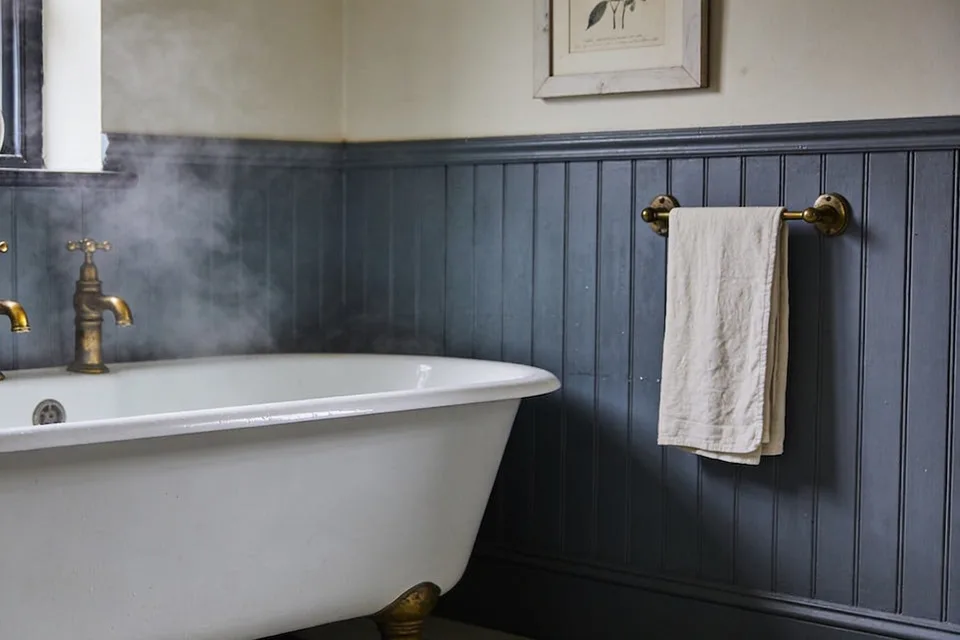
Nearly every room under this roof argues for depth — green gone black by the fire, umber upstairs, slate blue in the steam. This is the one room painted pale on purpose. The boards run to shoulder height, the same tongue and groove the working rooms already trust — the mudroom wears it in deep green, the bath in slate blue, a trade rather than a uniform — and here they are painted a chalky white with almost no color left in it, the shade of a sheet washed a hundred times. The reasons are working reasons. Whites are judged against these walls, and a room that reads stains and grades whiteness wants no color of its own arguing with the verdict; the window goes bare or nearly, because daylight is the room's second tool. The dark rooms keep their nerve by keeping one pale surface, and the house does the same thing at the scale of rooms: this is the exception, and the dark is deeper everywhere else for it. Underfoot, the mudroom's stone flags run straight through under the connecting door. The two rooms share a temperament — water in here is not an accident but the trade.
Begin with one load on air
Nothing needs building first. Take the next load out of the drum and give it to the air instead — the folding rack that is already somewhere in the house, the rail of the bath, a length of line strung for one afternoon. Fold everything straight off the line while it still smells of outdoors, and put one sheet on a bed the same evening; that smell is the whole argument, made better than any page can make it. The room can grow from there at its own pace — a jar labeled, a shelf cleared, ropes and pulleys when the ceiling is ready — because a laundry room is not so much built as agreed to, one Monday at a time.
Common questions
Do ceiling clothes airers actually work?
Yes, and the reasoning has not dated: the warmest air in any room is the yard of it under the ceiling, where nobody is standing, so wet linen hoisted into that layer dries overnight for nothing, out of the way of the work below. The old form — long pine laths slung between cast iron ends, riding up on a rope through two pulleys — earns its ropes even where a dryer already hums under a counter: for the wool a drum would felt, the linen it would age, and the quiet economy of heat nobody paid for twice. Hung against a warm wall, the back of a chimney a stove keeps mild, a wash pinned up at dusk is dry and breathing by breakfast.
Does drying laundry in the sun really whiten it?
It does. Sun is the old bleach — slow, even, free — and a white sheet given a season of bright mornings comes back whiter than any bottle leaves it. Wind matters more than sun, though: a gray morning with a good breeze outdries a still blue afternoon, and a household that hangs washing learns the sky by heart. The smell of line-dried linen has never been counterfeited either, though whole industries have tried — fold everything straight off the line while it still smells of outdoors, and put one sheet on a bed the same evening; that smell is the whole argument.
How do you wash a wool blanket by hand?
In a deep sink, in water barely warm, pressed and never wrung, then dried flat. Wool asks for patience and cool water, and a sink deep enough to drown a blanket is where patience has room to work — in this house the blankets come down from the beds one at a time each April and are folded away afterward for their summer in the wardrobe. A jug of white vinegar helps at the end of the wash, softening hard water and rinsing the last soap out of the wool.