 Cottage at Home
Disclosure: some links below are affiliate links — buy through one and we may earn a small commission, at no extra cost to you.
The English cottage mudroom: where the weather stops
The English cottage mudroom is where the weather stops — pegs, a bench, baskets with jobs, stone underfoot — and how to claim one from a back-door landing.
In this guide
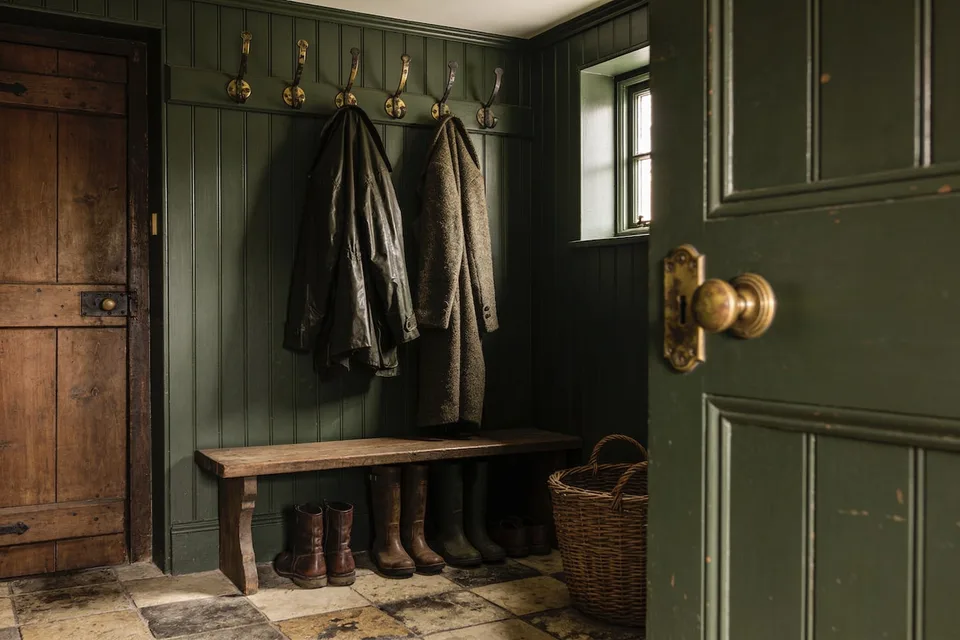
The back door bangs on the first wet evening of October, and the room takes what comes through it: two streaming coats, a dog mid-shake, boots pried off, toe to heel, and left where they fall. One door further in, the kitchen is dry and lamplit and smells of supper. Between the two stands only this — stone underfoot, pegs on the wall, a bench with a boot jack screwed to one end — and it is the whole reason the kitchen gets to be what it is. The weather stops here.
The room that takes the weather
This is the sacrificial room. It takes the mud so the hall never learns of it, dries what is wet so the wool upstairs never has to, and holds the cold at the threshold while the door stands open. In the old cottages the front door was ceremonial. It answered for weddings, the doctor, the vicar's visit, and stayed shut for whole seasons while the household lived through the back — through a low, plain room that went by boot room, or scullery passage, or no name at all, and dealt with everything the outside sent in. The names varied; the job never did. Most houses now have no back door doing any of it, which leaves the front entryway to take the same weather while still looking like the front of the house. The English cottage kitchen reads as kept — tended daily, accumulated slowly, worn kind — partly because it was never asked to cope with the weather; that bill is settled one room earlier. So with the dark living room, where cream wool and a pale stone hearth survive ordinary life because ordinary life wipes its feet first. Every kept room in the house is quietly in this one's debt.
Six feet of wall is enough
Most houses on this continent were never given one. There is a back-door landing, a strip of hallway inside the garage door, a porch that catches whatever the family sheds — and the habit is to treat these as shortfalls of square footage, rooms that failed to happen. They are better understood as mudrooms not yet claimed. The cottage pantry makes the same case from the kitchen side — that a working room is made by its keeping, not its dimensions — and the back door asks even less: six feet of wall, a bench, and a household agreement that outdoor things stop at the line. Nothing about the architecture changes. The landing becomes a room the day it is given the room's job.
Pegs, not hooks behind a door
Deeper in the house, the instinct is to hide coats — a closet, a hook on the back of a door — and the mudroom overrules it for one plain reason: a coat put away wet stays wet. Wet wool and waxed cotton want air on both sides and somewhere to drip that can bear it, which is exactly what a row of pegs over a stone floor provides. Run the rail long and mount it high, so the longest coat clears the bench. Leave a forearm's width between pegs, because coats touching are coats not drying, and let every member of the household own one peg, with a spare for whoever the weather blows in. A lower rail for children pays for itself within a month: a coat at shoulder height gets hung; one above reach gets dropped.
Pegs beat hooks because a peg carries whatever the season hands it — coat, dog lead, garden hat, the bag for town — and because a full rail can be read from the kitchen doorway like a shelf: who is home, what is drying, what has been forgotten. The coats themselves are the room's true furnishing. The wax jacket gone matte across the shoulders, re-waxed some Octobers and not others; the wool that has dried out a hundred times and come back every time. A peg here is not storage. It is where a coat goes to recover.
A bench, and a floor that fears nothing
Boots come off sitting down, or they come off badly — one-legged, hopping, a wet sock on cold stone for the trouble. So the bench is the one piece of furniture the room insists on: plank-built, painted or waxed, sturdy enough to stand on and plain enough that nobody minds what the boots do to it. Beneath it the boots wait in their rows, and the boot jack earns its screws from September on.
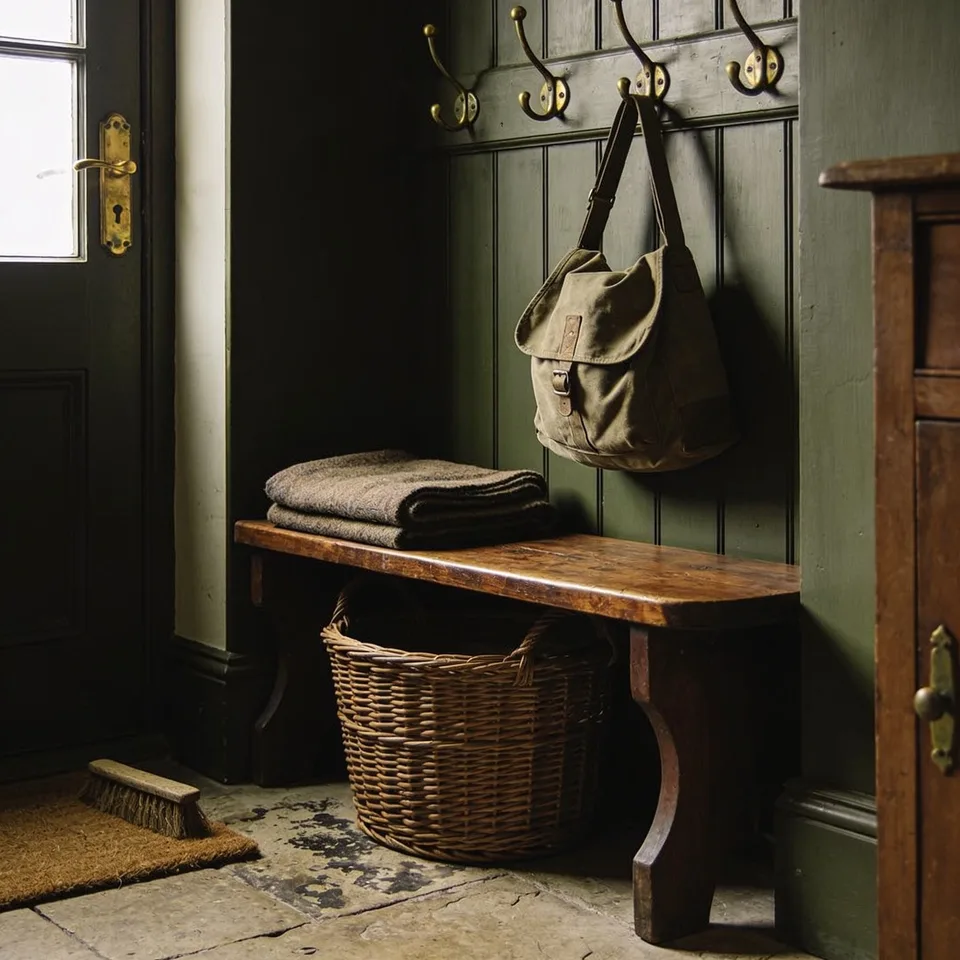
Underfoot, the old rooms kept stone — flags, brick, quarry tile — because stone holds no grudge against water. It darkens when wet, dries pale again, and wears a century of boots as polish rather than damage. The translation is easy, because the law is about temperament, not material: slate-toned porcelain, brick pavers, a painted concrete step all qualify, and anything precious does not. A floor that needs protecting from the room's own work will stop the room from working. The case for depth that runs through the darker house begins here as plain practicality — a dark floor forgives between sweepings what a pale one reports within the hour. A coir mat at the sill does the first rough work; a second inside the kitchen door does the last. And if a stretch of wall escapes the pegs, one small print above the bench is ornament enough for a working room — the free cottage printables include a botanical that would not mind hanging over boots.
Baskets with jobs
What cannot hang must land, and the difference between a mudroom and a mess is that every landing place has a name. One basket for mittens and hats, kept low where children can reach it honestly. One for the garden — gloves, twine, the pruners that are never allowed further into the house. One for the dog, with the old towel that means wet dog folded on top. One by the door for whatever is leaving: library books, letters, the neighbor's dish going home. A basket with a job stays a tool; a basket without one becomes a drawer that gave up, filling with everything and answering for nothing.
The baskets also carry the year in and out, because this room turns with the seasons harder than any other in the house. The mitten basket takes its place in the first wet week of September and gives way to sun hats by June, and most of what an amber autumn asks of a household arrives through this door first — mud, wet leaves, early dark. Autumn is the mudroom's season. The rest of the year is practice.
Watch one wet homecoming
Nothing needs buying yet. The next rainy evening, stand in the kitchen doorway and watch somebody come in: where they stop, what gets put down first, which way the coat travels, where the boots end up against all instruction. That path is the room asking for what it needs — a peg where the coat already tries to land, the bench where the boots already gather, a basket under whatever surface the keys keep finding. A mudroom is designed by being walked through, and the household has been drafting this one for years without knowing it. The first peg goes where the wall has been waiting.
Common questions
What do you actually need for a mudroom?
Less than the pictures suggest: six feet of wall, a bench, and a household agreement that outdoor things stop at the line. A back-door landing or a strip of hallway inside the garage door is not a room that failed to happen — it is a mudroom not yet claimed, and the landing becomes a room the day it is given the room's job. The furnishing list is short and plain: a long peg rail mounted high, a plank-built bench sturdy enough to stand on, a floor that fears nothing, a coir mat at the sill, and a few baskets that each have a job — one for mittens and hats, one for the garden, one for the dog, one by the door for whatever is leaving.
How far apart should coat pegs be?
A forearm's width, because coats touching are coats not drying. Wet wool and waxed cotton want air on both sides and somewhere to drip that can bear it, which is exactly what a row of pegs over a stone floor provides — and why the mudroom overrules the closet, since a coat put away wet stays wet. Run the rail long and mount it high, so the longest coat clears the bench, and let every member of the household own one peg, with a spare for whoever the weather blows in. A lower rail for children pays for itself within a month: a coat at shoulder height gets hung; one above reach gets dropped.
What kind of flooring is best for a mudroom?
Something that holds no grudge against water. The old rooms kept stone — flags, brick, quarry tile — because stone darkens when wet, dries pale again, and wears a century of boots as polish rather than damage. The law is about temperament, not material, so the translation is easy: slate-toned porcelain, brick pavers, or a painted concrete step all qualify, and anything precious does not. A floor that needs protecting from the room's own work will stop the room from working. Darker is more forgiving too — a dark floor forgives between sweepings what a pale one reports within the hour — and a coir mat at the sill does the first rough work.