 Cottage at Home
Disclosure: some links below are affiliate links — buy through one and we may earn a small commission, at no extra cost to you.
Cottage fall porch decor: the season's first room
Cottage fall porch decor for the season's first room — wool over the chair, a true flame in the lantern, and a door that reads warm from the road at dusk.
In this guide
The house is still keeping summer's hours — windows open at night, the quilts not yet down from the cupboard — but the porch gave up pretending a week ago. By four the boards are cool underfoot. A first leaf has wedged itself under the door, the evening air between the posts carries someone else's woodsmoke, and the light gives out sooner than it did on Friday. Autumn does not knock and wait to be let in; it moves onto the porch and keeps house there for a month before the rooms inside will admit anything has changed.
The season's first room
So it helps to stop treating the porch as the outside of the house and start treating it as the first room — the one furnished with weather. Every turn the house will make by late October, the whole amber shift indoors of wool brought out and lamps lit earlier, the porch makes first, in September, in public. Its furnishing law follows from that. A porch holds perhaps six things, every one of them legible from the road, so it forgives fakery less than any room in the house; nothing goes out there that cannot stand the damp, and nothing that is not either used or true.
Wool over the chair arm, because wool means it
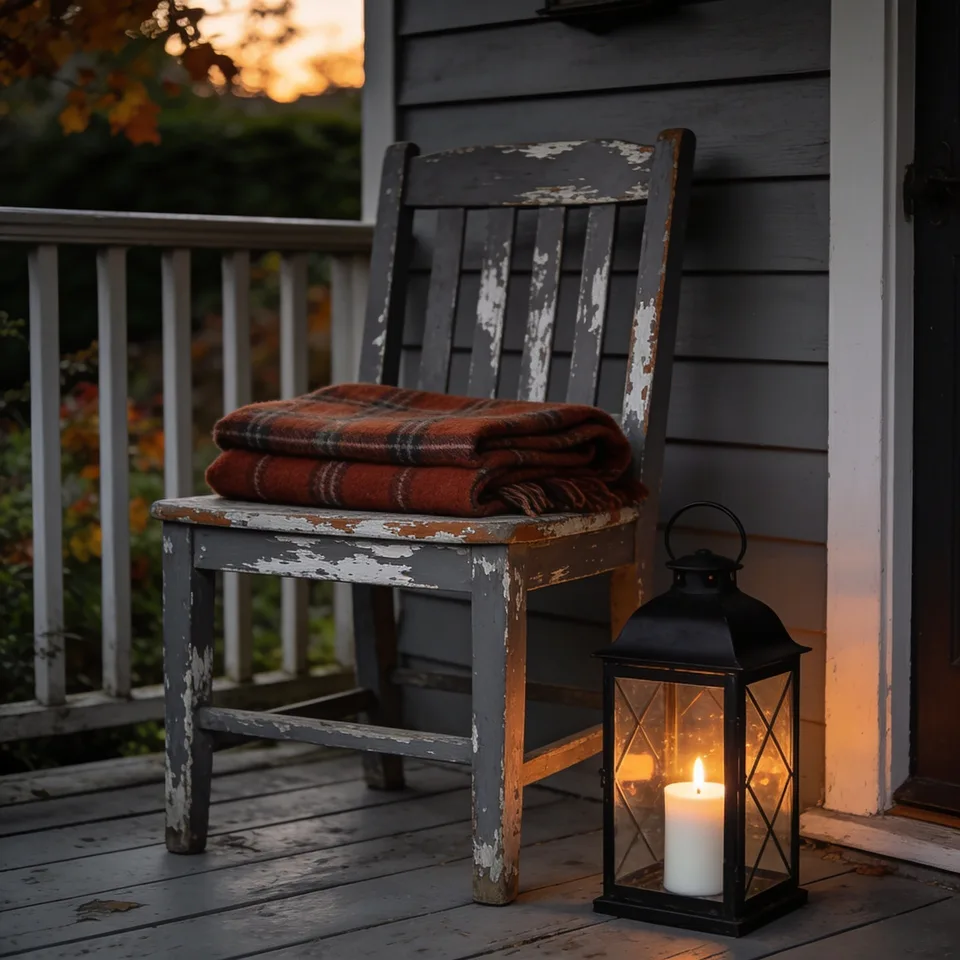
The chair can be almost anything wooden that has already stood some winters — paint gone chalky is not a flaw on a porch, it is a reference. What matters is the blanket folded over its arm, and that the blanket be wool. Wool keeps its warmth after the air turns damp, sheds a light mist rather than drinking it, and its dark plaids — rust, moss, umber — were the season's palette long before the seasonal aisle existed; fleece goes clammy at the first dew and reads thin from ten feet. A wool blanket at the door says someone sits out here in October, with tea, on purpose, and the real thing costs less secondhand than its imitation costs new — the thrift shelf carries the whole fall layer, blankets included. It comes in on nights of true rain — less a chore than one more small observance of the season. The same rule keeps a blanket alive in a screened Muskoka room, where it lives out over the water all day and is carried in with the glasses at night.
A lantern with a real flame in it
The porch at dusk asks for one light, and the honest version is a candle behind glass. A true flame moves — it breathes with the draft under the lantern door, doubles itself in the panes, and lays a live amber across the boards that no bulb has managed yet; the looping flicker of a battery candle is a photograph of that, and reads as one from the front walk. A lantern earns its keep here better than anywhere indoors: metal gone dark, a pane of slightly wavered glass, a plain white candle burned down past its first inch. It is lit when the light gives out, snuffed when the door is locked, and minded, the way porch candles always were. Where wind owns the porch outright, the answer is more glass, not less flame — a hurricane shade, or the lantern moved into the lee of the door.
The broom and the boot tray, in plain sight
Some of the best things on a fall porch were never decor at all. A corn broom on a nail by the door earns its place every morning the maple sheds; a boot tray of zinc or cast iron, holding actual boots with the mud still on them, says more about the season than anything bought to say it. There is no need to hide the working things. The porch is the outdoor cousin of the working threshold just inside, and it goes wrong the same way, styled past its work until it reads as a stage set. Sweep with the broom, use the tray, and let both be seen — kept tools are the decoration, and there is no deeper trick.
Cut from the walk, grown in a field
The garland aisle sells autumn by the foot, wired into a loop of leaves no tree dropped. The walk home carries better for free: branches just past their turn, dock gone to rust, the last hydrangeas dried on their stems, a few stalks of grass gone bronze — cut long and dropped in a galvanized bucket or a stoneware crock beside the door. They hold the season the way it actually looks past the gate, and when they tire, the next walk replaces them. A bought garland is finished the moment it is hung; a bucket of cut branches is different every week, which is the whole argument.
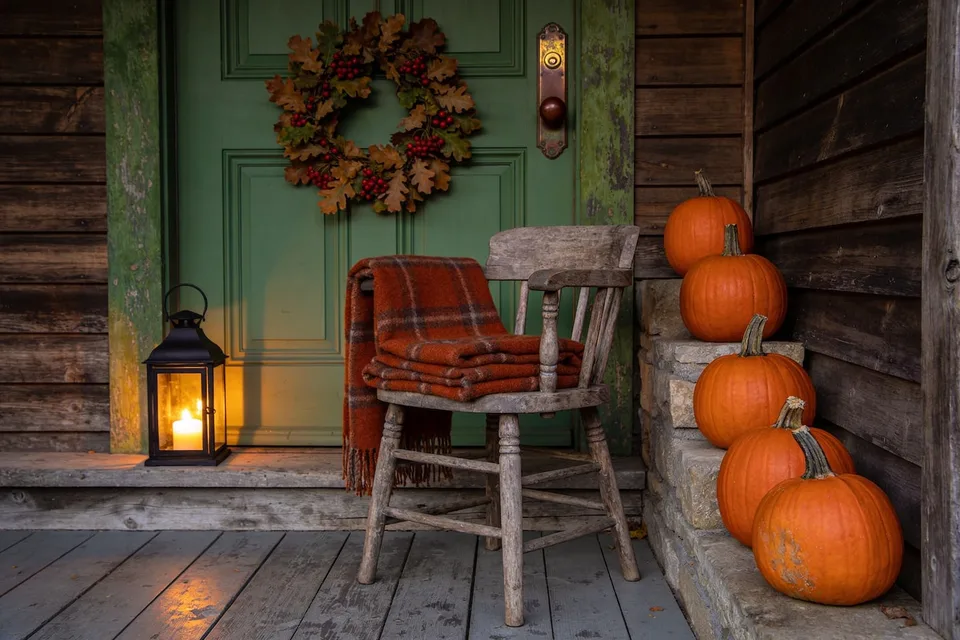
The pumpkins on the step belong to the same law: they should weigh something. A real pumpkin declares itself before it is touched — ribs uneven, stem curved and corky where it dried on the vine, skin carrying a faint bloom of field dust — where resin manages none of this and stays its one orange until March. Real ones ripen and slump with the season instead of ignoring it, and when a hard frost finally takes them they go to the compost having done a full season's work. Choose them unmatched, two or three sizes with one gone gray-green or ghost-white among the orange, and stagger them down the steps rather than flanking the door like sentries. A field never grew a matched pair, and the porch should agree with the field.
The door itself
The door is the porch's hearth — the still point everything else stands in relation to. Brass gone brown where hands have found it for forty years should stay brown; that patina is the record of every arrival the house has had, and low light loves it as it loves nothing polished. Paint gone soft at the edges — chalky on the panels, worn to wood at the latch side — has arrived where new doors are painted three coats trying to go. What the door asks for in fall is a wreath, and the honest one comes off the same walk as the branches: a wire ring, cuttings of oak and rosehip, whatever seed heads survived the bucket, jute to bind it, no bow. It will be a little asymmetric. So was the tree it came from.
Seen from the road, at dusk
Every porch has its hour of judgment, and it falls at dusk, from the road. Walk out to the gate or the far sidewalk and turn around: what carries at that distance is not detail but warmth — the one lit lantern, the dark shape of the chair under its blanket, pale pumpkins staggered down the steps, the wreath a circle of shadow on the door. A porch that says autumn from the road makes a promise about the rooms behind it, and the house should keep it; the room the door opens into is where the same season waits in wool and lamplight.
So begin at the end. Tonight, set one plain candle in one lantern by the door and light it before the evening walk; at the road, stop and look back. If the flame carries, the season has its first room — and the blanket, the bucket, and the pumpkins can arrive the way autumn itself does, a little at a time, across the threshold first.
Common questions
What should you put on a porch for fall?
Only a few things, and every one of them honest. A porch holds perhaps six things, all of them legible from the road, so it forgives fakery less than any room in the house — nothing goes out that cannot stand the damp, and nothing that is not either used or true. In practice that means a wooden chair with a wool blanket folded over its arm, a candle lantern lit when the light gives out, a corn broom and a boot tray in plain sight, a bucket of cut branches by the door, and real pumpkins staggered down the steps. The working things count as decoration here — kept tools, a flame that is actually lit — and they say more about the season than anything bought to say it.
What kind of blanket can you leave outside on a porch?
Wool, and it should be the real thing. Wool keeps its warmth after the air turns damp and sheds a light mist rather than drinking it, where fleece goes clammy at the first dew and reads thin from ten feet. The dark plaids — rust, moss, umber — were the season's palette long before the seasonal aisle existed, and a real wool blanket usually costs less secondhand than its imitation costs new. It does come in on nights of true rain, though that feels less like a chore than one more small observance of the season. Folded over the arm of a chair that has already stood some winters, it says someone sits out here in October, with tea, on purpose.
Are real pumpkins better than fake ones for the porch?
Real ones, and the difference reads from the road. A real pumpkin declares itself before it is touched — ribs uneven, stem curved and corky where it dried on the vine, a faint bloom of field dust on the skin — where resin manages none of this and stays its one orange until March. Real pumpkins ripen and slump with the season instead of ignoring it, and when a hard frost finally takes them they go to the compost having done a full season's work. Choose them unmatched, two or three sizes with one gray-green or ghost-white among the orange, and stagger them down the steps rather than flanking the door like sentries — a field never grew a matched pair, and the porch should agree with the field.