 Cottage at Home
Disclosure: some links below are affiliate links — buy through one and we may earn a small commission, at no extra cost to you.
Muskoka room: furnishing the screened room nobody furnishes
A Muskoka room earns its keep once it is furnished for damp, pollen and a short season: what survives out there, where a lamp goes, and the room's own calendar.
In this guide
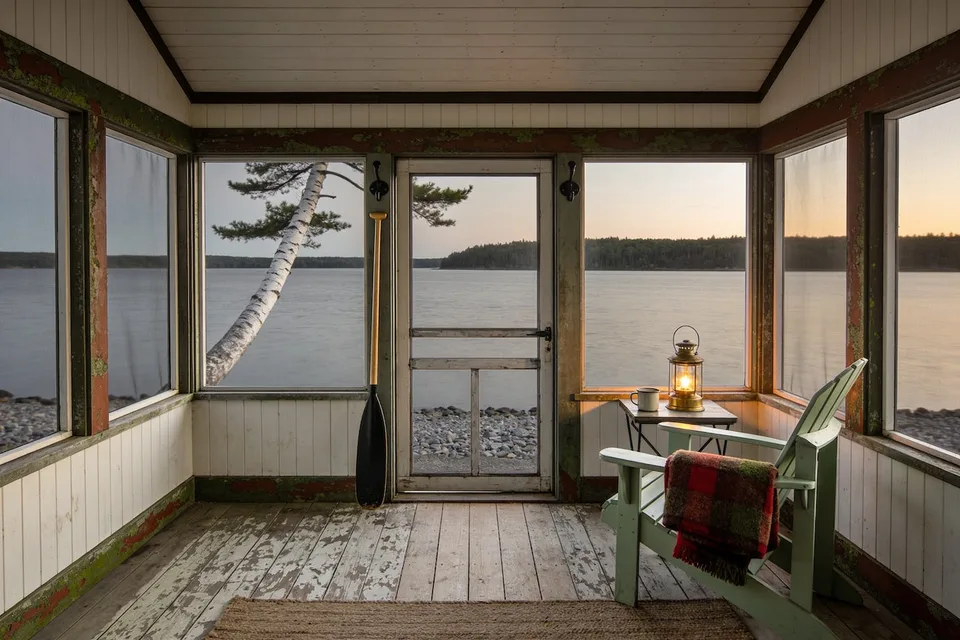
Every spring somebody puts the screens back on, carries out four chairs that wintered in the boathouse, and stops there. The room gets used all summer in exactly that state, because everything written about a Muskoka room is about building one, and nobody writes the part that comes after the trades leave.
What a Muskoka room is, and why it never gets decorated
A Muskoka room is a screened three-season room built onto a cottage, open to the air on two or three sides and roofed like the house. It is not a porch and not a sunroom: there is no glass, the weather comes through it, and it is shut and emptied for half the year. That last fact is the whole reason it stays bare.
Furnishing it feels wasteful, because most of what a room normally holds would be ruined by October. So the room gets the leftovers: the sofa that was replaced indoors, a plastic side table, a rug someone was throwing out. All of it is chosen to be sacrificed, and a room full of things nobody minds losing is a room nobody quite settles in.
The way out is not a bigger budget. It is choosing for the conditions instead of against them, which is the same argument as the mudroom makes indoors: a room that gets wet and dirty on purpose wants things that are happy wet and dirty, not things that are merely cheap.
What survives damp, pollen and a mouse
Three things decide whether a piece belongs out there: whether damp air will swell or spot it, whether yellow pine pollen will wash off it in June, and whether a mouse can nest in it over the winter. Painted wood, powder-coated metal, cane, rush and flat-weave wool all pass. Upholstery, particleboard, untreated cotton batting and anything with a hollow cushion do not.
Painted wood is the quiet workhorse. A wooden chair or a small painted table takes the damp, takes the pollen, and takes a scrub with a wet cloth in June without complaint, and when the paint finally goes it is a Saturday to put it right. Anything with a board core swells at the edges by the second August and never goes back.
For the floor, a flat-weave wool or a woven vinyl runner can be carried out and hosed on the grass, which is what actually happens to a cottage rug. Deep pile holds the damp against the boards underneath and grows a smell by August. A flat weave wool rug is one of the few things worth buying properly for this room, because it is the piece that gets abused most and shows it least.
Wool blankets live out there all day and come in at night, which is the rule that keeps them. Left folded on a chair through a damp week they go musty; carried in with the glasses they last decades. Keep them in one basket by the door so that bringing them in is one trip and not a decision.
Where a lamp goes in a room with no walls
There is nowhere obvious to put a lamp in a Muskoka room, because the walls are screens and the outlets, if there are any, sit on the single solid wall shared with the house. So the light gets solved at the two ends: something plugged in against the house wall, and something battery or candle out at the open end where the wiring never reached.
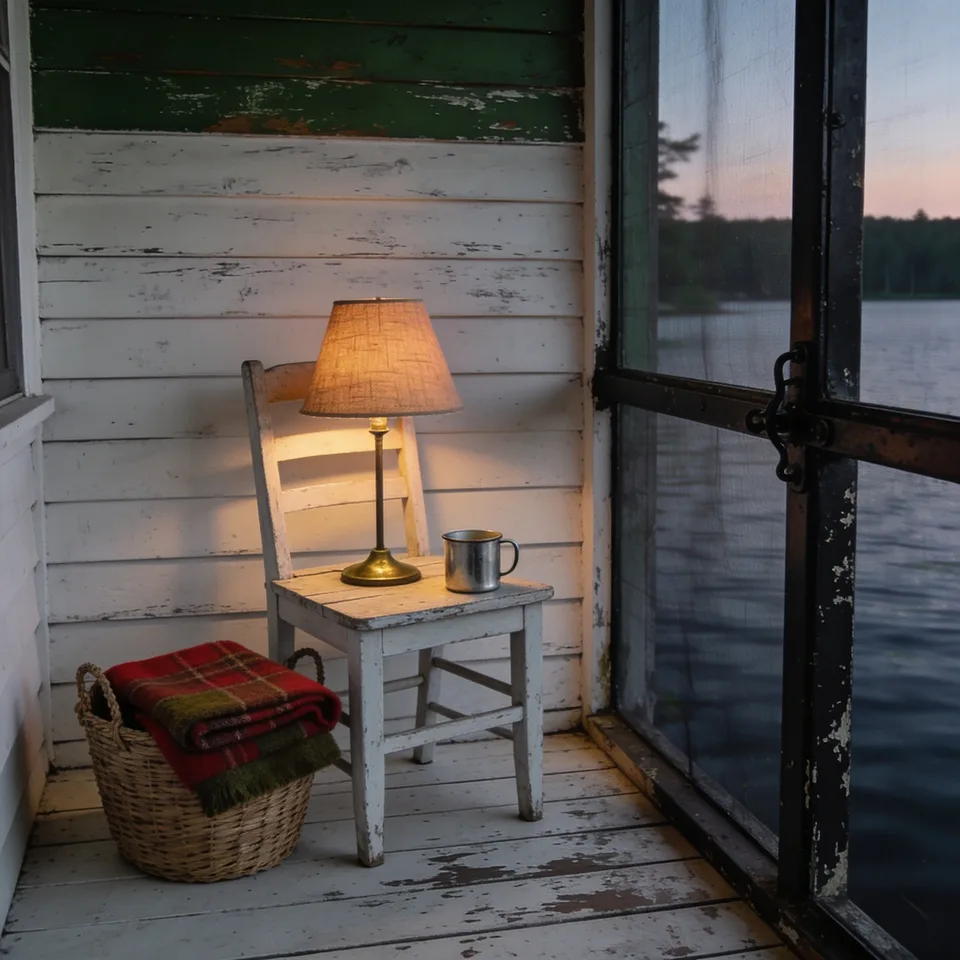
A table lamp against the house wall does more than any overhead fixture. Screened rooms are usually lit from a ceiling fixture that throws a flat white light and fills with moths by nine, and a low warm lamp at chair height makes the room usable for the hour after sunset that everybody actually wants. Wool and painted wood both hold that kind of light well.
At the open end, a pair of hurricane lanterns on the floor or a low table settles it, and glass takes the damp better than anything with a shade. Keep any flame well away from the screen itself, and away from the dried things people like to hang out there.
The one chair turned to the water
Turn one chair away from the group and toward the water, and leave it that way. It is the smallest arrangement decision in the room and the one that gets used most, because a screened room's real job is sitting alone in it early, and a circle of four chairs all facing each other says the room is only for company.
The rest can stay loose. Chairs that do not match are the honest look of a cottage room, and a room assembled over thirty years out of what the house had will always read better than four of anything bought together. This is the same principle as decorating with vintage finds indoors, and it is easier out here, where nothing has to be precious.
Give the single chair a small table it can reach without getting up, and a hook or a basket for the blanket. That is the whole of it. The view is the decoration, and anything hung on a screen is a thing between you and it.
The room's own calendar
The Muskoka room runs on three dates rather than four seasons: the May long weekend when the screens go on, the first cold night in August, and the Thanksgiving close. Furnishing for those three moments is more useful than furnishing for a summer, because the room is a different room at each of them.
The May opening is a wash rather than a decoration. Pollen comes down through June and there is little point arranging anything before it stops, so the sensible order is screens, sweep, hose the rug, and then carry things out over a couple of weekends as the room is actually used.
The first cold night in August is what the blankets are for, and it is the night people discover the room has no lamp. It arrives earlier than anyone expects, usually while the days are still hot, and a room that can answer it with a wool layer and a warm light gets used well into September instead of being given up on.
The Thanksgiving close is a carrying-in, and it is worth doing in one pass with a list: blankets, cushions, lanterns, rug, anything with a fabric on it. The blanket that passed the summer on the arm of the chair out there comes home to the city sofa, which is the small pleasure at the end of the season and the reason to have bought a good one.
What to buy first, honestly
Starting from nothing, buy in this order: a rug that can be hosed, one wool blanket per chair that lives out there, a lamp for the house wall, and a basket by the door. Everything else can wait for what the house already owns, and most cottages own more than they think.
Chairs come last, not first, which is the opposite of how most people do it. Four chairs bought in one afternoon cost more than the rest of the list together and are the single thing most likely to be wrong, because the right chair for a screened room is the one you find out you want after a summer of sitting in the wrong ones.
Common questions
What is a Muskoka room?
A Muskoka room is a screened three-season room built onto a cottage, open to the air on two or three sides and roofed like the house. It is not a porch and not a sunroom: there is no glass, the weather comes through it, and it is shut and emptied for half the year. That last fact is the whole reason it stays bare, because furnishing it feels wasteful when most of what a room normally holds would be ruined by October.
What furniture survives in a screened Muskoka room?
Three things decide whether a piece belongs out there: whether damp air will swell or spot it, whether yellow pine pollen will wash off it in June, and whether a mouse can nest in it over the winter. Painted wood, powder-coated metal, cane, rush and flat-weave wool all pass. Upholstery, particleboard, untreated cotton batting and anything with a hollow cushion do not. Anything with a board core swells at the edges by the second August and never goes back.
How do you light a Muskoka room with no walls?
The light gets solved at the two ends: something plugged in against the house wall, and something battery or candle out at the open end where the wiring never reached. A table lamp against the house wall does more than any overhead fixture, because screened rooms are usually lit from a ceiling fixture that throws a flat white light and fills with moths by nine. A low warm lamp at chair height makes the room usable for the hour after sunset that everybody actually wants.