 Cottage at Home
Disclosure: some links below are affiliate links — buy through one and we may earn a small commission, at no extra cost to you.
Vintage fall decor: autumn from the thrift shelf
Vintage fall decor from the thrift shelf: amber glass, stoneware crocks, worn plaid and old brass that already carry the season, gathered a dollar at a time.
In this guide
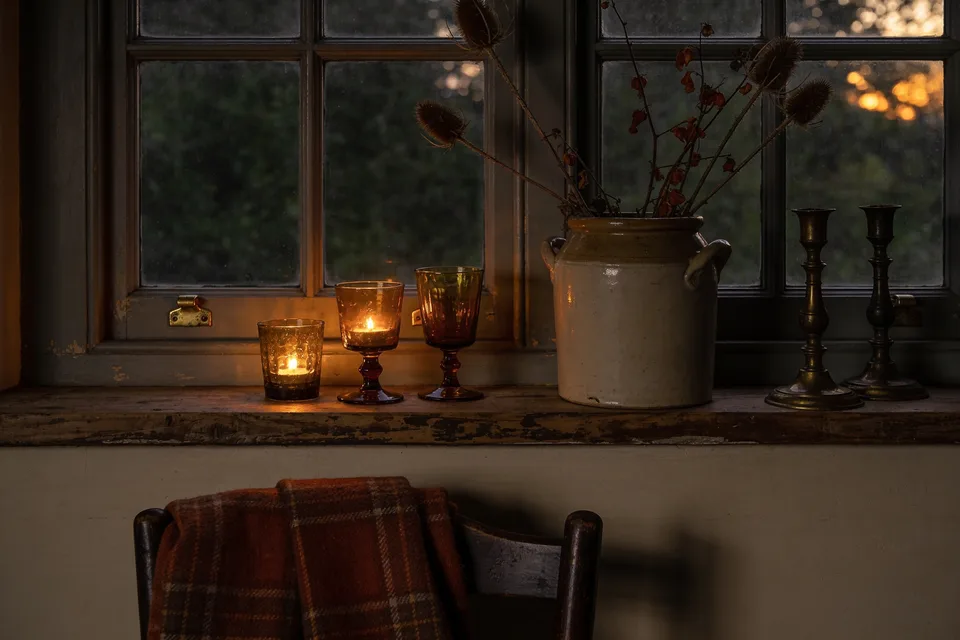
By five o'clock the sun is low enough to cross the windowsill, and the sill is ready for it: three amber tumblers, none matching, going ember-colored as the light moves through; a stoneware crock holding cut branches just past their turn; a plaid blanket folded over the chair below, soft the way only decades of washing can make wool. Nothing on that sill was made in this century. All of it together cost less than a supermarket candle.
Autumn is already on the thrift shelf
Every August the seasonal aisle builds its version of vintage fall decor out of new things pretending otherwise: lanterns pre-rusted at the factory, plaid printed on fleece, resin pumpkins in an orange no field ever grew. A few streets away, the thrift shop's ordinary shelves hold the real season and call it nothing at all. Amber and cinnamon glass. Stoneware the color of bread crust. Wool in the dark plaids. Brass gone brown at its edges. None of it has autumn stamped on it; all of it has autumn in it, in the material, the color, and the wear, which is why it looks right on an October sill and still looks right in January.
Old things run deeper than the seasonal aisle's palette. Nearly every color above has brown in its base, the same low register the whole house turns toward as the light drops, so they hold lamplight instead of shouting under it. And they are priced as if they belonged to no season, because the thrift shelf does not keep the calendar: an amber compote is a dollar in April because nobody asked April for one. So walk the housewares aisle by color and material rather than category, scanning for amber, umber, rust, and brown, and pick up whatever glows.
Amber glass, where the low sun crosses
Start with the glass, because it is the cheapest thing on the shelf and the one the season repays most. Pressed tumblers, footed compotes, small dishes made for jam and long since separated from their occasions. The amber and honey-brown glass of another era's cupboards turns up constantly, rarely more than a dollar or two. Its work is a windowsill. Amber glass does almost nothing at noon and nearly everything at five; stood where the low sun crosses, each piece lights from inside like a banked coal.
Three mismatched pieces and a gap do more than a collection: glass crowds quickly, and one deep brown bottle among the ambers keeps the row from going sweet. Run a thumb around every rim before a piece goes in the basket: a chip on glass is not the honest wear it is on old enamel, only an edge waiting to catch.
Crocks and flower frogs, for what the walk brings home
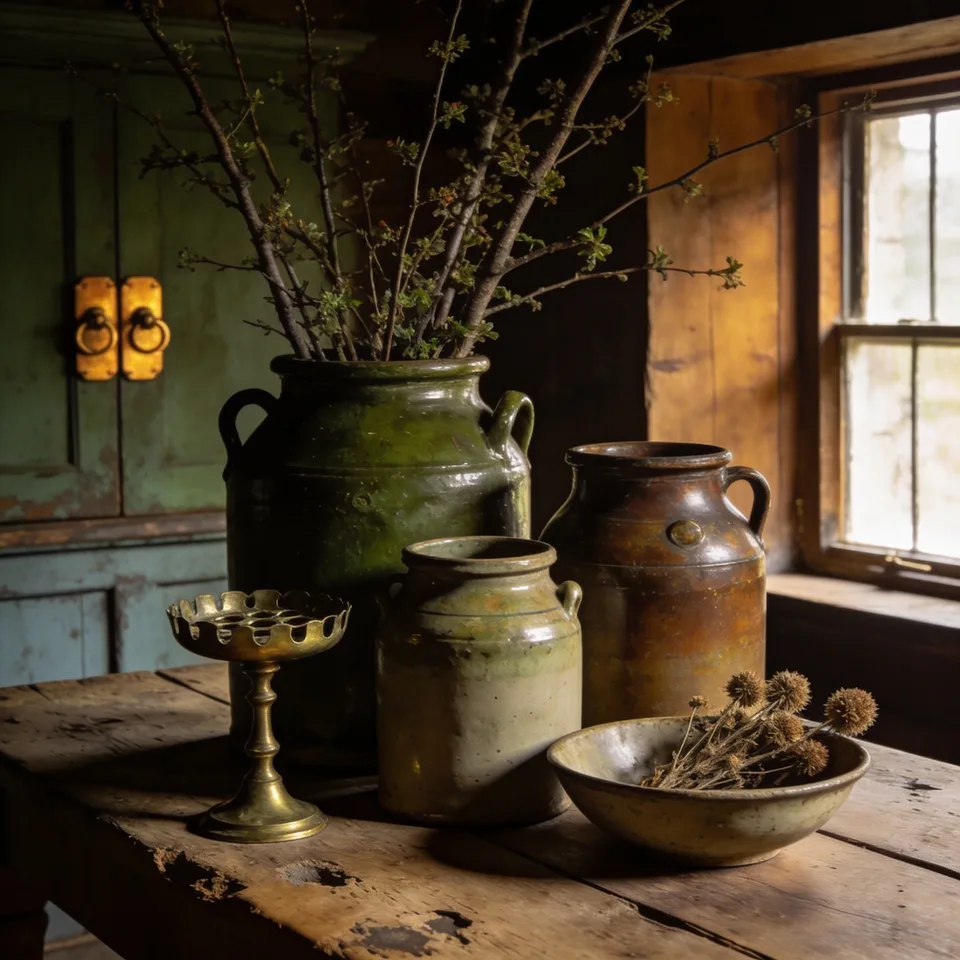
The crock is the season's vase, and the best of them were never vases at all: salt-glazed, thick-walled, made for pickles and lard and a century of standing on floors. Choose one by ear as much as by eye: tap the shoulder with a knuckle, and sound stoneware answers with a faint ring where a hidden crack gives a dead knock. The crack matters, because this crock's autumn work is holding water under branches. The staining does not matter at all. One tall crock by the door or the hearthstone takes the branches; a shorter one takes whatever the walk brings home through October.
The flower frog is the crock's small companion, and the shelves are full of them once the eye knows to look: heavy glass domes drilled with holes, hedgehogs of brass pins, made when every house arranged what the garden gave, and sold now for less than a greeting card. A frog turns any shallow bowl into a vessel for the stems a crock would swallow: five seed heads, three oak sprigs, one branch of bittersweet held at the angle it will keep. It is the difference between dried stems arranged and dried stems leaned.
Pyrex and tin, the kitchen's harvest shelf
The kitchen's autumn objects were made for it on purpose. The mixing bowls of the 1970s came printed with the season, wheat heads, leaves, and orchard fruit, in harvest gold and brown on milk-white glass, and they surface in thrift stores by the stack, often priced below one new bowl. They are not for display: opal glass that has baked fifty years of Sundays will manage this year's, and a stack on the open shelf warms the room precisely because it goes to work. The old tins do the standing still. Tea caddies and biscuit tins in orchard and wheat-sheaf prints hold the tea, the string, the spare candles, their soft-cornered printing doing more for a shelf than anything made this year. The kitchen's whole vintage layer, the enamel and the boards and the cloth, is its own subject, worth knowing before estate-sale season begins.
Plaid gone soft, and brass gone dark
The wool blanket is the one to be patient for. New plaid is stiff and apologetic; a blanket washed across forty years has gone soft clean through, and its colors (rust, moss, umber, the good dark checks) have faded exactly into the register the season wants. Judge it by weight in the hand, then hold it up to a window: a pinhole or two of light is an evening's darning and an honest price, a constellation of them is a bargain to walk past. Home, it goes where wool goes in October: over the arm of the chair that faces the fire, looking claimed, within reach.
Old brass candlesticks stand on every shelf, almost always alone, their partners lost a house or two back. Buy the singles and let them mismatch; three unmatched candlesticks on a mantel read as accumulated, which is the entire point. And leave the polish in the drawer. The brown in the brass is every November it has already stood through, and lamplight loves it; polished bright, a candlestick starts over at zero.
The same shelf usually carries a stack of frames, solid oak, gilt gone quiet, priced at nearly nothing because the prints inside them died of sunlight years ago. Take the frame and retire the print; the free set of prints is drawn in the same amber register, and a fresh sheet in an old frame puts autumn on the wall for less than the candlestick cost. And when the frames outnumber the free sheets, the harvest set in our own Etsy shop carries on where they leave off: six studies, the wheat sheaf, the quince preserves, the cottage loaf, drawn to keep the same company as the crocks and the amber glass.
Begin with one amber thing
Start at the window. On the next gray Saturday, give the nearest thrift shop ten unhurried minutes and come home with one amber tumbler, rim checked with a thumb, to stand on the sill the five o'clock sun crosses. If it lights, the season has its first object, and the crock, the blanket, and the candlesticks can follow the way old things prefer to arrive: one at a time.
Common questions
How do you decorate for fall with thrift store finds?
Walk the housewares aisle by color and material rather than category, scanning for amber, umber, rust, and brown, and pick up whatever glows. The thrift shop's ordinary shelves hold the real season and call it nothing at all: amber and cinnamon glass, stoneware the color of bread crust, wool in the dark plaids, brass gone brown at its edges. None of it has autumn stamped on it and all of it has autumn in it, in the material, the color, and the wear, which is why it looks right on an October sill and still looks right in January. It is also priced as if it belonged to no season, because the thrift shelf does not keep the calendar; an amber compote is a dollar in April because nobody asked April for one.
What should you look for when buying a vintage wool blanket?
Judge it by weight in the hand, then hold it up to a window: a pinhole or two of light is an evening's darning and an honest price, where a constellation of them is a bargain to walk past. The wool blanket is the one to be patient for. New plaid is stiff and apologetic, but a blanket washed across forty years has gone soft clean through, and its colors, rust, moss, umber, the good dark checks, have faded exactly into the register the season wants. Home, it goes where wool goes in October: over the arm of the chair that faces the fire, looking claimed, within reach.
Should you polish vintage brass candlesticks?
No, leave the polish in the drawer. The brown in the brass is every November it has already stood through, and lamplight loves it; polished bright, a candlestick starts over at zero. The candlesticks stand on every thrift shelf, almost always alone, their partners lost a house or two back, so buy the singles and let them mismatch — three unmatched candlesticks on a mantel read as accumulated, which is the entire point.