 Cottage at Home
Disclosure: some links below are affiliate links — buy through one and we may earn a small commission, at no extra cost to you.
Vintage cottage kitchen decor: things that have already lived
Vintage cottage kitchen decor begins with things that have already lived — chipped enamel, handed-down boards, worn linens — found honestly and used well.
In this guide
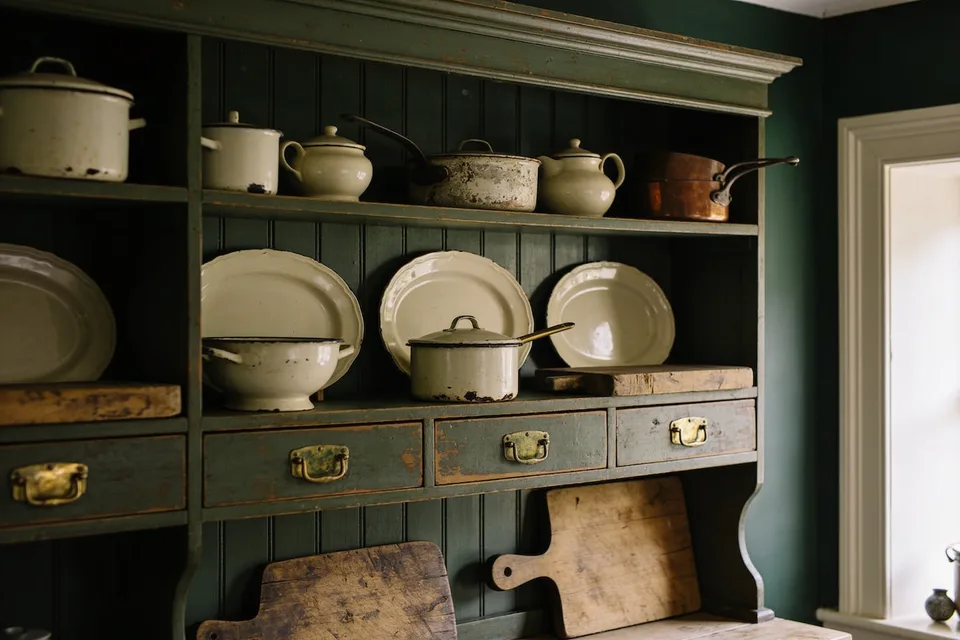
The kettle has just gone quiet, and the shelf beside the window is doing what it does every morning: holding a white enamel pitcher with a chip on its lip, a stack of plates in three patterns, a cutting board gone amber and dished in the middle by years of somebody else's bread. Nothing up there was bought to match. Nothing matches. The wall holds together anyway, the way a family photograph does.
That is the whole subject, really. A vintage cottage kitchen is not a look that arrives in boxes; it is a slow gathering of things that were used before they reached you — enamel that has boiled water on other stoves, spoons seasoned by other hands, cloth that has seen some winters. Everything in this guide follows from one distinction: the difference between an object with a past and an object manufactured to look like it has one.
Old, and made to look old, are different things
Real wear happens where the hands went. A wooden spoon polishes at exactly the spot a grip lands. A board dishes in the center, because that is where the knife spent its years. Enamel chips at the lip and the shoulder, because that is where a pitcher meets the world. Age applied at a factory lands where it will be seen instead — edges sanded with suspicious evenness, a gray wash sprayed across the whole surface at once, dents in decorative places. The eye reads the difference before the mind can name it. One object is a record; the other is a costume.
Most of what is sold as cozy cottage kitchen decor is the costume: new pieces distressed on purpose, a made-up history stamped on at the factory. None of this is a moral failure — a new towel is a new towel, and every good kitchen holds honest new things. The trouble is only in the pretending. A kitchen furnished with manufactured age reads staged the way a film set does: correct in every detail and empty in the middle. A kitchen with even three genuinely old things in it reads like someone lives there, because someone did — several someones, across more years than any one of them saw.
So the method of this whole guide is short: buy old things where old things are sold, let new things be plainly new, and never pay for a past that didn't happen.
Where old kitchen things actually come from
The quiet good news is that the real thing usually costs less than the imitation. It is simply sold in less convenient places, on its own schedule.
- Estate sales. The best source for working kitchenware, because everything in the house was actually used. Walk past the display cabinet and find the kitchen: the boards, the enamel, and the utensil drawer are often priced lowest of anything on offer, and they are the most honestly worn things in the building. Go early for the good boards, or on the last day, when the prices soften.
- Church sales, rummage sales, and their kin. Linens surface here more than anywhere else — embroidered tea towels, heavy tablecloths, plain woven toweling — often washed, pressed, and priced at nearly nothing by people who knew their owners. The crockery table rewards patience and a second look.
- The backs of family cupboards. The single best source, and the only one where things arrive with their stories attached. Ask a parent, an aunt, whoever ran the family's kitchens longest, what they still have and never use. Most families are quietly storing a kitchen's worth of handed-down things, waiting without knowing it for someone to want them.
- The ordinary thrift store, visited often. Not once — often. The plain shop on a weekday is where a real enamel roaster sits misfiled between new nonstick, and where stoneware turns up a piece at a time. The first visit finds nothing; the tenth finds the mixing bowl. This kind of gathering runs on rhythm, not luck.
Enamelware, and what a chip really means
What a chip means in practice depends on where it sits.
- Chips on the outside are character and nothing more. A pitcher chipped at the shoulder will pour for another fifty years, and the dark spot in the white is part of why the shelf looks kept rather than bought.
- A chip inside a cooking surface retires the piece from the stove. Bare steel and rust have no business against food, and acidic things — tomatoes, fruit, anything with vinegar — only hurry the trouble along. The pot isn't finished; it has changed jobs. Enamel chipped on the inside does its best work holding wooden spoons, dried flowers, balls of string, or the kindling beside the stove.
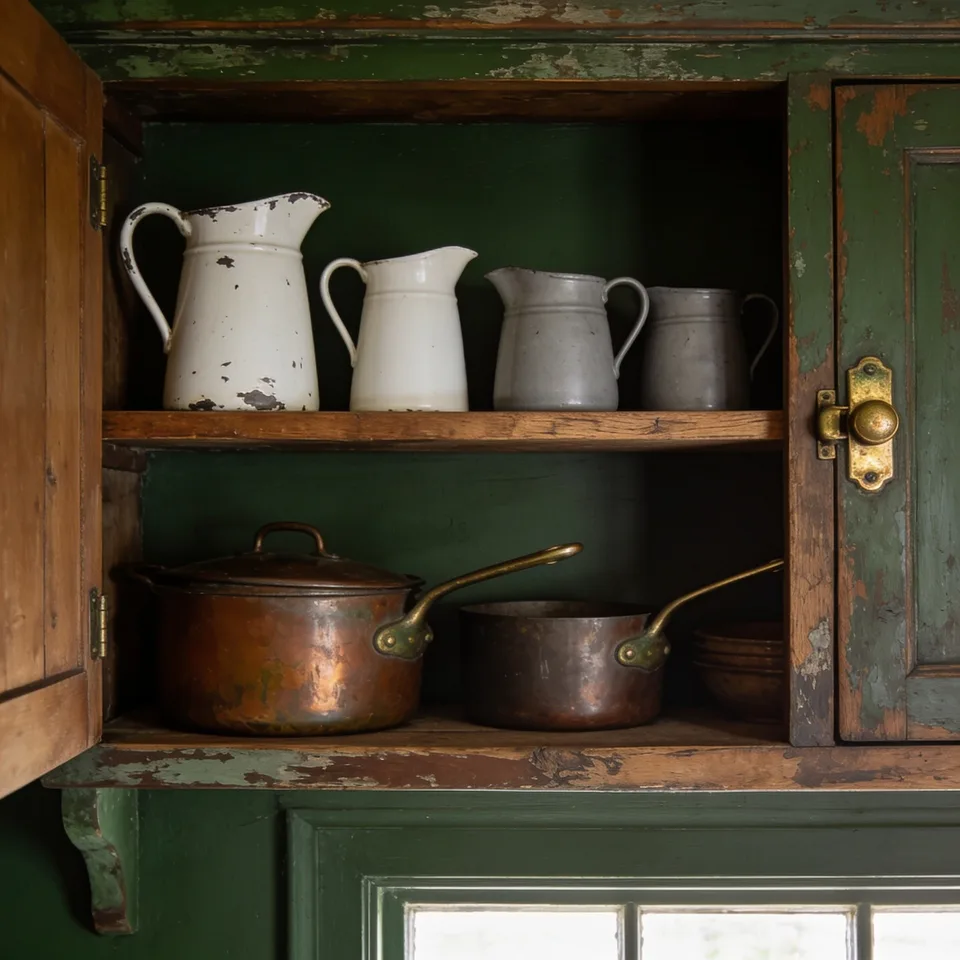
- Intact enamel can still earn its keep. A sound old kettle or roaster, its inside unbroken, handles ordinary cooking much as it always did. Treat it kindly — wooden utensils rather than metal, no leap from a hot burner into cold water — and it will outlast most of what is sold today.
Enamelware is glass, fired onto steel — which explains both its long life and its particular way of growing old. It doesn't stain and it doesn't hold smells, but where it takes a hard knock the glass gives way, and the chip goes down to the metal. The metal, exposed, rusts. So a chip is not a flaw in an old piece; it is the record of the piece having been somewhere.
When you are choosing, pick the piece up. Old enamelware has a weight and a cool, glassy skin to it, and the honest wear will be in the working places: the lip, the base, the handle where a thumb rode for decades.
Boards and spoons, and what wood remembers
An old cutting board carries its biography on its face: dished where the knife worked, scorched at the corner that met the pot, stained by whatever the household did most. Spoons tell the same story in miniature — the bowl worn thin and slightly sideways, always on the side its cook stirred from.
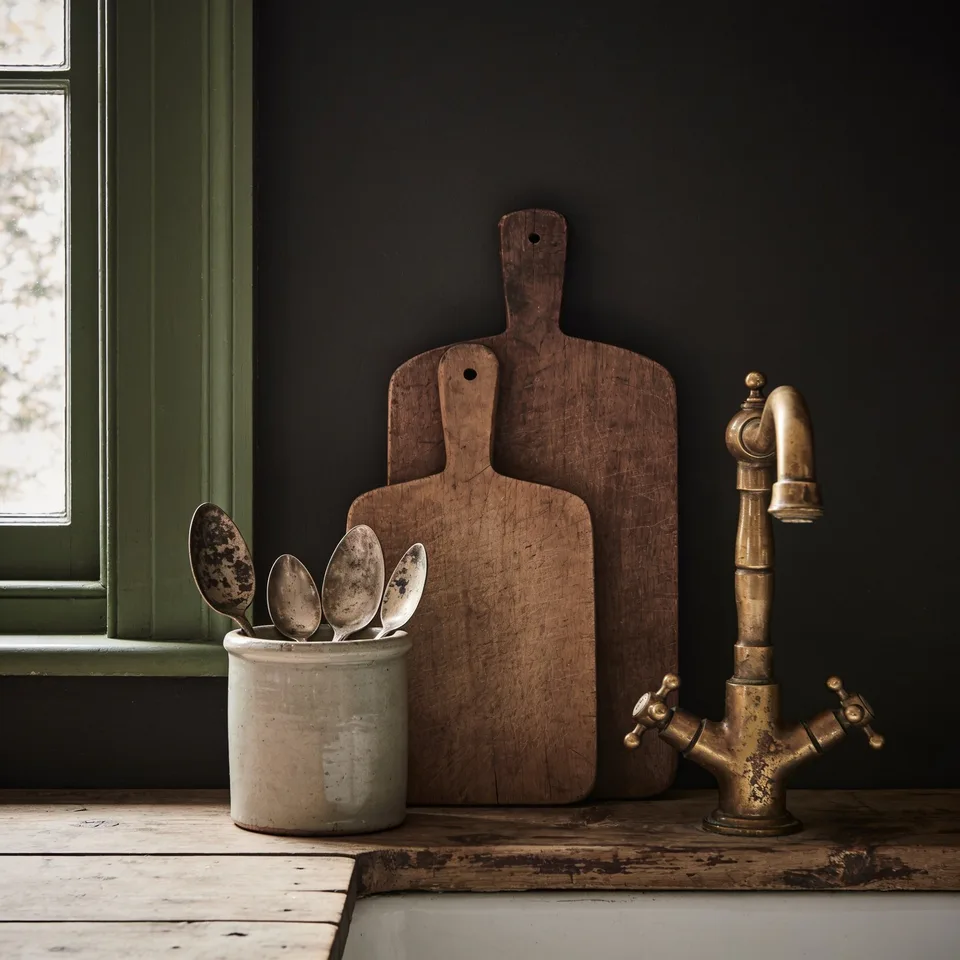
Whether an old board goes back to work is a plain question with a plain answer. A solid board — tight, uncracked, smelling of nothing but wood — can be scrubbed with hot soapy water, dried standing on its edge, rubbed now and then with a food-safe oil, and used every day. Wood has been doing this job for centuries and is still good at it. A board with deep splits is another matter, because a crack keeps what a wash can't reach. And a board wearing an unknown finish — paint, old varnish, anything glossy — shouldn't meet a knife at all, since there is no telling what the finish is. None of these boards is banished from the kitchen; they simply take the quieter posts. One stands against the backsplash behind the working board. One goes under the loaf at the table. One becomes the surface the teapot lives on.
Spoons, for their part, are nearly indestructible. Wash them, dry them, oil them once in a while, and stand them handle-down in a crock where their worn bowls show. A drawer full of old spoons is storage; a crock of them by the stove is a kitchen.
Stoneware and crockery, mismatched on purpose
Stoneware is the ballast of a vintage cottage kitchen — the crock of utensils, the mixing bowls stacked inside one another, the jug that has held everything from milk to cut mint. Gather it a piece at a time. A stack of plates in five patterns says accumulated over years; a boxed set manufactured to mismatch says shipped on a Tuesday.
The one thing worth understanding here is crazing — the fine web of lines that opens in old glaze. It is lovely, and it is also porous, which makes a crazed surface hard to truly clean; and very old glazes were not made to today's food-safety standards. So the honest rule runs like this: pieces whose history you can't vouch for hold things rather than serve them. The crazed bowl takes the clementines and the onions; the old crock takes the spoons; the jug takes the herbs. Daily food work belongs to sound, plainly modern stoneware — and this is the one place in the kitchen where a frankly new piece, unashamed of being new, earns its keep right beside the old ones.
Cloth that has seen winters
Old linens are the fastest way to warm a kitchen and the most overlooked table at every sale. Embroidered tea towels, heavy cloths, toweling woven for hard use — they carry more hand-work than anything else in the room, and they are routinely priced at next to nothing.
Their care is simple: a gentle wash, a line dry when there is one, and an afternoon in the sun for the stubborn stains, which is what the sun has always been for. But the real advice about old cloth is shorter — use it. A tablecloth kept folded against some future occasion serves no one; the occasion is Tuesday supper. A mark that won't lift is the record of a meal that happened. Hang the towel on the oven rail, spread the cloth, and let them keep doing what they were made for.
Arranging it so the kitchen reads kept, not staged
The difference between a kept kitchen and a staged one is not the objects. It is whether the objects live where they work.
- Keep things at their posts. The board leans near the bread knife because that is where cutting happens; the crock of spoons stands by the stove because that is where stirring happens. A shelf of retired objects across the room from their work is what a set decorator would build, and the eye knows it at a glance.
- Let one shelf carry it. A single open shelf of enamel and stoneware, doing real work, warms a whole room. The same pieces spread across every surface tip the kitchen into shop. Old things are strongest a few at a time, with plain space around them.
- Leave air, and let things touch. A kept shelf has a gap where a jar came down and hasn't gone back. Stack the bowls, lean the small board against the big one, let the towel hang crooked. Shops space objects apart so each can be seen; homes let them crowd and overlap.
- Give old surfaces deep color to stand against. Chips, patina, and worn wood read richest against walls with some dusk in them — moss, umber, colors that hold low light. If your kitchen is heading in that direction, our guide to a moodier cottage kitchen is the companion to this one: the paint does for the room what the years did for the pitcher.
Old things in a plainly modern kitchen
Let the modern kitchen be modern, and let the old things carry the age. Most of the kitchens these pieces land in are not cottages. They are ordinary rooms — flat-pack cabinets, stone-look counters, a builder's backsplash — and the temptation is to disguise all of that before the old things arrive. Resist it. Gluing a past onto the cabinetry is the same mistake as buying pre-distressed enamel, made at the scale of a room.
A hundred-year-old board standing on a plain white counter looks like exactly what it is: a life continuing in a new room. A row of chipped enamel above seamless cabinet fronts doesn't fight the room — it gives the room the one thing it could never buy new. The contrast is honest, and honesty is the entire method. A vintage cottage kitchen was never really a style; it is a habit of keeping things, and the habit fits any room that cooks. The walls can keep the same company without any pretending: our own Etsy shop carries a set of six drawn kitchen pieces, a crock, a braid of garlic, a set of scales, plainly new prints of plainly old things, printed at home for whichever thrifted frame turns up first.
There is more in this same spirit — shelves, boards, stoneware and steam — across the rest of our kitchen and pantry notes.
Start this week with a phone call instead of a purchase. Ask the oldest cook in your family what is sitting in the back of their kitchen cupboard, and mean it. Most of what this guide describes is already in a house you know — wrapped in newspaper, waiting, without anyone quite realizing it, for someone to want it.
Common questions
Is chipped vintage enamelware safe to use?
It depends on where the chip sits. Enamelware is glass fired onto steel, so a chip goes down to the metal, and the exposed metal rusts. Chips on the outside are character and nothing more: a pitcher chipped at the shoulder will pour for another fifty years. A chip inside a cooking surface retires the piece from the stove, since bare steel and rust have no business against food, and acidic things like tomatoes and vinegar only hurry the trouble along — the pot is not finished, it has changed jobs, and enamel chipped on the inside does its best work holding wooden spoons, dried flowers, or the kindling beside the stove. Intact enamel can still cook: treat it kindly, wooden utensils rather than metal, no leap from a hot burner into cold water, and it will outlast most of what is sold today.
Are old wooden cutting boards safe to use?
A solid board is, and daily. One that is tight, uncracked, and smelling of nothing but wood can be scrubbed with hot soapy water, dried standing on its edge, rubbed now and then with a food-safe oil, and used every day; wood has been doing this job for centuries and is still good at it. A board with deep splits is another matter, because a crack keeps what a wash cannot reach, and a board wearing an unknown finish, paint or old varnish or anything glossy, should not meet a knife at all. None of these boards is banished from the kitchen; they take the quieter posts instead — one leaning against the backsplash behind the working board, one under the loaf at the table, one as the surface the teapot lives on.
How can you tell real vintage kitchenware from fake?
Look at where the wear sits. Real wear happens where the hands went: a wooden spoon polishes at exactly the spot a grip lands, a board dishes in the center because that is where the knife spent its years, and enamel chips at the lip and the shoulder, where a pitcher meets the world. Age applied at a factory lands where it will be seen instead — edges sanded with suspicious evenness, a gray wash sprayed across the whole surface at once, dents in decorative places — and the eye reads the difference before the mind can name it. None of this makes a new thing a failure; a new towel is a new towel. The trouble is only in the pretending, so buy old things where old things are sold, let new things be plainly new, and never pay for a past that did not happen.