 Cottage at Home
Disclosure: some links below are affiliate links, and if you buy through one we may earn a small commission, at no extra cost to you.
Canadian Christmas decorations, the traditional kind: cranberries where the holly would be
Traditional Canadian Christmas decorations to make or gather this December: cranberries and popcorn on thread, cedar from the hedge, berries and one orange.
In this guide
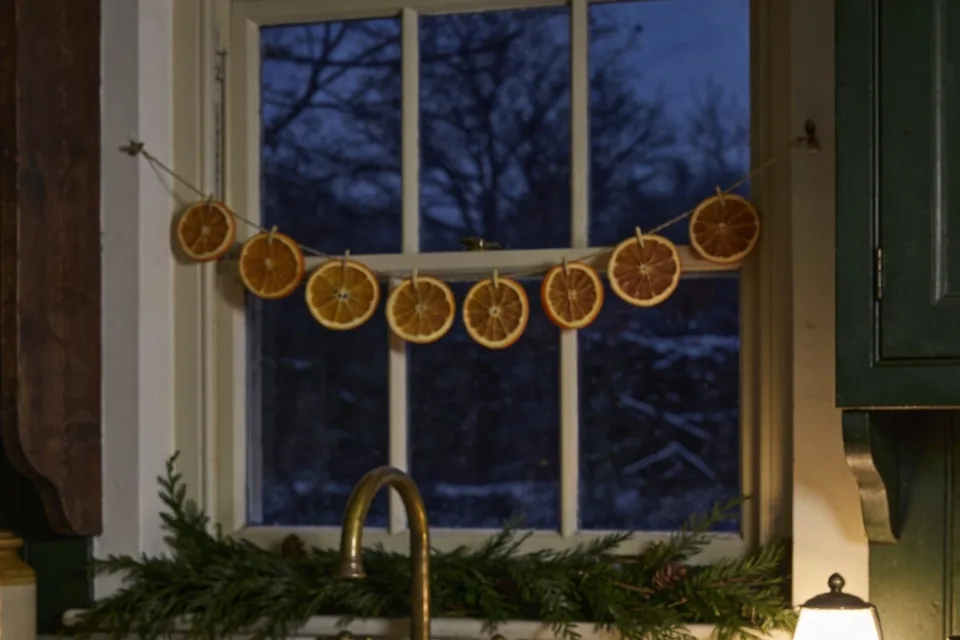
At four o'clock in December the window over the sink has already gone dark, and the house wants something red in it. The first houses in this country could not cut holly for that. There was none in the hedge, because there was no hedge, and holly does not grow wild in most of Canada. So they used what they had, and what they had is still the plainest, cheapest Christmas there is: a bag of cranberries, a bowl of popcorn, a few boughs off the cedar and one good orange. This page is about those things and how to make them this December.
What the first houses had instead of holly
Traditional Canadian Christmas decorations are the substitutes. Settlers who wanted the English Christmas they remembered had no holly, so the red came from cranberries and the green from spruce and cedar. Garlands came from the woods, berries from the hills, and an orange was the one bought colour in the room.
The Brown Homestead, a Georgian stone house of the early 1800s in St. Catharines that is now a historic site, writes that cranberries and spruce stood in for holly in Upper Canada, and that oranges, with evergreens and cranberries, were the decorations of the early century. The best first-hand account is from the writer Catharine Parr Traill, who lived in the backwoods north of Peterborough. In Lady Mary and Her Nurse (1856) she writes of "the festoon pine; a low-creeping plant, with dry, green chaffy leaves, that grows in the barren pine woods, of which the Canadians make Christmas garlands, and also some of the winter berries, and spice berries" with "berries of brightest scarlet, and shining dark green leaves."
None of it was bought, and almost none of it lasted past January. That is the whole spirit of it, and it is the part worth keeping. The English version, with its holly, paper chains and mistletoe, is on the English cottage Christmas page; this is what happened to it on the other side of the ocean.
Cedar and spruce, cut from the hedge
Cedar and spruce do the green. Take a few boughs from the back of a cedar hedge, where the gap will not show, and ask at a tree lot for the trimmings. Cedar lies flat on a mantel or a sill and keeps for weeks; spruce is fuller but drops its needles, so put it where nobody brushes past.
A cedar hedge is the nearest thing this country has to the English holly hedge: it is already in half the gardens on the street, and it gives you the green without a trip anywhere. Cut from the inside and the back, a little from each plant, with secateurs rather than a saw. Lay the boughs along the mantel shelf, tuck short pieces behind the picture frames, and run one length along the window sill over the sink, where you see it every time you fill the kettle.
Spruce smells more like Christmas than cedar does and holds a shape on a door, but it sheds as it dries. Keep it outside the front door or high on a shelf. For which green lasts longest indoors and how to keep it, cottage Christmas decor goes through fir, pine, cedar and spruce one by one.
The "festoon pine" Traill describes is ground pine, one of the clubmosses. It grows very slowly, and through the nineteenth and early twentieth centuries clubmosses were gathered so heavily for holiday greens that they became uncommon in many places. Leave it where it grows. A rope of cedar from the hedge does the same job and the hedge grows back by spring.
Cranberries, strung and in a bowl
Cranberries are the red. One bag from the grocery store does a string along the mantel and a bowl besides. Thread them on strong button thread with a long needle, or pour them into a clear bowl of water under a candle, where they float and catch the light.
Fresh cranberries are firm enough to thread without splitting, and they keep their colour well indoors, slowly darkening and going soft at the skin. Hang the string where the room is coolest, away from the stove and any radiator, and it lasts through to Christmas. Lay it along the cedar on the mantel and the two together are the whole old Canadian colour scheme, red on dark green.
The bowl is even simpler. Fill a pressed glass bowl with water, tip in a few handfuls of cranberries, and they float in a red layer on top. A few sprigs of cedar pushed in at the edge and one short candle standing in the middle on a saucer make the table's centrepiece for a week. Keep any flame well clear of the dry greenery.
Popcorn on thread, a day old
A popcorn garland is the traditional Canadian Christmas tree trimming that costs almost nothing. Pop plain corn the night before, with no butter or salt, so it is slightly stale and holds together on the needle. Thread it alone, or five pieces of popcorn to every cranberry, in lengths you can tie together.
This is a job for the kitchen table on a dark evening, with the radio on and everyone sitting down to it. Give each person a needle and a length of thread about as long as their arm, knot a cranberry at the end so nothing slides off, and push the needle through the middle of each piece. Fresh popcorn breaks; day-old popcorn bends a little and takes the needle. When the lengths are done, tie them end to end.
The garland goes on the tree, looped from branch to branch, or along the top of the window frame. It is the Canadian cousin of the English paper chain: something made at the table, together, from what was in the cupboard.
The garlands and berries over the frames
The old place for gathered garlands and red berries was over the mantel and along the picture frames, exactly where Traill's Canadians hung them. Lay a short length of cedar or a cranberry string along the top of each frame, and let one strand drop down a side.
Most houses have three or four frames that see the whole room, and those are the ones to dress. Keep it light: a single piece of green along the top edge, held by its own weight or by a small loop of thread over the hanging wire, with a few cranberries or a short string tucked in. It reads as old the moment it goes up, because that is where people have always put it.
If you have a bare frame or an empty spot over the mantel, a small seasonal print can sit in it under the green; the free sheets on vintage Christmas printables are made for that.
One whole orange
An orange was a luxury in a nineteenth-century Canadian winter, and a single one in the toe of a stocking or in a bowl on the sideboard was a real present. Today it is the December box of mandarins, and the old gesture is still one bright thing in the room, not a fruit display.
Choose the best orange in the bag and give it a place of its own: a plain wooden bowl on the sideboard with three or four oranges and a twist of cedar, or one on the window sill beside the cranberry bowl. Push whole cloves into the skin in rows and an orange keeps for weeks as it dries, and it scents the room the whole time.
The dried slices on string in the picture above are the kitchen version, made in a low oven over an afternoon; how to do them is on the cottage Christmas kitchen page.
Begin with a bag of cranberries
Start with one bag of cranberries and one evening. Buy them with the groceries, thread one long string at the kitchen table, and lay it along the shelf or the sill you look at most. That is a traditional Canadian Christmas decoration, finished in an hour, and everything else on this page can follow it a weekend at a time.
Common questions
What are traditional Canadian Christmas decorations?
The traditional Canadian Christmas is decorated with what the woods and the larder could spare: spruce and cedar boughs for the green, cranberries for the red, popcorn and cranberries strung on thread, garlands and berries gathered from the woods, and an orange. Settlers here had no holly hedge, so they used what grew close by.
What did early settlers in Canada use instead of holly?
Holly does not grow wild in most of Canada, so the first houses took their red from cranberries and their green from spruce and cedar. In 1856 Catharine Parr Traill wrote that Canadians made their Christmas garlands from a low creeping plant of the pine woods, with winter berries and spice berries of the brightest scarlet.
How do you string cranberries and popcorn for a garland?
Pop the corn plain the night before, so it is a little stale and does not shatter on the needle. Thread a long needle with strong button thread or fishing line, knot the end around a cranberry, and push the needle through the middle of each piece. Five pieces of popcorn to one cranberry is a good rhythm. Make it in lengths of two or three feet and tie them together on the mantel.