 Cottage at Home
Disclosure: some links below are affiliate links — buy through one and we may earn a small commission, at no extra cost to you.
Vintage Christmas printables: six prints of what winter gives
Vintage Christmas printables from this house's own December walls — six free prints of what winter gives, with plain notes on paper, old frames, last-minute gifts, and where each hangs.
In this guide
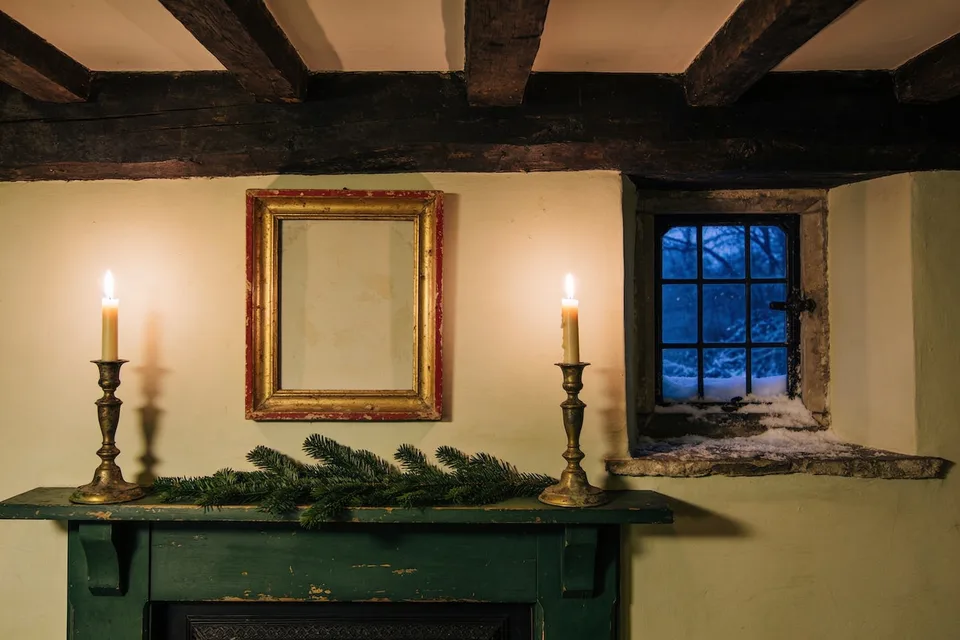
The robin holds the stair now. Through October that post belonged to the crow — the house's darkest bird in its darkest month — and when the crow moved down to a quieter wall in November, the turn of the stairs stood bare for a few weeks, which is a long time for the best dusk in the house to go unwatched. It is not bare anymore. A small print in a honey-colored oak frame, a naturalist's robin perched on a bare hawthorn twig, and from half past four — the landing window quits early this deep in the year — the hall lamp finds that breast the way it once found black wings: half-lit, at the exact place the house turns. The crow said October. The robin says something kinder, and says it all winter.
Christmas comes in louder than any other season even attempts. The stores were committed before the Halloween aisle came down — glitter by the sheet, garland that never grew on anything, licensed faces, songs on a loop — and a house that has kept itself quiet since September can start to wonder whether the whole feast is sold at one volume. It is not; the quiet way in is simply older than the stores. Before Christmas belonged to the display aisle, its outdoor cast — mistletoe and holly, the robin, the first serious snow — belonged to the botanical plate and the naturalist's study, drawn by people who would give a berry a whole morning of looking. Prints in that tradition carry everything the month means and nothing it merely sells. This is a guide to the six vintage Christmas printables that hang in these rooms from early December — winter's own nature, drawn as old plates — and to the plain work around them: the wall each print keeps, how they print well on a dark afternoon, and how a spare one in an old frame quietly answers the twenty-third of December.
December's one quiet gesture
The six sheets are the given things — what winter does on the other side of the glass, hedge and garden and sky, brought indoors at the size of a piece of paper — and they occupy nothing. A print hangs in the one dimension the season has not claimed, sheds no needles, asks for no water, and steps down after Twelfth Night without leaving more than the nail it borrowed. How that December layer is hung among the pictures that stay all year — borrowed nails, the same-frame swap, and the January drawer — is its own piece. By the second week of the month the house is as full as it ever gets. The green is in and laid along the mantel, the box is down from the attic, the candles have moved from the drawer to the table — that whole slow argument is its own piece — and nearly all of it occupies something: sills, shelves, the tabletop, the corner where the tree stands. December's things are either kept things or cut things, and both kinds take up room. The six sheets are a third kind.
That is the walls' gesture, and it wants making once and well. December is not October; it does not need the walls to supply the mood, because the month walks in carrying its own. What the walls can supply is the quiet — the one layer of the season that does not glitter, ring, or need plugging in. A single robin drawn seriously, met on the stairs twenty times a day, holds more of the feast than a window's worth of tinsel, for the same reason a cut fir bough beats a garland that never grew: somewhere in the lineage of the thing, somebody was paying attention. Keep the walls to the given six, let everything else shine, and the rooms balance.
What the vintage Christmas pack holds
Six prints, drawn the way the old plates were drawn — fine etched line under a muted wash, grounds of aged ivory, the greens browned and the one red banked low — and each of them something winter gives without being asked: the hedge, the garden, the sky. Here they are the way they hang, one to a wall, each in its own light.
The mistletoe sprig hangs where mistletoe has always claimed the right to hang — over a door — which makes it the door into the set. Paired leaves gone yellow-green the way the real plant goes, berries drawn as small globes of wax, every stem studied rather than staged: an earnest botanical plate of a thing most houses only ever meet as a plastic sprig. It keeps the lintel between hall and kitchen, in a slim brass frame hardly wider than the sprig, and the old custom beneath it is left to enforce itself, which it manages.
The winter robin is the spine of the pack, and it has the stair. A naturalist's bird study, feathers counted the way the old draftsmen counted them, perched on a bare hawthorn twig with a few red haws still holding — the season's bird because no other stays so near once the cold shuts the garden, and no hedge is finished in winter without one supervising it. The breast is the set's single ember of color, and the dusk on the landing banks it perfectly. Some walls ask for a bird; that one, it turns out, asks for a bird twice a year.
The Christmas rose is the pack's plainest argument — a hellebore, the flower that blooms in the cold months, one face turned up for once and one tipped the way hellebores insist on looking, a nodding bud between them and a ruff of dark serrated leaves behind. Out in the beds the real ones open while everything else stays under. It hangs above the reading chair, inside the lamp's low circle where the moth spent October, because the deep-winter evenings are read out in that chair, and it is worth keeping one witness at eye level that the garden has not stopped — only lowered its voice.
The pinecone and spruce sprig is the woods' entry: two cones drawn scale by scale, needles rendered singly, attention enough to turn a thing picked up on any walk into a thing worth a frame. It takes the wall over the boot bench by the back door, in a narrow pine frame, where the winter walks come in stamping — and it settles a household score in passing. Spruce sheds too fast to earn a long stay indoors, so this house keeps its spruce on paper, where the needles hold.
The snow crystal studies are the furthest of the six from the hedge — a loose scatter of crystals on the same aged ivory as the rest, set down in the manner of the first patient observers who caught falling snow on cloth and recorded each one before it went, no two alike, which is the plate's whole point, and these tinted faintly with the house's own winter colors, green and rust and a little gold. It goes to the bedroom, beneath the bare oak branch and its full moon — the October sheet that never came down, winter skies having been its real subject all along. The two hang as one weather: the moon keeping the night, the crystals keeping what falls out of it.
And the paperwhite narcissus closes the set, barely Christmas at all, which is its job — the windowsill bulb drawn whole, roots to white flower, the way every dresser-top forcing hopes to end up after its November start in a bowl of grit. It has the kitchen dresser, in the cream-painted frame the pumpkin study kept until the last pie of November — harvest handing the shelf to forcing season — and the real bulbs stand two shelves below in a bowl of stones, doing the same thing more slowly. The morning light takes print and pot together.
Nothing in the six glitters, rings, or plugs in. They tell the season from outside the glass — hedge, garden, sky, drawn as they arrive — and they keep easy company with the brass, the stoneware, and the cut green. The season's gathered half — the holly sprig in its jug, the orange pomander, the brown-paper parcel, the pudding in its cloth — sits for its own six portraits in The Cottage Christmas, the still-life set sold as The Cottage Christmas: given things and kept things, two sets hanging like siblings on either side of the same December.
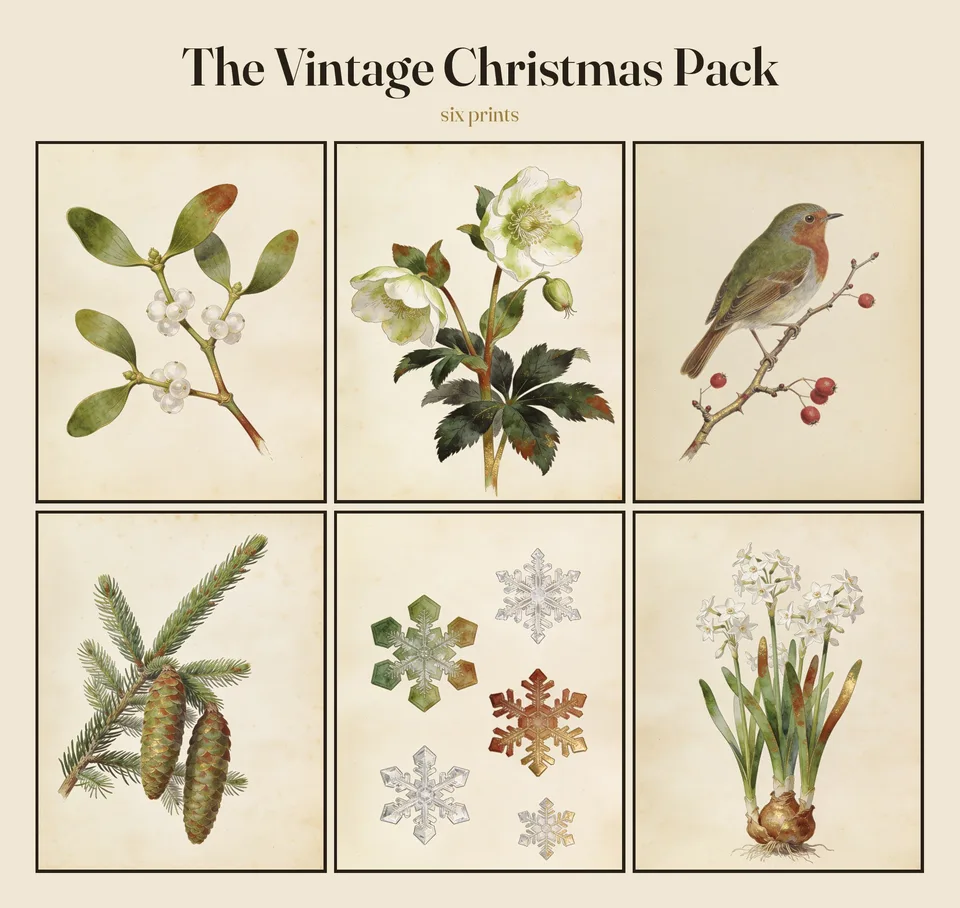
If this kind of December belongs on your walls, the set is free — six vintage Christmas printables, sized for home printing at anything up to 8×10 inches or A4. It comes through the same door as the amber autumn pack: leave an email address, and the six arrive ready for whatever frames the season turns up.
Printing in the dark of the year
The printer's part happens after dark now — the afternoon is over by half past four, and the errand is mercifully indoors. An ordinary home inkjet at its best-quality setting, fed ordinary matte paper, does everything these plates need at their sizes. Matte matters even more in December than it did in October: these rooms run on flame and low lamps by evening, and a glossy sheet hands every taper back as a skate of white glare crossing the robin's breast, where matte drinks the light and lets the plate keep it. If the drawer offers two whites, take the warmer one — a bright-white sheet reads as cold as the month, and the ivory ground does half the aging in an aged print.
The snow plate is the one that asks for the best-quality setting without argument: its crystals are drawn in a line fine enough that a hurried draft mode breaks them into dust, and the whole sheet is those lines. Everything else forgives. Print tonight on whatever the drawer holds; the shortest weeks are no season for waiting on a paper order.
A last-minute gift in an old frame
Every December holds one small emergency in reserve: the twenty-third, a name still unaccounted for, the stores loud and picked over. The house's answer costs a sheet of paper and a secondhand frame. Print one of the six at best quality and set it in an old frame — the thrift shop keeps a rack of them right up to closing, priced by the frame and never the picture, and any house that has been printing its own walls for a season owns a spare or two already. Then brown paper, string, and a sprig of the mantel's fir under the knot. It wraps flat, travels in a coat pocket if it must, and looks on arrival like what it is: a thing somebody made rather than grabbed.
Choose by the person, not the print. The robin goes to whoever keeps a feeder filled; the snow crystals to the one who reads the sky before driving anywhere; the paperwhites to a windowsill gardener; the hellebore to the real gardener taking winter hard. Old glass with a little wave in it only helps — a bird behind wavy glass looks handed down, not printed Tuesday. And there is no need to dress the gift up as more than it is. The pack is free and prints again in a minute; what the gift carries is the choosing, and the choosing shows. A pencil line on the back — which print, and the wall it was imagined on — finishes it better than any card.
What Twelfth Night takes, and what winter keeps
The greenery goes out with the tree, and the mistletoe goes with it: the feast's own print, down off its lintel, flat in a drawer under plain paper until next December asks. Everything else stays, because five of the six were never Christmas; they were winter, and winter has January and February still to give. Until then, through Advent the six live apart, one to a wall, which is how a small set covers a whole house without tipping any room into theme. For the twelve days themselves the house allows one gathering: the Christmas rose and the snow crystals come down to the mantel and stand propped among the fir between the candlesticks, paper and flame sharing the shelf. Paper is the one decoration that moves house without complaint, and for that week the shelf reads as a single sentence — flame, green, flower, snow. The robin stays on its stair. Some posts should not go unwatched twice in one winter.
Then Twelfth Night — or the mid-January Saturday that stands in for it — and the two ledgers part. The robin keeps the stair until the garden starts answering it back. The snow crystals stay beside their moon as long as snow stays a fact of the sky. The hellebore holds the reading chair into the weeks the real ones open in the beds, the pinecone keeps the boot-bench wall for the whole season of stamping walks, and the paperwhites preside over however many bowls of grit the dresser ends up hosting — in this house the forcing runs to March. Christmas ends on a date; the pack does not. Season by season, what gets drawn for these walls gathers with the rest of the printables.
Tonight, the door
Start at the door, not the walls. Every house has one doorway the whole of life files through — kitchen to hall, most likely — and a lintel above it that nobody has looked at since the paint dried. By half past four tonight the dark will have arrived to be met. Print the mistletoe at the printer's best setting, borrow the smallest frame any shelf will lend, and hang it over that doorway before supper. No plan, no wall audit, no waiting on the box or the tree. One earnest sprig where the old custom says it belongs, and every pass beneath it lets the season in a little early. The other five can follow as frames turn up; December only needs to be over one door to be in the whole house.
Common questions
What is in the vintage Christmas printable set?
Six prints of what winter gives without being asked: a mistletoe sprig, a winter robin on a bare hawthorn twig, a Christmas rose, a spruce sprig with two pinecones, a study of snow crystals, and a paperwhite narcissus drawn whole from roots to flower. Each is drawn the way the old plates were, fine etched line under a muted wash on grounds of aged ivory, the greens browned and the one red banked low. The set is free and sized for home printing at anything up to 8×10 inches or A4: leave an email address, and the six arrive ready for whatever frames the season turns up.
What paper should you use to print wall art at home?
Ordinary matte paper, run through an ordinary home inkjet at its best-quality setting, does everything these plates need at their sizes. Matte matters most in rooms that run on flame and low lamps by evening: a glossy sheet hands every taper back as a skate of white glare, where matte drinks the light and lets the plate keep it. If the drawer offers two whites, take the warmer one, since a bright-white sheet reads cold and the ivory ground does half the aging in an aged print. The snow crystal plate is the one that insists on best quality without argument; its lines are fine enough that a hurried draft mode breaks them into dust.
What is a good last-minute Christmas gift you can make at home?
A print in a secondhand frame, which costs a sheet of paper and a stop at the thrift shop, where old frames sit on a rack right up to closing, priced by the frame and never the picture. Print one of the six at best quality, set it behind the old glass, then brown paper, string, and a sprig of the mantel's fir under the knot. Old glass with a little wave in it only helps; a bird behind wavy glass looks handed down, not printed Tuesday. Choose by the person rather than the print: the robin for whoever keeps a feeder filled, the snow crystals for the one who reads the sky before driving anywhere, the paperwhites for a windowsill gardener. A pencil line on the back, naming the print and the wall it was imagined on, finishes it better than any card.