 Cottage at Home
Disclosure: some links below are affiliate links — buy through one and we may earn a small commission, at no extra cost to you.
Christmas gallery wall: what goes up, what stays, and how it comes down
A Christmas gallery wall the cottage way: which prints go up in December, what stays on the wall all year, and how to hang the season without one new nail.
In this guide
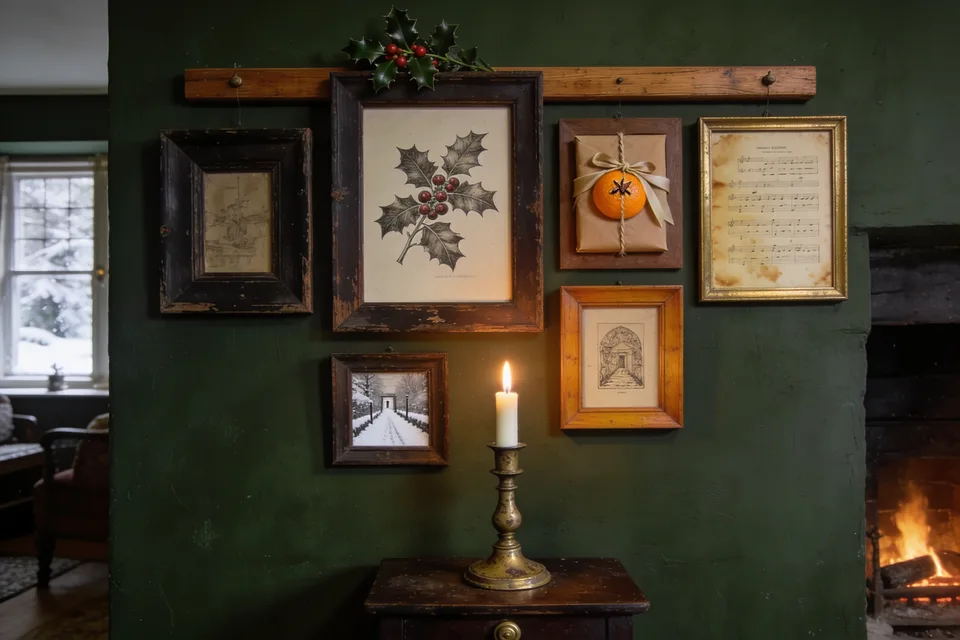
The wall the armchair faces has been filling for years, and by the second Sunday of December it has taken on a few more. A holly sprig, drawn in fine etched line and washed the browned green of the real thing, hangs in a brass frame that spent the autumn holding a teasel. Below it a page of old carol music, foxed at the corners, sits in a narrow oak frame that has kept that nail since long before this house started printing its own walls. A cut sprig of real holly is tucked behind the top edge of the biggest frame. Nothing has been drilled. By half past four the taper on the table below is lit, and the brass along the wall takes the flame a moment before the paper does.
Search for a Christmas gallery wall and you'll be shown finished walls: grids of nine matched frames, boards full of them, shops selling the frames by the set. What nobody shows is how it gets built in a house that already has pictures on its walls and means to keep them, and how it comes down in January without leaving a mark. That's this page. The prints themselves, the free six of winter's own nature with the plain notes on paper and printing, live on their own page. This one is about the wall.
A kept wall with a December layer
A Christmas gallery wall, in this house, is a seasonal layer of paper hung among the pictures that stay all year: a handful of framed prints of the season's kept things, a page of old sheet music, a small winter engraving, added to the standing wall in December and lifted off again in January. It borrows nails and hooks. It never makes them.
We'd hesitate to call it a gallery wall out loud, and it's worth saying why. The walls here fill slowly, a frame at a time over years, never as a set, and a wall hung in one afternoon spends years living that afternoon down. So a matched grid of nine Christmas frames is the one thing this page won't teach you. But December is the exception the kept wall allows, because the season's layer comes down. A few prints hung for five weeks don't have to pretend they accumulated. They only have to hang kindly among the things that did, and then go back in the drawer.
What stays on the wall all year
Everything that was hung for good stays put: the botanical plates, the old engravings, the mirror by the door, the plates climbing beside it. None of it comes down for December. The standing pictures are what keep a Christmas wall from reading as a display, because the season is seen hanging among a house's own things instead of replacing them.
The standing collection was hung once and right, and it keeps its nails the way a seasonal wall can't: a sage plate over the flour bin is as true in December as in June. Leave it. The year-round pictures do the December ones a kindness, in fact. A holly sprig hung between a fern plate and an old chart looks like it was found and framed by somebody who lives here, where the same print in a grid of its five siblings looks like it came in a box. Two or three of the year-round frames on the chosen wall will be the right size for a swap; the rest simply stay and keep the season company.
What goes up, and what comes down first
What goes up is paper and only paper: the six still-life studies of the season's kept things, a page of old sheet music, a winter engraving, a vintage Christmas postcard in the smallest frame the house owns, and a sprig of real holly tucked behind the top edge of a frame or two.
What comes down is the autumn layer, the amber prints that have held their frames since September, and they leave on the same afternoon the December sheets go in, so the wall is never bare in between.
The six studies are the gathered side of December. The Cottage Christmas is six prints in fine etched line under a muted watercolour wash on aged cream paper: a sprig of holly heavy with berries, a clove-studded orange on its ribbon, an evergreen wreath with pine cones and dried orange slices, a brown-paper parcel tied with twine, a strap of patinated brass sleigh bells, and the pudding, crowned with holly. They're CA$19 for the six, they print at home, and nothing in them glitters. Three or four is the right number for one wall. The free six from the printables page stay where that page hangs them, one to a wall through Advent, the robin on the stair; this wall is for the gathered things.
Then the house's own old paper, which is where a wall like this stops being a set. A page of vintage sheet music, a carol printed for parlor pianos with the words set under the notes, reads from across the room as a page of anything and up close as the season in a typeface that dates it; it wants a narrow dark frame and no mat. An antique winter engraving does for weather what a botanical plate does for a plant: a cart track under snow, bare elms, a frozen millpond, the whole cold of it built from fine hatched lines. Vintage Christmas postcards, the small old cards with a lantern-lit lane or a robin on a fence post, take the smallest frames the house owns and hang low, like footnotes. If a nativity is part of your December, it belongs here too, in the plainest frame on the wall. And last, holly behind the frames, one sprig at most to a frame, the way the English cottage Christmas has always tucked it. Everything on the wall either grew or was printed, which is the law the kept house runs on all month: greenery over glitter, and paper is on greenery's side.
Hung so January can lift it off
Hang the December layer from what the wall already offers: the picture rail's hooks and cord, the nail an autumn print has just given up, and frames that share a size so a new print swaps in behind the same glass. Done this way, a seasonal wall leaves the plaster exactly as it found it, every year, and the frames never move at all.
The picture rail is the old house's answer, and worth borrowing if your ceiling has one. A hook rides the rail and a cord drops from it, so the arrangement is made by sliding hooks and shortening cords, and the wall never meets a hammer.
Where there is no rail, the swap is the method: the frame that held October's teasel takes December's holly on the same nail, because the print was made to fit the frame and the frame already fits the nail. That's the reason to print to the frames you already own rather than buy frames for the season: the frame is the permanent thing, and the paper turns inside it. Do the swap on the table, never on the wall: frame face down on a cloth, the points turned back, the backing lifted out, the autumn sheet slid into a drawer between plain paper, the December sheet laid in, backing and points back, and the frame goes up on its own nail with the wire settled on the same head. A vintage brass picture frame is the one worth hunting for this job, because it's the frame the candle finds first, and a single brass one among the dark wood is all the shine the wall needs.
Anything left over gets propped on the mantel or a narrow shelf, which counts as hung for December's purposes and comes down by being picked up.
The hanging rules are the house's usual ones: lower than instinct argues, a hand's width apart, set by eye rather than by level. And small. Three to five seasonal pieces among the pictures that stay, on one wall, is plenty; the fir and the brass and the tree are happening elsewhere in the room.
Holding together against fir and candlelight
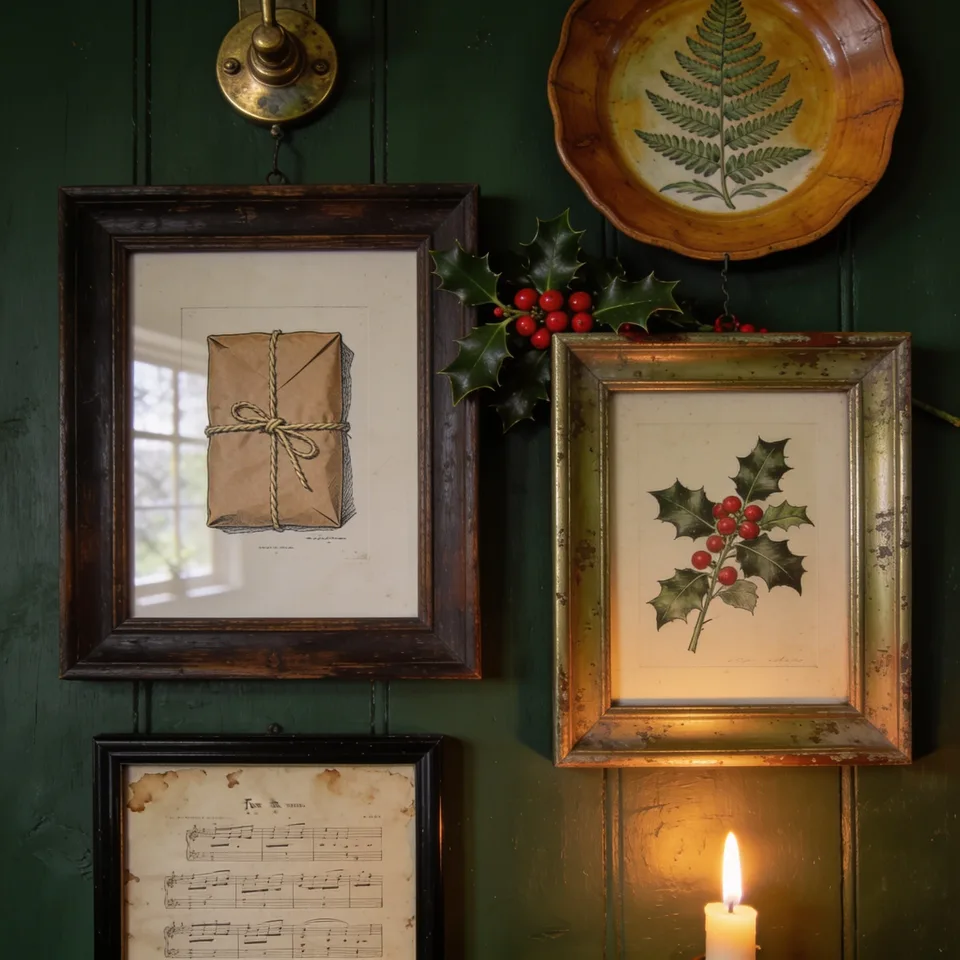
The wall holds because everything on it shares one low palette: aged ivory paper, browned greens, umber, brass gone soft with handling, and one banked red. Against a deep wall and the fir on the mantel, the prints read as more kept things, and by candlelight the brass frames take the flame before the paper does.
The moody Christmas is the room this wall hangs in: deep green paint, fir laid flat along the mantel, brass at three heights, the overhead off from half past four. Against that, what fails is anything bright. A white mat throws a clean rectangle of light around every print and turns the wall into a row of little windows; a mat a shade warmer than white, or none at all, lets the paper sit back into the green. A glossy sheet hands every taper back as a skate of glare, where matte paper drinks the light and keeps it, so the prints go on matte and nothing else. Dark wood, honey oak and rubbed brass are the frames the wall wants.
The red is the thing to watch. The holly berries in the print and the holly behind the frame are the one true red in the room, and they answer each other across a few inches of green; that's why nothing else on the wall should be red, and why the postcards with scarlet coats and crimson bows stay in the drawer. The greens agree on their own: the printed holly is a browned green from the start, and by the third week the fir on the mantel has browned at the tips to meet it. By evening the whole wall is one thing, old paper, old wood, a little brass, and a candle lighting it from below. The tree glows from inside its own dark across the room, and the wall doesn't try to.
Twelfth Night, and the drawer
On Twelfth Night, or the mid-January Saturday that stands in for it, the season slides out of its frames and lies flat in a drawer between plain sheets, never rolled; the autumn print or the year-round one goes back behind the glass; the hooks ride back along the rail; and the wall shows no sign the month was there.
The prints keep. Matte paper flat in a dry drawer comes out next December as it went in, and if a sheet has creased, the file prints again for the cost of the paper. The holly goes out with the tree. The frames don't move. What's left on the wall in January is the wall you had in November, and that's the whole point of hanging a season this way. When the layer does come off, the wall is only part of what changes. What the room holds once the tree is out covers the rest of that afternoon: what stays up, what goes back in the box, and the few things that only come out in January.
Begin with one frame
Tonight, take one frame off the wall you look at from your chair, one about the size of a sheet of paper. Print one study at the printer's best setting, the holly or the parcel, lay the frame face down on the kitchen table, swap the sheet in behind the glass, and hang it back on its own nail.
Leave the rest of the wall alone for a week. If by Sunday your eye keeps going to it at half past four, the second frame will tell you which one it is. The wall is already there, and December only needs to borrow it for a month.
Common questions
How do you hang a Christmas gallery wall without putting new holes in the wall?
Hang the December layer from what the wall already offers: the picture rail's hooks and cord, the nail an autumn print has just given up, and frames that share a size so a new print swaps in behind the same glass. A hook rides the rail and a cord drops from it, so the arrangement is made by sliding hooks and shortening cords, and the wall never meets a hammer. Where there is no rail, the swap is the method: the frame that held October's teasel takes December's holly on the same nail, because the print was made to fit the frame and the frame already fits the nail. Anything left over gets propped on the mantel or a narrow shelf, which counts as hung for December's purposes and comes down by being picked up.
What do you put on a Christmas gallery wall?
What goes up is paper and only paper: the six still-life studies of the season's kept things, a page of old sheet music, a winter engraving, a vintage Christmas postcard in the smallest frame the house owns, and a sprig of real holly tucked behind the top edge of a frame or two. The studies are the gathered side of December, a holly sprig, a clove-studded orange on its ribbon, a wreath, a brown-paper parcel, a strap of sleigh bells and the pudding. The sheet music and the engraving are the house's own old paper, and the postcard hangs low like a footnote. Three to five seasonal pieces among the pictures that stay all year is plenty; the rest of the season, the fir and the brass and the tree, is happening elsewhere in the room.
Do you take down your regular pictures to put up a Christmas gallery wall?
No. Everything that was hung for good stays put: the botanical plates, the old engravings, the mirror by the door, the plates climbing beside it. None of it comes down for December. The standing pictures are what keep a Christmas wall from reading as a display, because the season is seen hanging among a house's own things instead of replacing them. What does come down is the autumn layer, the amber prints that have held their frames since September, and they leave on the same afternoon the December sheets go in, so the wall is never bare in between. Two or three of the year-round frames on the chosen wall will be the right size for a swap; the rest simply stay and keep the season company.