 Cottage at Home
Moody Christmas decor: deep green, brass, and candlelight
Moody Christmas decor — evergreen on deep walls, brass and candlelight in pools, a tree lit from inside its dark, and why December is the deep room's month.
In this guide
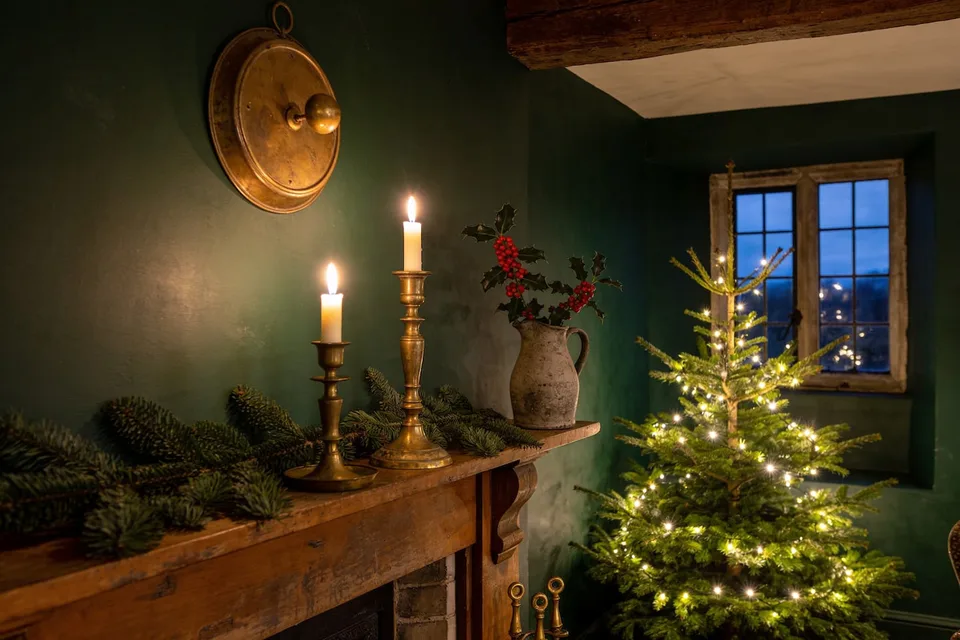
The sitting room has been deep green since long before the season arrived, and by the second week of December it looks like the reason the color was chosen. Fir lies along the mantel with brass candlesticks standing in it at three heights, lit since dusk — which is to say, since half past four. The walls take each small flame and hand it back warmer. Outside, the last blue is leaving the window; inside, nothing needs switching on.
Most December decorating is written for pale houses, and it reads like a rescue: the dark is coming, string lights against it, brighten every corner, fight the season to a draw. The moody house has no quarrel to settle. Its whole year runs on lamplight and corners allowed to go soft, and December — night on the glass by half past four, the deepest dark in the calendar — is not the month that tests that argument but the month that wins it. Moody Christmas decor is barely a project at all. Everything a cottage Christmas carries through the door — cut greenery, brass, flame, thin glass from the box — was drawn from rooms that had fire for light and dark for walls, and set against deep paint it is simply home again. A pale room borrows Christmas. A deep room hosts it.
Green on green
Against a white wall, a fir bough is an outline — handsome, seasonal, and plainly a visitor. Against moss or bottle green it stops being trim and becomes depth: the wall reads as more wall, older wall, the hedge carried on indoors. That is the first thing deep paint does for the season, and it changes what the greenery is for. There is no case here for the lush wired garland that photographs like a shop window. A few honest boughs, laid flat where they land — fir along the mantel because it holds its needles longest, cedar on the deep sill where it lies still, pine over the doorframe that kept its nail — do more against dark walls than armfuls manage against white, because the wall is carrying half the argument. And this is the ground holly was always meant for. Berries on a pale shelf are a print of themselves; in the green dark they are the one true red in the room, and they burn. A single stem in a stoneware jug is plenty. Deep walls make small gestures loud, which is the quiet economy of the whole month.
Brass and flame, with the dark left in
Candlelight is where the deep room collects its winnings. A flame against a white wall lights the wall; a flame against umber or bottle green lights itself, and the wall holds the glow close around it like a cupped hand. So the candles multiply on their usual terms — brass candlesticks gathered secondhand one at a time, stood at unequal heights so the flames sit at different altitudes, a run of them down the green-laid mantel and one on any shelf deep enough to keep a pool of its own. The dark between the flames is not a gap waiting to be filled. It is the setting the flames are set in, and half of moody Christmas decor is deciding what not to light. Anything with shine earns its keep near a flame: a mirror doubles the taper stood in front of it, a window after dark does the same for free, and worn brass gives back a softer copy of every light in the room. By Twelfth Night the tapers will have run wax down the candlesticks, and nobody should hurry to scrape it. December signs its work in wax.
A tree lit from inside its own dark
The tree takes warm-white lights, strung deep along the branches rather than looped at the tips, and the stringing matters more in a dark room than anywhere else. Set deep, the lights make the tree glow from inside its own dark, the way a lantern glows; looped at the tips, they make it wear a costume. In a dark-walled living room that difference is the whole evening: against deep paint every small warm point burns at its full value, where a white wall answers each one with gray. The old thin-silvered baubles do their best work here too — each takes the nearest light and returns a smaller, worn version of it, so a dressed tree in a deep room carries dozens of little lit windows. Then the rest of the room steps down to meet it: one lamp by the chair, the fire if the room has one, nothing overhead. A lit tree in a bright room is an ornament, one thing among the others. A lit tree in a dark room is a hearth, and the chairs will drift toward it without being asked.
Dinner lands after dark
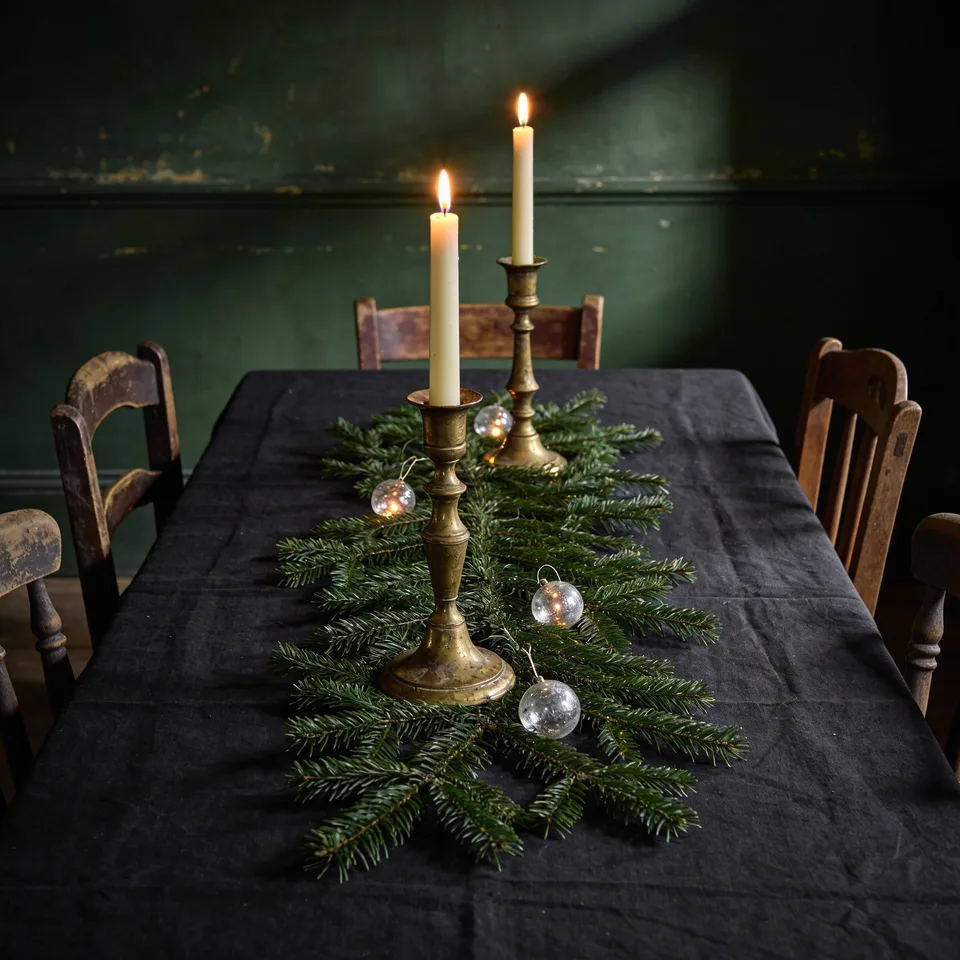
Christmas dinner is the year's one meal that everyone has agreed, for generations, to eat by night — which makes it the deep room's occasion before a single fork is laid. The moody dining room has been rehearsing all year on deep walls, one low light, and chairs that never matched; the season only asks it to double the flames. Fir goes down the middle of a dark cloth and lies flat the length of the table. Tapers stand in it at two or three heights, close enough together that their pools join into one. A few baubles from the box rest loose in the green, where they catch the flames and hand them down the table. Everything stays below chin height, so the light lands on faces and the talk can cross it; the tall centerpiece built to be admired belongs to rooms this one has never wanted to be. When the plates go out and the overhead stays off, the walls step back into their dark and the table becomes the lit room inside the room — which is what a December table has been for as long as there have been Decembers.
Down the hall, quieter
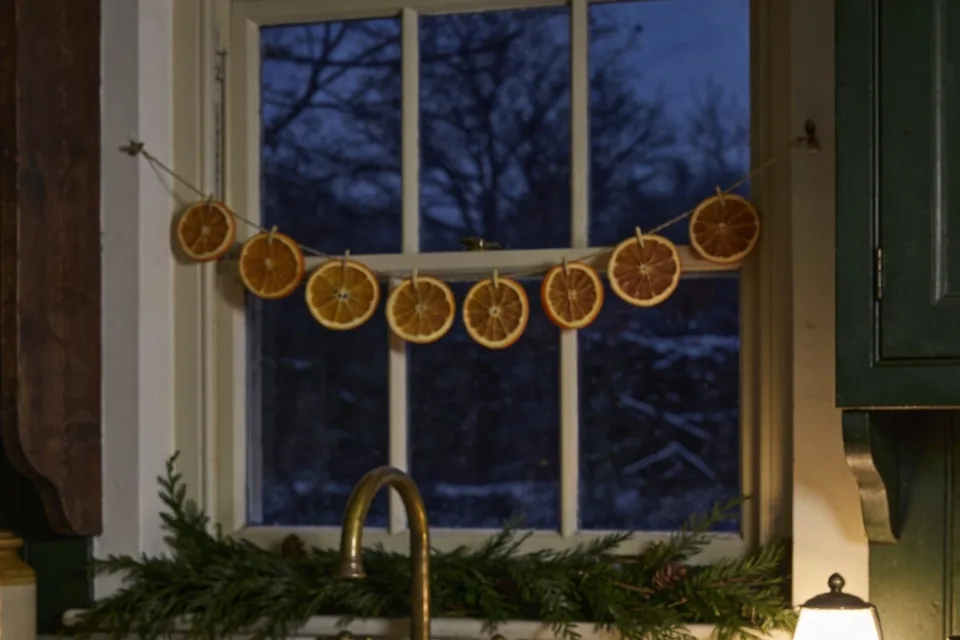
The rest of the house takes the season at a lower volume, each room in its own key. The dark kitchen barely changes its habits: the counter lamp it has argued for since September now wins every day at four, the string of dried oranges in the window reads twice as amber against deep paint, and the kettle going on at dusk is ceremony enough. If that room takes one more thing, it is paper. Two of the six studies in The Cottage Christmas are the kitchen's own December, the clove-studded orange on its ribbon and the pudding crowned with holly, and one of them pegged to a string on the deep wall by the kettle gets from the paint exactly what the oranges get. The moody bedroom takes the quietest December in the house — a sprig of pine on the dresser, the wool already on the bed, and, borrowed from the tree for the darkest fortnight, one short string of warm lights along the headboard, lit for the hour before sleep. Darkness done kindly does not close its door to the season. It lets December in the way it lets everything in — a little, and in lamplight.
Begin at half past four
The test costs nothing and is already on the calendar. Some afternoon this week, at the hour the light goes, leave the overhead off in whichever room owns your deepest wall, and stand one lit candle and one cut bough against it. Watch what the wall does — not brighten, but hold. If the room feels kept rather than dim, the season knows where to go next: more green, more brass, the tree strung deep. And if the walls are still pale, the night outside the window will stand in for deep paint until the paint board gets its winter audition. December is generous that way. It brings the dark house's best argument around to every house, free of charge, at half past four.
Common questions
How do you decorate for Christmas when you have dark walls?
Let the walls carry half the argument. Against moss or bottle green a fir bough stops being trim and becomes depth, so a few honest boughs laid flat, along the mantel, the deep sill, over the doorframe, do more than armfuls of garland manage against white. Holly earns its keep here too: in the green dark its berries are the one true red in the room, and a single stem in a stoneware jug is plenty. Then brass candlesticks at unequal heights down the green-laid mantel, the tree strung with warm-white lights set deep along the branches, and the overhead left off. Deep walls make small gestures loud, which is the quiet economy of the whole month.
Should Christmas tree lights go deep in the branches or on the tips?
Deep along the branches, and it matters more in a dark room than anywhere else. Set deep, the lights make the tree glow from inside its own dark, the way a lantern glows; looped at the tips, they make it wear a costume. Warm white is the color to hold to, and against deep paint every small point burns at its full value, where a white wall answers each one with gray. The old thin-silvered baubles finish the work, each taking the nearest light and returning a smaller, worn version of it, and then the rest of the room steps down to meet the tree: one lamp by the chair, the fire if the room has one, nothing overhead.
Can you get the moody Christmas look without dark walls?
You can, because December brings the dark house's best argument around to every house, free of charge. Some afternoon this week, at the hour the light goes, leave the overhead off in whichever room owns your deepest wall, and stand one lit candle and one cut bough against it. Watch what the wall does: not brighten, but hold. If the room feels kept rather than dim, the season knows where to go next, more green, more brass, the tree strung deep. And if the walls are still pale, the night outside the window will stand in for deep paint until the paint board gets its winter audition.