 Cottage at Home
Disclosure: some links below are affiliate links — buy through one and we may earn a small commission, at no extra cost to you.
The moody cottage bedroom: darkness done kindly
Why the moody cottage bedroom is the one room with everything to gain from going dark — paint that sleeps well, bedding without glare, lamps kept low and warm.
In this guide
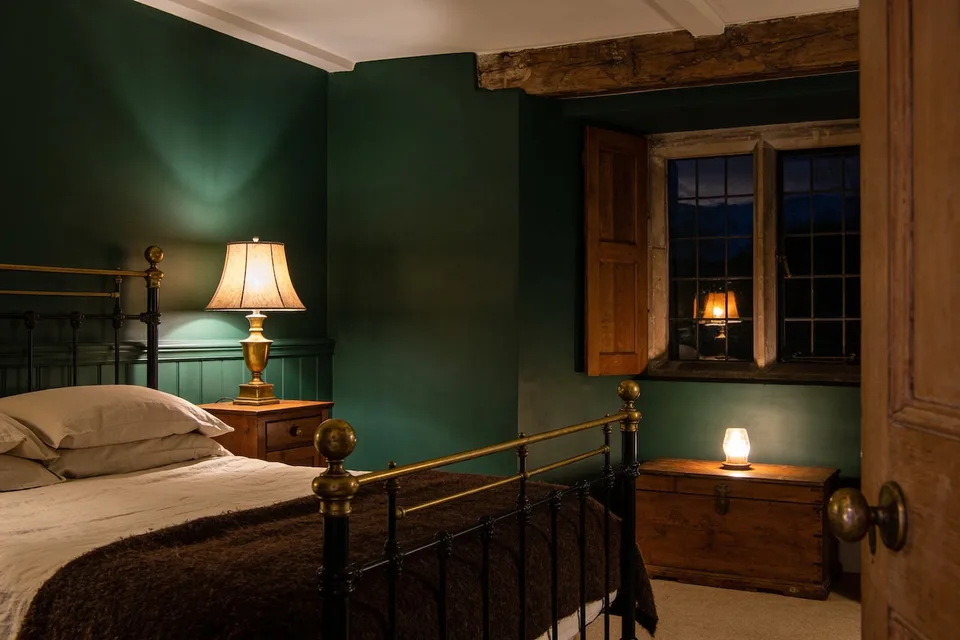
The lamp comes on at nine and the room arrives with it. Walls that spent the day passing for black turn out to be green — a deep, brown-rooted green, the color of a hedge losing the last of the light — and they hold the lamp's circle where it falls instead of handing it around the room. The brass of the lamp stem is the brightest thing in sight. Beyond the glass the yard has gone blue-dark, and in here the dark is warmer than the daylight ever was.
The most lamplit room in the house
Count the hours this room is actually seen. A kitchen lives all day; a bedroom is entered at the end of the day and left at the start of it — an hour of lamplight at night, half an hour of gray at seven, dark in between. Whatever the walls do at noon, almost nobody is there to know. It is the most lamplit room in the house, the only room whose whole waking life happens at dusk and dawn, and so the room with the most to gain from going dark. The house-wide case for deeper color is made in the argument for a moodier cottage; the bedroom is where that case stops requiring courage. Downstairs, a dark wall spends daylight the house might want back. Up here there is no daylight to spend. A moody cottage bedroom is less a style decision than a scheduling one — a room dressed for the hours it actually keeps.
Colors that sleep well
Not every dark sleeps well. Under a warm bulb the cool darks — charcoal, ink, the blue-blacks — go flat and a little dead; lamplight feeds them nothing they can use. The darks that thrive at night carry brown at the root. Green with a spine of brown in it, down at the bottle and bracken end of the card. Clay, umber, the browned reds. Brown itself — tobacco-dark, bog-oak dark — which nobody proposes for a bedroom and everybody sleeps well inside. Lamplight is brown-gold, and a wall with brown in its base takes it the way waxed pine does, coming forward and warming as the evening goes on, until the color looks mixed for the hour. The full argument for deep paint — what it costs a room in daylight, how to choose among the greens and near-blacks — is made downstairs in the darker cottage kitchen, and the way to audition a color at the room's own hours, rather than noon's, is already set out in the English cottage bedroom. What belongs here is only the rule of register: choose a dark with evening in it, not ink.
A den, not a crypt
The worry about a dark bedroom is always the same — that it will come out gothic, a crypt with a bed in it — and the worry is right about the wrong ingredient. Dark is not what makes a room cold; hardness is. Deep walls over a bare floor, gloss paint, chrome and glass and nothing soft anywhere: dark and smooth reads as a vault, and it even sounds like one. Dark and soft reads as a den. The same bottle green behind a wool rug, a waxed pine chest, and brass gone brown at its high points is about as sinister as the underside of a quilt. Divide the labor plainly: the color does the depth, and texture does all of the warmth. Walls in a matte finish, never sheen — flat paint drinks the lamp and lets it go slowly, where gloss throws it back hard. Wood with wear on it. Wool anywhere it will lie. Brass left unpolished, because the brown in old brass is the same brown at the walls' root, and lamplight finds it first. Walls this deep are generous to modest art, too: a pale print that looked thin against white comes forward against green, its mat glowing like a lit window, and the free set of cottage prints sits in the same amber register these walls flatter. When the wall asks for more than six, The Kept House in our own Etsy shop holds twelve studies on the same aged cream grounds, which is exactly the paleness that comes forward against a green wall. Its darker cousin, The Moody Garden, six flowers drawn for rooms painted deep, is with the rest on our shop page.
Bedding in the dark register
The place most dark bedrooms go wrong is the bed itself. Optic white bedding — the bright hotel kind — is a daylight material. Under lamplight, against deep walls, it turns to glare: the whitest object in the room by a distance, and the eye, which came here to rest, keeps being called back to it. The kind move is to bring the bed down into the room's own register. Not black bedding — that is the crypt again — but one shelf over from white: unbleached linen, oatmeal, clay, a moss or bottle green that answers the walls without matching them. The sheets themselves can stay cream, since sheets spend the evening under other things. It is the visible acreage that sets the tone — the cover, the wool blanket over it, whatever lies folded at the foot — and those layers want to sit near the walls' depth, so the bed reads as part of the dusk instead of floating on it like a lit raft. Keep the contrast modest and the textures deep: wool over linen, nap over shine, weight over loft.
Two lamps, kept low
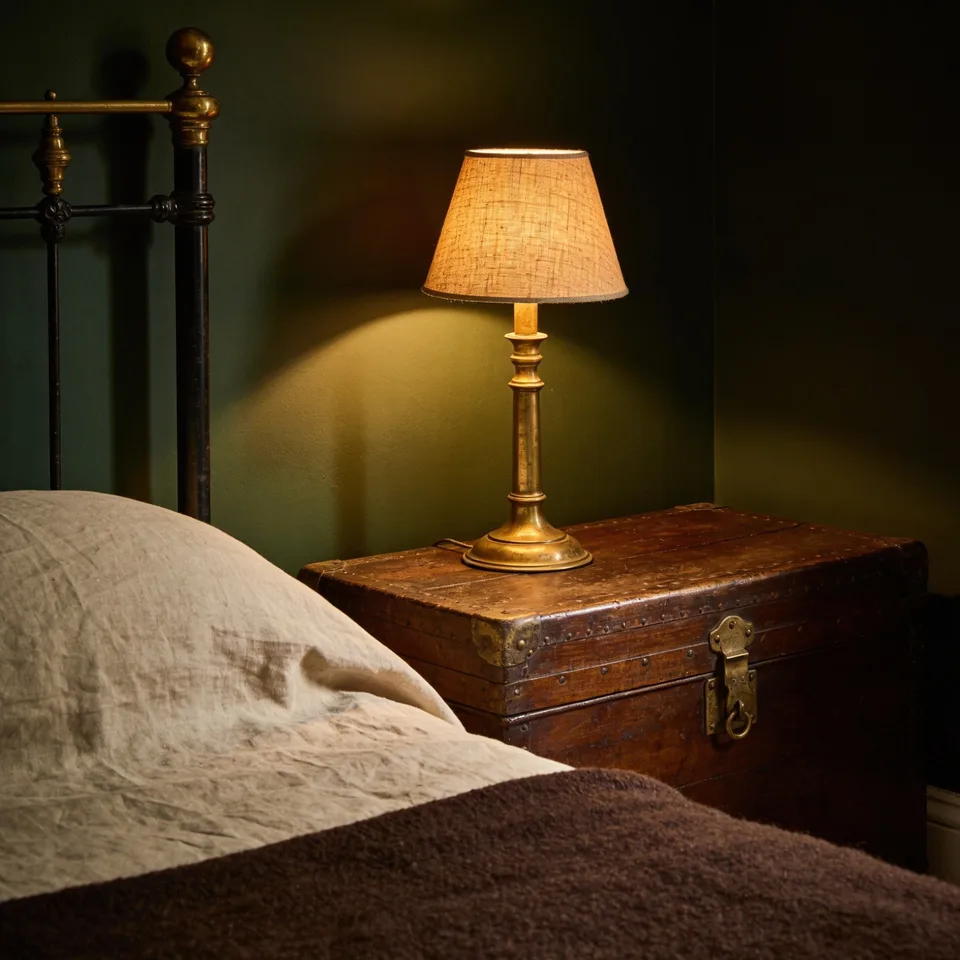
Deep walls change the arithmetic of light. Nothing bounces, so every lamp does exactly what it says and no more — which is why the lamps, not the paint, are where this room is won or lost. Two is the number. One at the bed, low enough that its circle lands on the book and not the ceiling; one across the room, on the chest or at the shoulder of a chair, so the dark has a far shore and the room keeps its size after nightfall. Bulbs at the candle end of warm — a bulb that shows a room its true colors belongs in a workshop. Shades of linen or paper, never a bare bulb, which undoes in one glance everything the walls were mixed to do. Aim the light at things — the page, the wood, the brass — and let the walls keep the dark, which is now their job. The ceiling fixture has no work after dusk. And if the far lamp happens to land beside a chair, the room has quietly acquired a reading corner, which is the den's whole promise in a single seat.
The window given back
A pale, bright room cannot see out of its own windows at night; the lit walls turn the glass into a mirror, and the room spends the evening looking at itself. A dark room gets the window back. With the walls deep and the lamps kept low, the pane goes clear again — snow arriving slantwise under the streetlight, the moon working slowly over the neighbor's roof — and the last minute before the curtains close becomes something to stand still for. The same walls are kind at the other end of the night. A pale room switches on with the first sun, all at once; a deep room lets morning in by degrees, the window brightening while the room around it stays dim, so that waking on a January morning feels less like an alarm and more like a tide coming in.
Begin with the second lamp
Nothing needs painting tonight. Go down to a room that finishes its work at dinner and borrow its warmest small lamp — the one with the fabric shade — and stand it across the bedroom from the bed. Light both ends of the room at dusk for a week, ceiling fixture off, and let the walls sit in it. By Friday the pale paint will have begun to look like the temporary arrangement it always was, and the green can be chosen without hurry, at ten o'clock, by the very light it is going to live in.
Common questions
Should you paint a bedroom a dark color?
The bedroom has more to gain from going dark than any room in the house. Count the hours it is actually seen: an hour of lamplight at night, half an hour of gray at seven, dark in between, so whatever the walls do at noon, almost nobody is there to know. Downstairs, a dark wall spends daylight the house might want back; up here there is no daylight to spend. Choose a dark with evening in it rather than ink — green with a spine of brown, clay, umber, the browned reds — because lamplight is brown-gold, and a wall with brown in its base takes it the way waxed pine does, warming as the evening goes on. A moody bedroom is less a style decision than a scheduling one: a room dressed for the hours it actually keeps.
How do you make a dark bedroom feel cozy instead of gloomy?
Divide the labor: the color does the depth, and texture does all of the warmth. Dark is not what makes a room cold, hardness is. Deep walls over a bare floor, gloss paint, chrome and glass and nothing soft anywhere read as a vault, while the same bottle green behind a wool rug, a waxed pine chest, and brass gone brown at its high points reads as a den. So keep the walls matte, never sheen, because flat paint drinks the lamp and lets it go slowly where gloss throws it back hard. Then wood with wear on it, wool anywhere it will lie, and brass left unpolished, since the brown in old brass is the same brown at the walls' root, and lamplight finds it first.
What color bedding goes with dark walls?
One shelf over from white: unbleached linen, oatmeal, clay, or a moss or bottle green that answers the walls without matching them. Optic white is a daylight material, and under lamplight against deep walls it turns to glare, the whitest object in the room by a distance, so the eye that came to rest keeps being called back to it. Black bedding is the other mistake. The sheets themselves can stay cream, since sheets spend the evening under other things; it is the visible acreage that sets the tone, the cover and the wool blanket over it, and those layers want to sit near the walls' depth so the bed reads as part of the dusk. Keep the contrast modest and the textures deep: wool over linen, nap over shine, weight over loft.