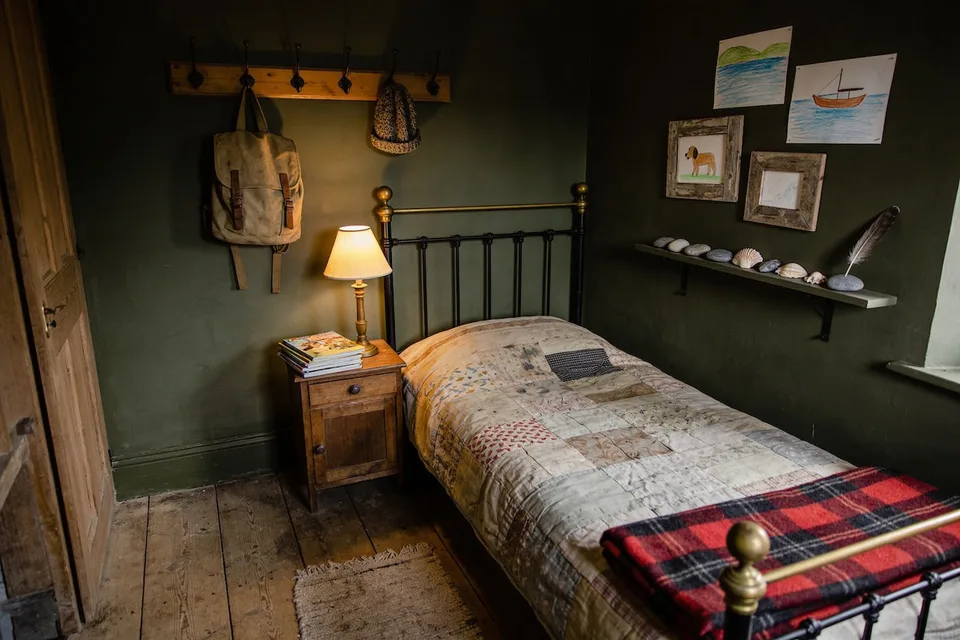
 Cottage at Home
Disclosure: some links below are affiliate links — buy through one and we may earn a small commission, at no extra cost to you.
The English cottage bedroom: accumulated, not decorated
What makes an English cottage bedroom read as kept, not styled — iron beds, inherited quilts, deep moody walls — and how to grow one without importing a thing.
In this guide
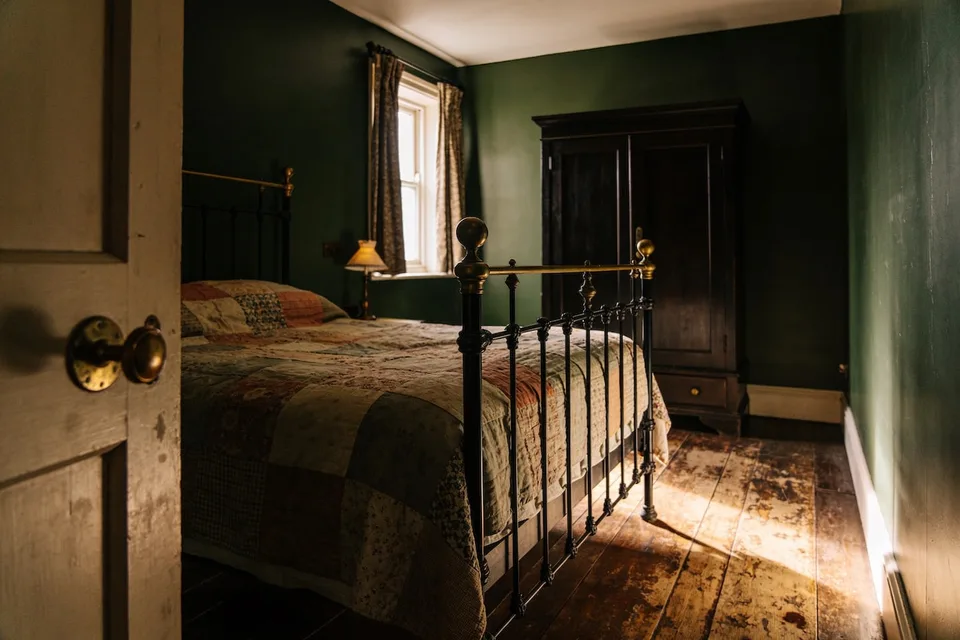
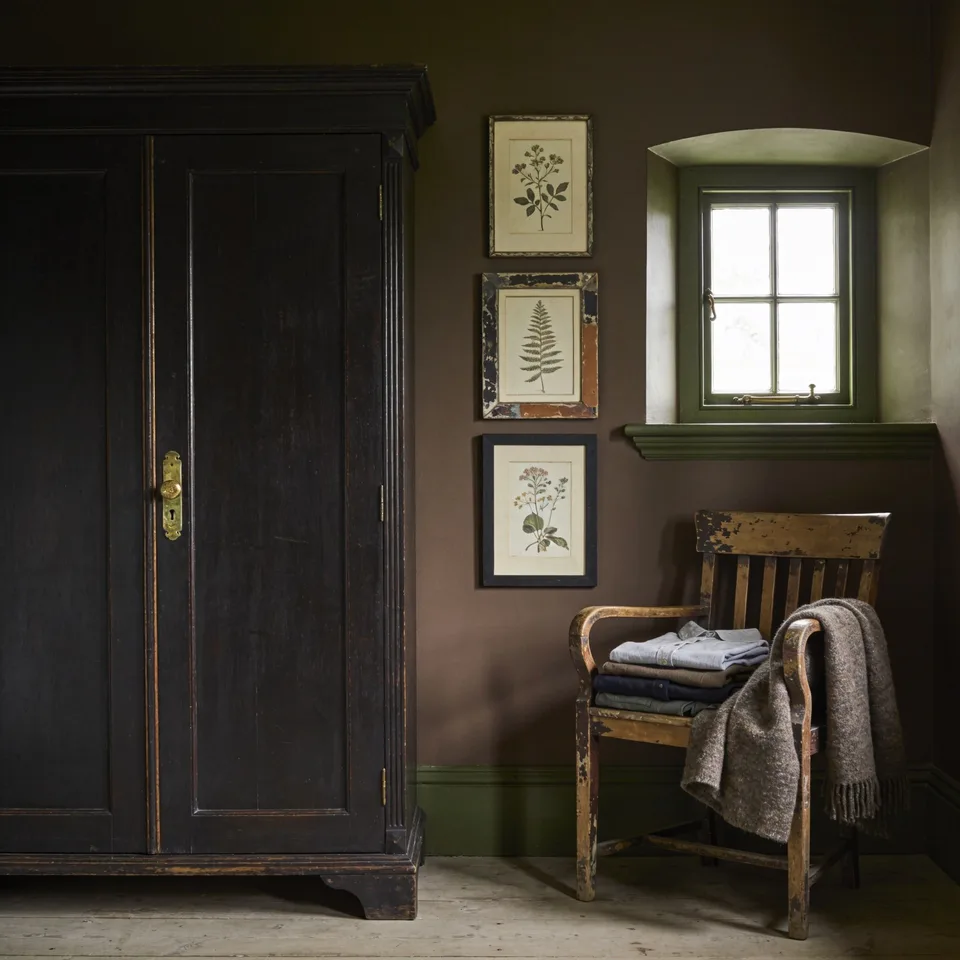
The bed came with the room, or might as well have — black iron, taller at the head than anyone makes them now, wearing a quilt that was pieced by somebody nobody can quite name from dresses nobody remembers being worn. The wardrobe beside the chimney has been there longer than the plumbing and stands slightly proud of the wall where the floor gave up being level. Three botanical prints hang by the window in frames that agree on nothing. The lamp is small, and it comes on early.
Nobody decorated this room. It filled — over years, from downstairs, from other houses, from the backs of cars after funerals and weddings — and the filling is the entire secret. The condition that makes an English cottage kitchen read as kept rather than installed climbs the stairs without losing anything: a room accumulated rather than schemed, tended rather than finished. If anything, the bedroom is the easier place to begin. It is the least public room in the house and the most forgiving — nobody performs in it, nothing in it has to match for company, and half of what it wants is probably in the family already, folded in a chest, waiting to be asked for.
What makes a bedroom read as kept
Most English cottage bedroom ideas arrive as a list of goods — the brass bed, the beamed ceiling, roses at a leaded casement — and the list is not wrong, only beside the point. Stand in the real room and what registers first is not any object. It is the sense that the room has been slept in, aired, and put right every morning for about a century, by people who never once thought of it as a project.
That sense has tells, and each one can be built:
- Nothing arrived together. The bed, the wardrobe, the chest of drawers, and the chair are four different woods from four different decades. A matched suite — headboard, dresser, nightstands in agreeing veneer — says one order, delivered on one day, and the room never quite recovers from the confession.
- The textiles are the oldest things in the room. Quilts and blankets outlive furniture up here. They fade on the window side, take a mend at the corner a heel always finds, and carry the record of the house the way brass downstairs carries handling.
- The furniture stands on legs. Wardrobe, washstand, chest — freestanding pieces with air under and around them, movable in theory and never moved. The fitted closet run and the built-in headboard wall are the bedroom's version of the seamless kitchen: one decision, wall to wall.
- The light is low and local. Lamps at the bed and the chair, switched on early, making small pools. The overhead, if it exists at all, is for finding a dropped earring, and nothing else.
Under the tells runs the same verb that runs the kitchen: kept. The bed is made, the window cracked for airing, the blanket folded back at the foot in April and drawn up in October. But the bedroom has a second engine the kitchen lacks — houses send things upstairs. The chair too good to discard, the lamp displaced by a newer one, the prints from a hallway that got repainted: the bedroom is where a household's objects retire, and retirement, given a decade or two, is indistinguishable from belonging. Decorating fights that current. Keeping steers it.
The bed: iron bones, borrowed quilts
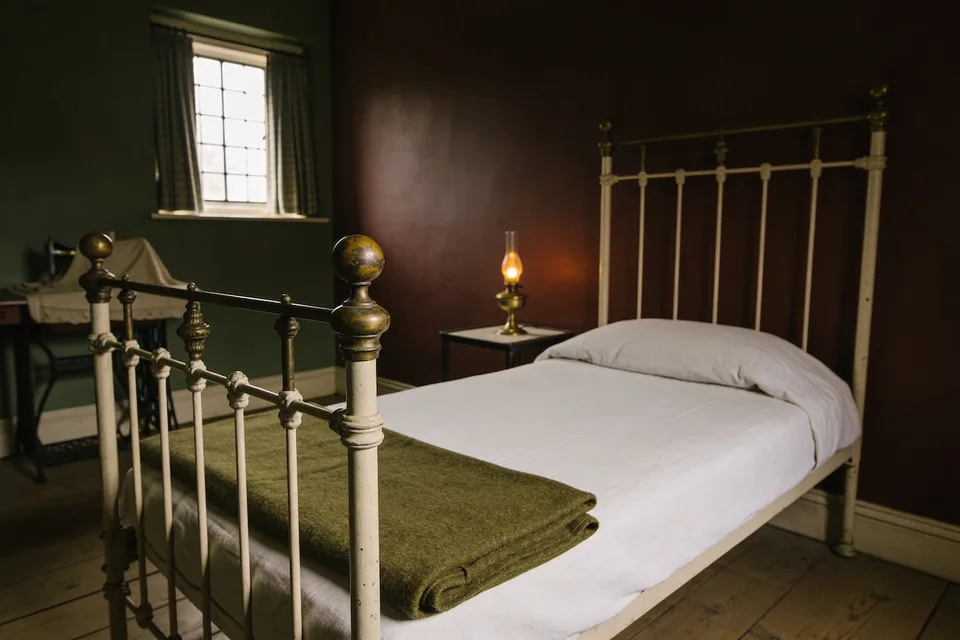
Begin with the frame, because the bed is to this room what the dresser is to the kitchen: the one big honest piece everything else stands in relation to. The old answers are iron or wood — a black or cream iron frame with rails and knobs and a little noise in it, or a wooden one with turned posts and a low foot — and they share the trait that matters, which is that they are furniture. Legs, air underneath, a frame the mattress sits in rather than a platform it disappears into. A padded headboard bolted to the wall reads as hotel; an upholstered platform reads as showroom; a frame with bones reads as something that was carried up the stairs at an angle, because it was. A plain new iron frame does this work without apology — the form has not needed changing in a century — and the old frames themselves surface constantly on this continent, out of farm attics and spare rooms, carrying one honest complication: many are doubles, a size this century finds small. Conversion rails solve it. So, some houses decide, does sleeping closer.
Then refuse the set. The coordinated ensemble — duvet cover, shams, a fan of agreeing cushions — is the loudest signal a bedroom can send that it was done in a single afternoon. The kept bed is gathered instead: plain white or cream sheets as the ground floor, a wool blanket doing the actual warmth, a quilt on top doing the actual talking, and a second blanket or quilt folded flat across the foot for the cold snap that comes every year to every continent. Nothing needs to agree. The quilt can argue with the blanket's binding, the folded one at the foot can argue with both, and the argument is the look — because the argument is how beds were made for two hundred years before bedding learned to arrive all at once in a zippered bag.
The quilts are where this subject stops being a metaphor. If there are quilts in the family — and on this continent there very often are, folded in a cedar chest two phone calls away — they belong on a bed and not in the chest: fading a little, mended when they need it, doing the exact work they were pieced for. This is the law that governs a grandmother's kitchen, applied one floor up: the inherited thing is not a relic to be preserved but a tool to be used, and use is what keeps it in the family in any sense that matters. A quilt with no family behind it serves too — other households' quilts surface constantly, orphaned and outliving their beds, and they take up a new post without complaint. Wear is not a defect in any of them. The fading on the window side is the room keeping a diary.
The same bed suits a child's room down the hall, chosen once for the teenager they will become. The cottage kids room is about the rest of that room, and the one wall that is theirs to change.
Walls that hold lamplight
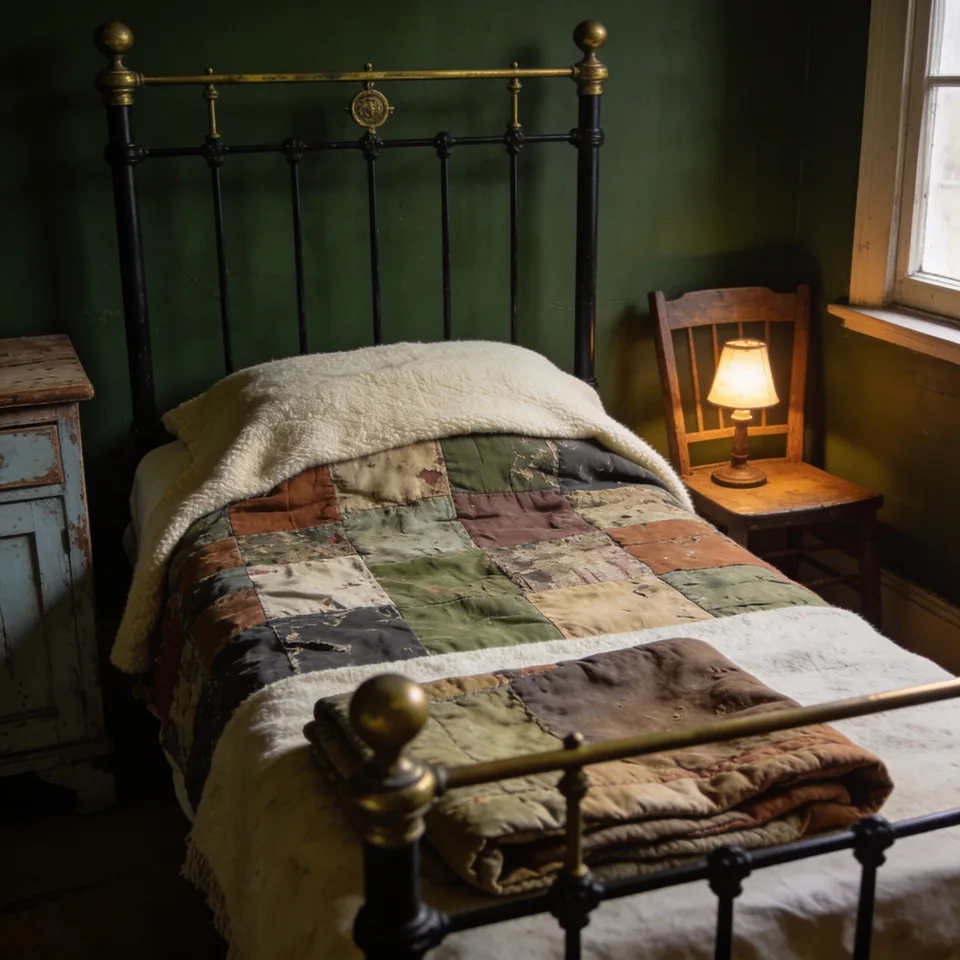
The usual instinct is to paint a bedroom the color of sleep as commonly imagined: pale, cool, hushed. The cottage instinct runs the other way. This is the room seen almost entirely at the dark ends of the day — last thing at night, first thing on a winter morning — and a room lived in by lamplight can carry far more color than one judged at noon. Deep green with brown folded into it. Umber. A red gone quiet toward old brick. The complicated, weathered end of the card, where a color changes its mind as the lamp comes on.
A bedroom gone darker behaves differently than a dark room downstairs. At night, deep walls stop bouncing the lamp around and let it pool, so the lit things — the bed, the book, the brass of the lamp itself — come forward while the walls step back into a standing dusk. The room feels smaller the way a coat feels smaller than a hall, which is the feeling bedrooms are for. The moodier bedroom is, at bottom, a lamplit bedroom: the walls do their real work after the sun has gone. Taking the trim along with the wall — one deep color straight over baseboard and casing — is the older habit, and it flatters ordinary drywall toward something more like old plaster. Where the ceiling slopes into the room, paint the slope too; the room becomes a tent of the color, which sounds alarming and sleeps beautifully.
There is a real trade here — deep color spends light, and a north-facing room with one small window will feel the cost by February — and the full argument, including how to test a color before trusting it, is made downstairs in the dark cottage kitchen. The bedroom version is shorter and kinder: judge the color at the room's own hours. Paint a board, stand it against the wall, and look at it at ten at night by lamplight, then again at seven on a gray morning. Noon has no vote in this room.
What earns a place upstairs
If the bedroom accumulates on its own, the question is not how to fill it but what gets to stay, and the working rule is short. A thing earns its place by being used, by being inherited, or by having been there longer than anyone can account for.
The wardrobe passes on all counts, which is why one anchors nearly every bedroom in this tradition. A freestanding wardrobe in a house that already has closets sounds redundant, and the redundancy is the point: nobody installs one anymore, so a wardrobe can only have arrived — with somebody, from somewhere — and it stands there saying so. It gives the room a second tall thing to answer the bed, it swallows the off-season clothes whole, and its door, which no longer quite latches, is the kind of small fault a kept room carries without embarrassment.
Botanical prints hold the walls for a similar reason: they were the ordinary art of every cottage century, cut from damaged herbals and hung in whatever frames the drawer offered. Hang them low and near — over the nightstand, beside the wardrobe, at heights a person in bed actually sees — in odd numbers and disagreeing frames, and they read as having landed one at a time, which is how everything in this room is supposed to land. If the walls have gone over to evening colors, a dark ground suits them even better: a set of six dark-ground florals waits in our own Etsy shop, the foxglove and the peony among them, drawn on grounds deep enough to hold their own against umber by lamplight, and printed at home.
The rest of the census earns its keep nightly. The chair holds tomorrow's clothes and a blanket in reserve. The washstand does the nightstand's work with a history behind it, and its marble has forgiven every water glass since the plumbing came. The lamp, the current book, the jar of whatever was blooming in the yard — used, used, used. What fails the rule is anything that arrived as bedroom decor: the cushions whose entire career is being moved to the floor at night, the lettered sign instructing the room to dream, the vase that has never met water. None of it works, none of it was handed down, and the room knows.
The window and its year
An English bedroom window sits low under the eaves, small and deep in its wall, and the bed is almost always placed to know it — set sideways to the light, headboard against something solid. A North American window is larger and thinner-framed, and the arrangement still holds. Put the headboard against mass, let the morning come across the bed rather than straight into the sleeper's eyes, and give the sill work: a geranium that tolerates the cold near the glass, a jar of whatever the yard is doing, a short stack of books between readings.
Then let the window run the calendar, because upstairs it does anyway. In June the light arrives before five and the curtains earn their lining. By October it comes in low and lands on the quilt mid-morning like a cat. By December the window is mostly for watching weather from under the blankets, and the lamps carry the room from four in the afternoon. The bed keeps the same calendar — the second quilt goes up in October and away in May, the wool blanket sits out the summer folded in the wardrobe — and a bedroom kept this way needs no seasonal decorating, because the seasons are already doing it.
The curtains themselves want weight: linen or wool, lined, hung from the plainest rod, long enough to actually close. Downstairs, a café curtain leaves the top of the glass open because a kitchen's business is with daylight. A bedroom's business is with dark, and in a deep-walled room especially, black open glass at night undoes the lamplight — curtains drawn give the walls back their color and the room its lid. And if there is a chair in this room, the window is where it drifts: one seat angled to the glass, a lamp at its shoulder, which is how a bedroom corner becomes a reading nook without a single board being cut.
Upstairs in a North American house
The recipe survives translation better upstairs than anywhere else in the house, because the bedroom's materials are the portable kind. The quilt is not even a translation — patchwork has been this continent's own bedroom art for as long as there have been scraps and winters, and the chest it is folded in is likelier to be in a relative's basement than in any English county. The iron bed crossed over early and multiplied; frames still come out of farmhouses and attics in every province and state. The wardrobe is orphaned weekly by closet-rich renovations, the washstand was orphaned by plumbing a hundred years ago, and both are glad of upstairs work. Nothing on the list needs a crate or an ocean.
And none of it is required to be old. A plain new iron frame, white sheets, a wool blanket, one secondhand quilt, walls painted some version of evening, lamps kept low, curtains that close — every piece of that can be new and unembarrassed about it, because kept is not an age. It is the habit: the airing, the folding, the putting-right, applied long enough that the room stops looking arranged and starts looking inhabited. Given the habit, a room assembled this year begins accumulating on its own. The family things find it. They always need somewhere to go. That is also why the room nobody sleeps in most of the year is the easiest one in the house to get right: it only has to be made ready for four nights, and the same short list of blanket, lamp and cleared drawer does most of the work.
The overhead light, retired
Tonight, not this weekend: leave the ceiling light off and cross the room to the lamp instead. Let the room be seen the way its whole tradition assumes — small pools, warm bulbs, corners allowed to go dark — and notice what it starts asking for. Walls a shade deeper. A blanket with more weight in it. The prints hung lower, where the lamplight can reach them. The switch by the door can keep its one job of finding the dropped earring. The room, meanwhile, will have begun keeping evening hours, which is the first old thing any bedroom learns.
Common questions
What makes a bedroom read as an English cottage bedroom?
Accumulation rather than decoration. An iron bed, quilts that were handed on rather than bought as a set, walls deep enough to hold lamplight, and objects that arrived one at a time over years. Nothing in the room looks chosen on the same afternoon.
Can you get the look in a North American house?
Yes, without importing anything. The room's character comes from proportion and light rather than from English objects: lower light, warmer wall colour, textiles with some age, and restraint about how much arrives at once.
What wall colour suits it?
Something deep enough to hold lamplight rather than reflect it. Pale walls throw a bedside lamp back into the room; a deeper wall absorbs it and leaves the pool of light where you are reading.