 Cottage at Home
Disclosure: some links below are affiliate links — buy through one and we may earn a small commission, at no extra cost to you.
The English cottage Christmas: handed down, not bought
An English cottage Christmas, handed down rather than bought — paper chains pasted at the table, holly from the hedge, mistletoe, crackers, stockings.
In this guide
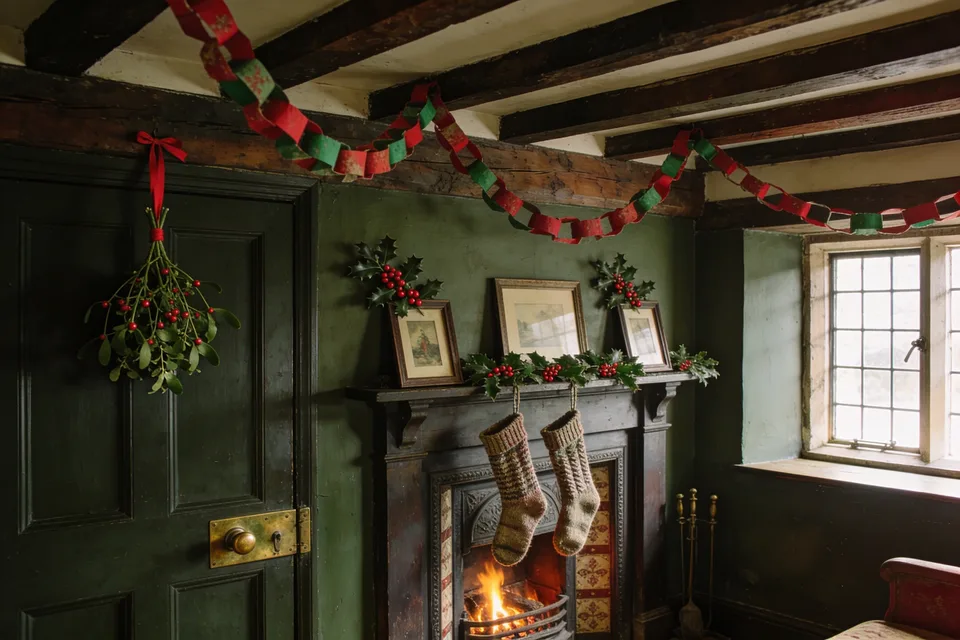
The chains go up on the first Sunday of December, because they always have — paper loops in faded reds and greens, pasted at the table over two evenings and slung between the ceiling beams until the room wears them like bunting. Holly stands among the picture frames. Two knitted stockings hang empty at the mantel, made by somebody two generations back and darned ever since. And on the door into the hall, tied with red ribbon, the mistletoe, which everyone passing under pretends not to have noticed.
Almost none of it was bought, this year or any year — and that is the entire subject. The English Christmas admired from this side of the ocean — the greenery, the paper, the small rules thick on the calendar — was never a look that could be ordered. It was a set of things done: cut on one morning, made at one table, hung in one doorway, pulled at one meal — done last year and the year before, until nobody can say when it began. The kept house in December runs on greenery over glitter; the English cottage adds the older layer, which is ritual, and ritual travels better than furniture. The argument that lets the English cottage kitchen be begun an ocean from its low stone original — that kept is a condition, not an address — holds in December best of all. A tradition cannot be shipped. It can only be started.
Paper chains, pasted at the table
Start with the paper, because the paper is where the doing is plainest. A paper chain is a strip, a loop, and the next strip through it — a thing so simple that for generations English stationers sold strips ready-cut in packets, gummed at one end like stamps, and children licked and looped their way through December evenings. Before the packets it was wallpaper offcuts and flour paste. Nothing about it has advanced, because nothing needed to: scissors, a glue stick, and whatever colored paper the house already holds — last year's wrapping smoothed flat, the best pages of a seed catalog — and an evening turns into thirty feet of chain.
Hang it generously or not at all: corner to corner across the ceiling, meeting at the light fixture. A chain wants to droop — the sag between fastenings is the whole line of it — and it looks best in rooms that have stopped apologizing for being small. By New Year it will have faded unevenly, and it will tear coming down; that is not failure, it is the design. The chain was never the decoration. The evening was, and the evening keeps.
Holly from the hedge, mistletoe over the door
Holly earned its place in the cottage by growing within reach of it — in the hedge, the churchyard, the corner of the garden nobody planted — and it was cut the way beans were picked. The berries do the season's red, and the sprigs go where holly has always gone, which is not into arrangements but behind things: behind the picture frames, along the mantel among the plainer green, one stem in the jug on the sill. Some houses held it back until Christmas Eve — early greenery, the feeling ran, carried the wrong luck — and most now settle for mid-December. Where no hedge offers, this continent grows its own answer: winterberry, the native holly, bare-stemmed and berried like a drawing of the English kind, in bunches at every winter market — and florists sell true holly by the stem. Settlers in Canada, with no hedge to cut from, took their Christmas from the woods and the larder instead, which is where traditional Canadian Christmas decorations begin. The errand survives either way: something is cut, carried in wet, and the coats drip in the room that takes the weather while the stems get their water.
Mistletoe keeps a different station. It is not scattered but hung — one sprig, over one doorway, the busiest the house owns — because its whole job is to be passed under. In England it grows half-wild in orchard trees and comes down with a hook; here it is bought, a sprig in a paper sleeve, and no less itself for that. Tie it with ribbon, hang it from the lintel nail, and let the custom decorate: a kiss for whoever meets beneath it, and in the strict old accounting a berry came off with every kiss, so the sprig kept its own tally and ended the season spent. A house needs exactly one. More is a misunderstanding of the plant.
Crackers at the table
A cracker is a paper parcel the shape of an oversized sweet — which is what it began as, a Victorian confectioner's wrapper that outgrew its filling — and it lies crossed on the plate at every setting, oldest guest to youngest. It is the tradition's loudest object, and the day itself brings it. The rules are fixed. Arms cross, each cracker is pulled with a neighbor, the snap goes off, and whoever holds the larger half keeps the contents: a paper crown, a motto with a joke bad enough to be traditional, some small thing that skitters under the sideboard and is found at Easter. Everyone wears the crown. This is the rule that matters, and it binds hardest on whoever announces that they will not; by the pudding they are crowned like everyone else, and the table is a parliament of tissue-paper royalty passing the sprouts.
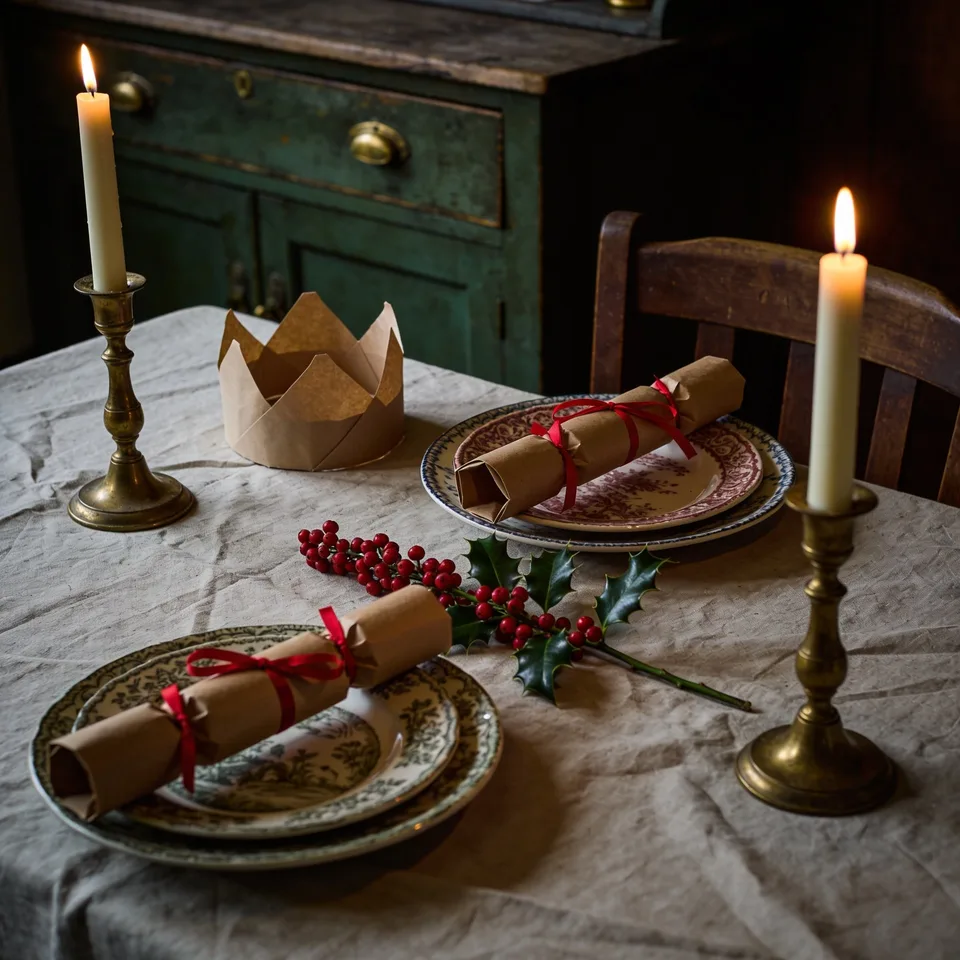
Groceries on this continent stock crackers all December, some plain and good, many glittered. The kept-house move is plainer still: crackers can be made — tissue, thin card, the saved core of a paper roll, snap strips from any craft shop — and a homemade cracker holds what a bought one cannot, which is a joke written for the actual person whose plate it waits on. The rest of the table needs nothing new. The creased cloth, the collected-singly plates, and the odd chairs were all rehearsed at the November table, and by the time the crowns are on, the meal has gone over to candlelight — what that flame does against deep walls is its own December subject, argued down the hall.
Stockings, and where they hang
The stocking predates the mantel it now decorates. The older habit hung it at the end of the bed — an iron footboard is made for the job, and the English cottage bedroom upstairs still offers the original position — and the mantel won later, where the fire was the warmer promise. Either post is correct. What matters is the object: a real stocking, knitted or sewn, named or initialed, no two in the house alike, brought out yearly until it needs darning, and then darned. The matched velvet set, monogrammed in a single font, is the coordinated bedding of the fireplace — one order, one afternoon, and everyone can tell. A stocking earns its hook by coming back.
What goes in it kept, for generations, to a famous minimum: a clementine in the toe, walnuts, a coin, one small thing truly wanted. The list survives not out of thrift but out of fit — a stocking is a small container, and small containers set kind limits. By Twelfth Night it is empty again, folded away until next winter: a sock eleven months of the year, and decoration only because the household keeps faith with it. None of that is for sale.
One evening, one chain
Begin before the season quite does. Some evening in early December, with the kettle just boiled, cut whatever colored paper the house already holds into strips, and make one chain the length of one wall with whoever is around to loop it. Hang it where the room passes under it daily. It costs nothing, matches nothing, and will not survive to February, which is exactly how the tradition works. A tradition is only a thing a house has done twice. The chain is the cheapest possible way to start counting.
Common questions
How do you make old-fashioned paper chains for Christmas?
With scissors, a glue stick, and whatever colored paper the house already holds — last year's wrapping smoothed flat, the best pages of a seed catalog. A chain is only a strip, a loop, and the next strip through it, and an evening at the table turns into thirty feet of chain. Hang it generously or not at all: corner to corner across the ceiling, meeting at the light fixture, and let it droop, since the sag between fastenings is the whole line of it. By New Year it will have faded unevenly, and it will tear coming down — that is the design, not a failure. The chain was never the decoration; the evening was.
How do Christmas crackers work at the table?
A cracker lies crossed on the plate at every setting, and the rules are fixed: arms cross, each cracker is pulled with a neighbor, the snap goes off, and whoever holds the larger half keeps the contents — a paper crown, a motto with a joke bad enough to be traditional, some small thing that skitters under the sideboard. Everyone wears the crown; that is the rule that matters, and it binds hardest on whoever announces that they will not. Groceries stock crackers all December, but they can also be made from tissue, thin card, the saved core of a paper roll, and snap strips from any craft shop — and a homemade cracker holds what a bought one cannot, which is a joke written for the actual person whose plate it waits on.
What goes in a traditional Christmas stocking?
A clementine in the toe, walnuts, a coin, and one small thing truly wanted. The list has kept to that famous minimum for generations, not out of thrift but out of fit — a stocking is a small container, and small containers set kind limits. The stocking itself matters as much as the filling: a real one, knitted or sewn, named or initialed, no two in the house alike, brought out yearly until it needs darning, and then darned. By Twelfth Night it is empty again and folded away — a sock eleven months of the year, and decoration only because the household keeps faith with it.