 Cottage at Home
Disclosure: some links below are affiliate links — buy through one and we may earn a small commission, at no extra cost to you.
Vintage Thanksgiving table: the cloth, the odd plates and the low light
A vintage Thanksgiving table for the Canadian meal in October or the American one in November: the once-a-year cloth, plates and stemware gathered one at a time, brass tapers, and every chair in the house pulled up.
In this guide
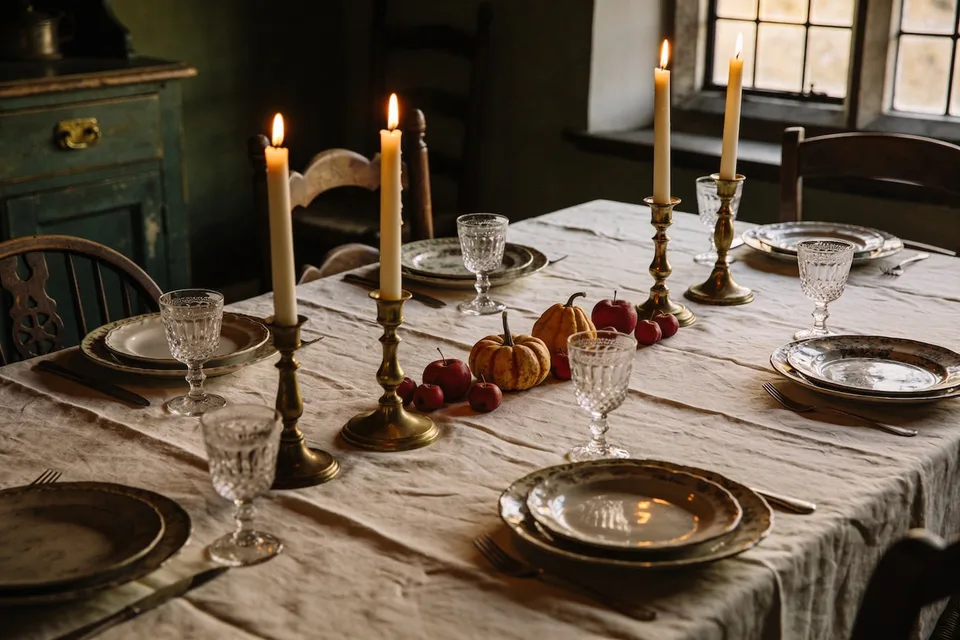
Twice each autumn the table is asked to be more than it is. Canadian Thanksgiving comes first, the second Monday of October, while the maples are still holding most of their colour; the American one follows at the end of November, when the trees are bare and dark arrives before the pie does. Different weather, same request: more chairs than the room owns, more plates than one shelf carries, a meal that begins in daylight and ends by flame. And in a kept house the answer to that request is not bought in October. It is assembled — out of the cupboard over the fridge, the drawer that sticks, the box of leaves in the hall closet, and whatever the thrift shelf has been quietly supplying all year.
The table stretched past itself
Somewhere in most dining tables there is a table and a half. The leaves come out from under the bed or the back of a closet a shade different from the rest of the top — less faded, less marked, wood that has spent its life in the dark being kept — and the seam where they drop in is nothing to apologize for; it is the line where the everyday table ends and the holiday begins. The rest of the year, the supper table works low and mostly bare, and that is its own quiet law. The feast suspends it. Once the leaves are in, the chairs are conscripted from the whole house: the desk chair, the piano bench, the two from the porch wiped down, the folding chair that lives behind the furnace. A holiday table seated in matching chairs looks furnished; one seated in whatever the house could muster looks attended, and attended is the better look. Nobody at the meal remembers the chairs matching. Everybody remembers there being room.
A cloth that has done this before
The once-a-year cloth is the strongest single piece of holiday decor a house can own, and it is almost never bought new. Some come down through families — hemstitched linen, a border of drawn threadwork, initials in one corner belonging to somebody two generations gone — and the rest come through the thrift store, where banquet-sized cloths wait folded on the same secondhand shelves that supply the rest of the fall layer, priced at a fraction of their yardage because households that seat twelve have gotten rare. Either way the cloth arrives with its history pressed in. The fold lines from eleven months in the cupboard can be hung out on the line the day before, or ironed while the kitchen is still calm, or simply left — creases are the plainest proof there is that a cloth is kept, not new. And the faint ghost of some earlier year's gravy, washed down to a shadow, is not damage. It is a record of service, the tablecloth's version of the heat ring, and it means the cloth has sat through this meal before and knows how it goes.
Settings gathered one at a time
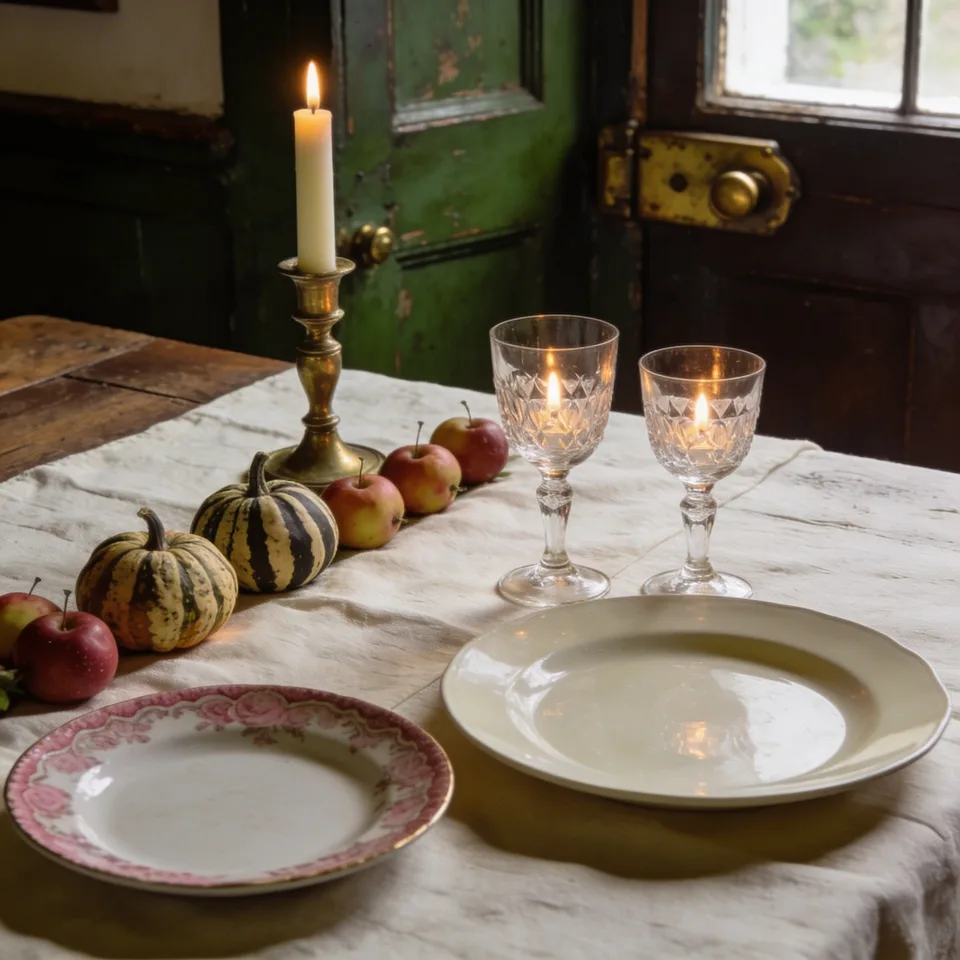
Almost nobody inherits a whole service for twelve anymore, and the holiday table is better for it. Plates gathered singly — a rose rim beside plain ivory, blue transferware beside a gilt edge worn to a whisper — read as years and households rather than one purchase, and they give every seat a small identity: in houses that eat this way, somebody is always seated at the pheasant plate, and it is always the same somebody. Stemware follows the same law. One stem per person and no two alike — a pressed-glass goblet, a lone survivor of somebody's wedding crystal, an etched water glass gone soft at the rim from washing — costs a dollar or two apiece gathered over a year of Saturdays, and by candlelight a run of unmatched stems catches the flame at six different heights down the cloth. The line between collected and accidental is drawn simply. One odd plate at a matched table reads as a shortage; every plate different reads as a decision, and the cloth underneath, holding all of it on one ground, is what makes the decision look calm.
Serving pieces with one working day a year
Every kept house has a shelf of things that work one day a year: the platter sized to the bird and to nothing else, the gravy boat, the lidded tureen, the footed compote, the divided relish dish that exists because this meal exists. They are the most inherited objects in a house and the cheapest on the secondhand shelf for the same reason — every grandmother owned them, and the apartments that came after had no cupboard willing to house them. Take them in anyway. A turkey platter spends three hundred and sixty-four days in the sideboard's low cupboard, down the hall from the kitchen's other older things, and earns the space in one afternoon of arriving at the table full. And whatever was saved for good should be out, because this is the day good was saved for; china that never leaves its box has been retired, not kept. A chipped lid, a crazed glaze, a mend from before glue was any good — none of it disqualifies a dish from service. It certifies it.
A middle from the garden and the larder
The seasonal aisle sells a finished centrepiece for this meal — wired silk leaves, plastic berries, a candle ring — and it is the one thing the holiday table has no use for, because the meal itself is the centrepiece and the middle of the cloth only needs to agree with it. So the middle comes from the garden and the larder: small gourds and one striped squash, crabapples, walnuts still in their shells, the last rosehips, a few stems of dried hydrangea or seed heads from the fencerow, laid down the length of the cloth in a loose run rather than massed into one arrangement. A stretched table wants length, not a summit. Everything stays low, below the conversation, for the same reason the everyday table keeps its jug short, and nothing minds being moved when the platters land, because nothing is fixed to anything. It is the season the rest of the house has been keeping since September, arriving at the cloth — food, and things that were nearly food, standing in for abundance because they are the real thing.
The meal in low light
The two Thanksgivings end the same way, at different hours. In mid-October the Canadian meal begins in afternoon light and finishes at dusk, the window going blue behind the stems; by late November the American table is candlelit from the first course, dark by half past four, the whole meal carried on flame. Either way, low light is where all of it — the creased cloth, the odd stems, the brass gone soft with handling — stops being mismatched and becomes one thing. Tapers down the length, the big light off, and the differences between the plates fall away into warm and lit; candlelight has been forgiving tables like this one for as long as there have been tables. A dining room kept deliberately dark understands this all year, but the feast is where the argument finishes: the room narrows to the cloth, the cloth holds everything the house has kept, and the faces lean in. When the chairs push back at last there will be wax down the candlestick shoulders and a new faint shadow near the gravy's seat, and both already belong to next year's table.
For the wall the table sits under, our Cottage Thanksgiving printable set is six vintage-look prints for the season, run off at home and framed in whatever the house already has.
If no cloth came down to you, begin one. Some Saturday before the holiday, take the thrift shelf's best banquet cloth home for a few dollars, wash it, and let it do this October; fold it away afterward with its creases and its one new shadow, and bring it out again in late November, or next year. Every handed-down thing on every table started exactly there — as the year somebody decided a thing was worth keeping. The inheritance does not have to arrive. It can leave from here. Bring the same cloth out again five weeks later and the Christmas table is most of the way laid already.
Common questions
Do Thanksgiving plates and glasses have to match?
No. Plates gathered one at a time, a rose rim beside plain ivory, transferware beside a gilt edge worn soft, read as years and households rather than one purchase, and one stem per person with no two alike costs a dollar or two apiece gathered over a year of Saturdays. The line to hold is simple: one odd plate at a matched table reads as a shortage, while every plate different reads as a decision, and the cloth underneath, holding all of it on one ground, is what makes the decision look calm.
What do you do if you do not have enough chairs for Thanksgiving dinner?
Borrow from the rest of the house. The desk chair, the piano bench, the porch chairs wiped down, the folding chair that lives behind the furnace: once the leaves are in, every seat the house owns is fair game. A holiday table seated in matching chairs looks furnished; one seated in whatever the house could muster looks attended, and attended is the better look. Nobody at the meal remembers the chairs matching. Everybody remembers there being room.
What goes in the middle of a Thanksgiving table?
The garden and the larder, laid low down the length of the cloth. Small gourds and a striped squash, crabapples, walnuts still in their shells, the last rosehips, a few dried stems or seed heads, set in a loose run rather than massed into one arrangement, because a stretched table wants length, not a summit. Keep it below the conversation and fix nothing to anything, so nothing minds being moved when the platters land. The meal itself is the centrepiece; the middle only needs to agree with it.
When is Canadian Thanksgiving, and does the table change from the American one?
Canadian Thanksgiving comes first, the second Monday of October, while the maples are still holding most of their colour; the American one follows at the end of November, when the trees are bare. The request is the same both times: more chairs than the room owns, more plates than one shelf carries. What changes is the light. In mid-October the Canadian meal begins in afternoon light and finishes at dusk, the window going blue behind the stems, so the tapers go on as the meal goes on rather than from the first course.