 Cottage at Home
Disclosure: some links below are affiliate links — buy through one and we may earn a small commission, at no extra cost to you.
Vintage Christmas table setting: transferware, old glass, and a cloth that shows by candlelight
A vintage Christmas table setting gathered second-hand: red transferware, cut crystal, green depression glass, spotted mercury glass and an old damask cloth.
In this guide
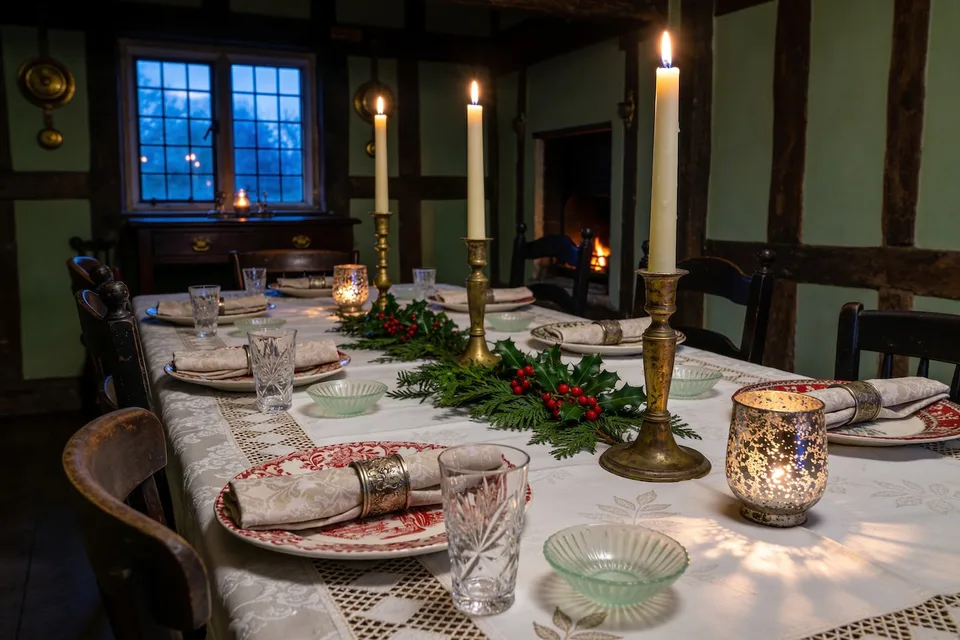
By three o'clock on Christmas Eve the cloth is down and the light has already begun to go. It's a white damask, a few dollars at a church sale a dozen Decembers ago, and in the flat afternoon it reads as plain white linen. Then the first taper is lit, and the pattern comes up out of it: a border of leaves and a lattice running the length of the table, woven white on white, there only where the flame rakes across the weave. Red transferware plates go down, no two the same pattern. A small green glass dish at each place, two spotted old mercury glass holders that look like silver and never were, cut crystal to the right of every knife, and napkins pushed through rings that carried somebody else's initials before they carried ours. Nothing on the table was bought new. Most of it cost less than the ham.
Search for a vintage Christmas table setting and you'll be shown finished tables: a retailer's grid of matching mercury glass, a boxed set of twelve holly plates, a runner and napkins sold together so they agree. What nobody shows is how a table like this gets gathered, a Saturday at a time, out of things that have already lived through other people's Christmases, and how the decades on it are made to sit together by candlelight. That's this page. The November table was the rehearsal: the leaves in, the odd chairs, the settings collected singly. The English cottage Christmas says the table needs nothing new, and it's right. This page is about what that nothing new is made of.
Set with things that have already lived
A vintage Christmas table setting, in this house, is a table laid entirely from second-hand things: red transferware plates in more than one pattern, cut crystal and green pressed glass, old mercury glass holding the candles, and a damask cloth underneath that has done this before. Nothing on it matches, and the cloth is what holds it together.
The vintage part is only partly about age. The dining room read by era makes the case the rest of the year: the things of the table outlast everything around them, and a fork is never in fashion or out of it. December is the one month the house lets all of those decades onto one cloth at once and lights them. What keeps that from looking like a jumble is one plain rule. Everything on the table can disagree about its date as long as it agrees about its color: white cloth, one family of red on the plates, green in the glass and the branches, silver and brass wherever the flames are. Hold to that and a 1930s pressed dish sits beside a Victorian plate and neither looks out of place, because by candlelight nobody is reading dates.
Almost all of it comes from second-hand shelves, gathered singly across a year, by the method the whole house uses for old things: a thing comes in because it has a job, and the job here is a seat at this table. A single red plate is worth carrying home and a stack of eight matched ones usually isn't, because the stack was bought once and will always read that way, where eight singles read as eight Decembers. Leave the holly-printed set and the mercury glass sold by the dozen on the shelf. They aren't bad things. They just arrive finished, and a table like this one never is.
The cloth: damask that only shows by candlelight
The Christmas cloth here is old white damask, and it's chosen for one reason: the pattern is woven in the same color as the ground, so it disappears in flat daylight and comes up when a low flame rakes across it. A cloth like that does more for a candlelit table than anything you could set on top of it.
Damask is a weave, not a print. The figure is made by the threads changing direction, so the leaves catch light one way and the ground catches it the other, and the design is only there when the light is low and coming from the side, which is a description of a candlelit dinner. Under the kitchen's overhead light the cloth is plain; at half past four with six tapers going, it's the most patterned thing in the room. Vintage damask table linen turns up on the second-hand shelf folded and yellowed along the creases, priced like any old cloth, because most households stopped ironing anything this size a generation ago. Take the big ones. A banquet cloth folds under itself to fit a shorter table, and it irons the way every cloth in this house irons, damp and hot, the day before rather than the morning of.
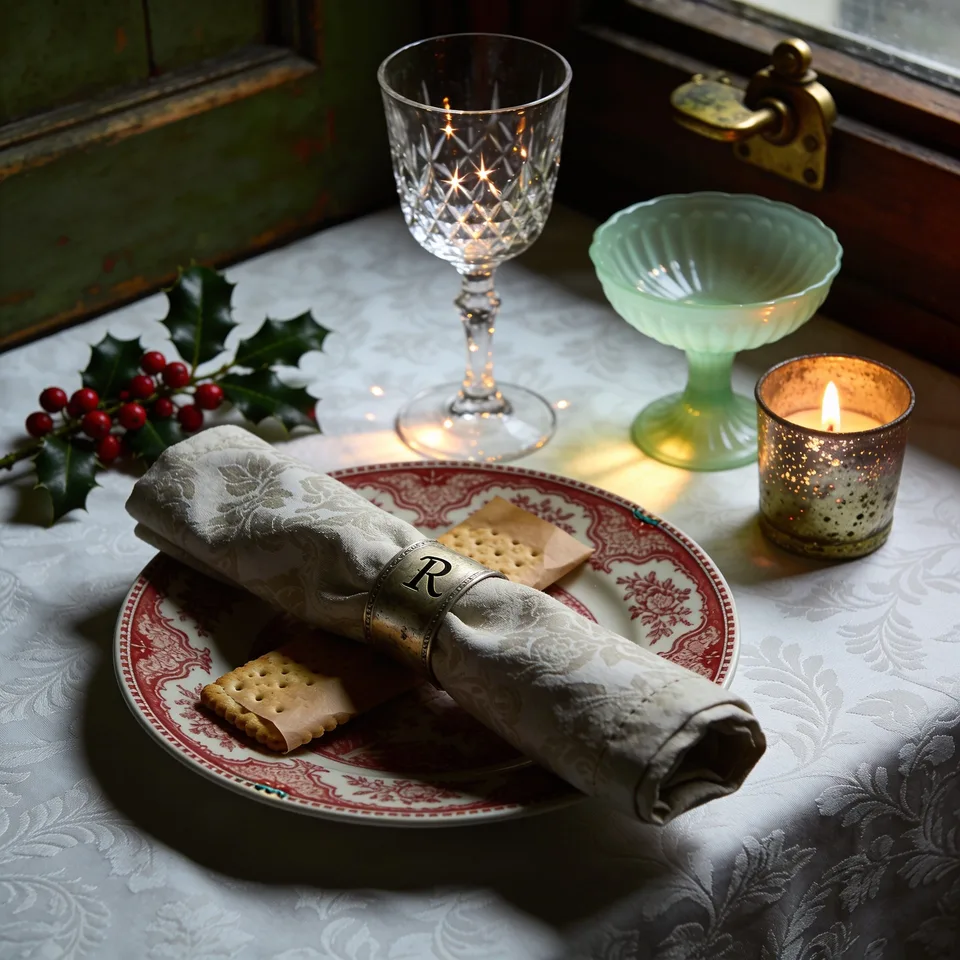
The napkins are the same weave, and old dinner napkins are enormous, some of them two feet square. They go through antique napkin rings, and the rings are the one place the table lets the eras show plainly. A napkin ring was made for a house where the same napkin served all week and everybody needed to know which was theirs, which is why old ones carry a single initial or a number and almost never turn up as a matched set. That's their use now: each person gets a ring, the same ring every year, and the ring is the place card. Where the silver plate has worn through to brass on the rim, a century of thumbs pushed the napkin in. Leave it.
Plates: transferware, and which red
The plates are transferware, the printed English pottery that has been cottage china since the late 1700s, and for Christmas the color is red: red or pink on white, in whatever patterns the shelf has yielded. The brown transferware that did the autumn table goes back in the cupboard, because on a Christmas cloth brown reads as a leftover.
Transferware is printed, and the printing is what makes old plates so easy to mix. The pattern was engraved on a copper plate, inked, pulled onto thin tissue, and the tissue laid by hand on the unfired pot; then the pot was glazed and fired and the tissue burned away. Every old plate carries the marks of that hand: a seam in the border where two pieces of tissue met, a corner where the pattern blurred because the tissue slipped. A factory set can't have those, and on a table of a dozen patterns they're what the eye rests on.
Mix them freely, within the color. A pink castle beside a red rose beside a shepherd under a red tree all agree because the red agrees and the white agrees, and what you're after is a plate at every setting that's clearly a cousin of the next, never a twin. The November table's transferware was blue and brown; December wants red, and red is the harder color to find in ones and twos, which is the argument for starting in January when the thrift shelves fill with what somebody's family cleared out after the holidays. A chip on the rim goes to the person who'd mind least. A crazed glaze, the fine web of lines in an old plate's surface, goes anywhere, because by candlelight crazing reads as depth. A cracker lies across the plate, and that's the whole dressing of it.
Glass: cut crystal, and the green that came free with flour
Two kinds of old glass work the Christmas table: cut crystal for the wine, which throws candle flame down the cloth in small sharp points, and green pressed glass from the 1930s for whatever else needs a dish, because green glass under a taper throws green onto white linen and nothing else on the table can do that.
The crystal's argument is made for the rest of the year in the dining room, and Christmas only asks for more of it: one cut glass at every place, no two alike, gathered singly for a dollar or two the way the pressed goblets were for November. Telling hand-cut from molded takes a thumbnail. Run it across the pattern: a cut glass has edges sharp enough to catch the nail, where a pressed one is smooth and rounded and usually carries a faint seam up the side where the mold closed. Both are welcome here. The cut ones go nearest the tapers.
The green is the part the retailer grids never think of. Depression glass is the machine-pressed colored glass American factories turned out through the 1930s so cheaply that it was given away, a dish in a sack of flour, a plate for sitting through the second feature at the picture house. Pale green is the commonest color, and a good deal of it has a trace of uranium in the mix, which is why a green sherbet dish glows under a blacklight and why it takes candle flame lit from inside rather than reflecting. Vintage green depression glass is still among the cheapest old glass on any shelf, because so much of it was made. One footed sherbet at each place holding the cranberry sauce, or a green plate under the pudding, is enough. The green answers the cedar and the holly, and it's the one green on the table that also shines.
Mercury glass and brass, where the flames stand
The candles stand in old mercury glass and brass, at two or three heights, none above chin height. Mercury glass is blown double-walled and silvered on the inside, so it gives the table the look of old silver at a thrift-shelf price, and where the silvering has spotted with age it takes a flame better than the bright new kind.
Old mercury glass was never mercury and never solid silver. A glassblower made a piece with two walls and a gap between them, poured a silver solution in through the hole left where the blowing rod came away, drained off the extra, and sealed the hole with a metal disc and a little glass plug, or a cork under wax. It was cheap silver for households that would never own the real thing, made in quantity for only a few decades in the middle of the 1800s. Turn a piece over. The old kind has a plug or the trace of one in the base and a wall you can see doubled at the rim; the new kind, sprayed silver on the inside of a single wall, has a solid bottom and a shine with no depth to it. Where an old seal failed, damp got in and the silvering went gray and spotted in patches, and that's the piece to buy. A flame beside spotted mercury glass reads as candlelight on old silver; beside the new kind it reads as a mirror. Mercury glass candle holders in the old double-walled kind turn up as votives, small vases and goblets that hold a taper as well as a stem, and the spotting keeps the price down. One rule of care: never put them in water. The seal is the weak point, and water that gets past it lifts the silvering, with no putting it back. Wipe the outside and leave the inside alone.
The brass does the rest: the tall tapers stand in the same brass candlesticks that carried November, at unequal heights, so the pools of light join down the cloth. The whole kept house runs on brass and flame in December, and the table is only where the most of it gathers.
Setting it, in the order that works
Set the table on Christmas Eve, in this order: the blanket, the cloth, the candles, the plates, the glass, the napkins in their rings, and the greenery last, on the day. Candles go on before plates so their heights are decided while the cloth is still empty, and cut greenery goes on last so it's fresh through the meal.
The blanket first: an old wool blanket or a length of felt cut to the table, which is what a silence cloth was, the layer old houses laid under the linen so the plates landed quietly and the hot dishes never met the wood. It also gives damask a soft ground to lie on, so the woven pattern shows as texture rather than as creases. Then the cloth, folded under at one end if it's a banquet size.
Candles next, before a single plate, because the heights are a decision and a crowded table can't make it. Stand the brass and the mercury glass down the middle and move them until the tallest flame sits below the faces and the pools of light meet. Then the plates, the cousins spread out so the two most alike never sit side by side. Glass to the right, above the knife, with the cut crystal beside the taller candles where it can catch them. Napkins pushed through their rings and laid on the plate, with the cracker across. The greenery is the last thing and the only thing done on the day: cut cedar laid flat between the candles, holly tucked in where red is wanted, all of it low enough to pass a dish over. Everything down the middle of a Christmas table eaten after dark has to stay below the conversation, and a table set in this order stays there on its own.
Begin with one plate
This Saturday, if the thrift shop has one red transferware plate on its shelf, bring it home and wash it. Put it at your own place at supper tonight, under whatever light you usually eat by, and find the seam in its border where the printer's tissue met.
Next Saturday, look for its cousin. That's the whole method, and December is still a long way off.
Common questions
How do you set a vintage Christmas table?
Set the table on Christmas Eve, in this order: the blanket, the cloth, the candles, the plates, the glass, the napkins in their rings, and the greenery last, on the day. Candles go on before plates so their heights are decided while the cloth is still empty, and cut greenery goes on last so it's fresh through the meal. The blanket first: an old wool blanket or a length of felt cut to the table, which is what a silence cloth was, the layer old houses laid under the linen so the plates landed quietly and the hot dishes never met the wood. Stand the brass and the mercury glass down the middle and move them until the tallest flame sits below the faces and the pools of light meet. Glass to the right, above the knife, with the cut crystal beside the taller candles where it can catch them. Napkins pushed through their rings and laid on the plate, with the cracker across.
How can you tell old mercury glass from new?
Turn a piece over. The old kind has a plug or the trace of one in the base and a wall you can see doubled at the rim; the new kind, sprayed silver on the inside of a single wall, has a solid bottom and a shine with no depth to it. Old mercury glass was never mercury and never solid silver. A glassblower made a piece with two walls and a gap between them, poured a silver solution in through the hole left where the blowing rod came away, drained off the extra, and sealed the hole with a metal disc and a little glass plug, or a cork under wax. Where an old seal failed, damp got in and the silvering went gray and spotted in patches, and that's the piece to buy. One rule of care: never put them in water. The seal is the weak point, and water that gets past it lifts the silvering, with no putting it back.
What color transferware goes on a Christmas table?
Red: red or pink on white, in whatever patterns the shelf has yielded. The brown transferware that did the autumn table goes back in the cupboard, because on a Christmas cloth brown reads as a leftover. Mix them freely, within the color. A pink castle beside a red rose beside a shepherd under a red tree all agree because the red agrees and the white agrees, and what you're after is a plate at every setting that's clearly a cousin of the next, never a twin. The November table's transferware was blue and brown; December wants red, and red is the harder color to find in ones and twos, which is the argument for starting in January when the thrift shelves fill with what somebody's family cleared out after the holidays. A chip on the rim goes to the person who'd mind least.