 Cottage at Home
Disclosure: some links below are affiliate links — buy through one and we may earn a small commission, at no extra cost to you.
Cottage fall table decor: the supper table in season
Cottage fall table decor ideas for the supper table in season — centerpieces kept low, stems cut from the garden, amber glass, and linen washed soft.
In this guide
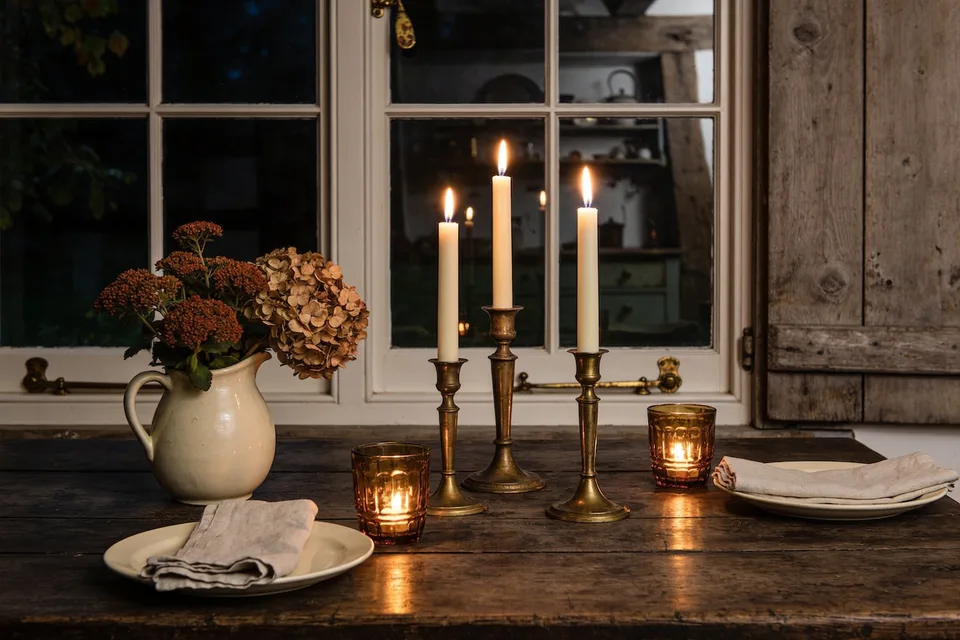
Sometime in the last week of September, supper crosses into the dark. The meal reaches the table at the hour it kept all summer, but now the window goes black before the plates are cleared, the garden drops out of the glass, and the room quietly lets go of its corners. What is left is the table — wood, flame, the faces around it — a small lit country in a dark house. From here to April this is where the evening actually happens, and the table might as well be furnished for the job.
A centerpiece below the conversation
Of all the turns the house makes for autumn, the table's is the least about buying and the most about restraint, and the restraint begins in the middle. A supper table's real work is faces: talk crosses it at chin height, and a tall arrangement parked in the center — the florist's vase, the branches that looked right on the hall table — stands in the conversation like a guest nobody knows. So the fall centerpiece stays low. The test is taken sitting, not standing: pull out a chair, look at the place across from yours, and anything that makes you lean to see it has volunteered for the sideboard, where tall things live well. What the table itself keeps is squat and few — a low jug of stems, a bowl of apples, candles — nothing rising much more than a hand's width off the wood except flame, which is thin enough to talk through.
Stems cut on the way in
The garden past its peak is better to a table than the garden in June, because autumn does the arranging. Sedum gone from dusty pink to rust, hydrangeas drying papery on the stem, rosehips, fennel and poppy gone to seed, the last small dahlias, the sage that wanted cutting back regardless — all of it arrives already in the season's colors, and none of it needs to last, because more is outside the door. Cut short, on the walk in to start supper: stems a hand long, not an arm, so they sit down properly in low vessels — a cream jug, a mustard pot, the gravy boat that outlived its ladle. A bought bouquet is bred tall for a hall vase and has to be argued down to table height; garden stems come at the right scale, cost the walk to the gate, and keep the table honest about the calendar. What stands in the jug this week will not be what stands there at the end of October, and the table is better for admitting it.
Amber glass, and what a flame does inside it
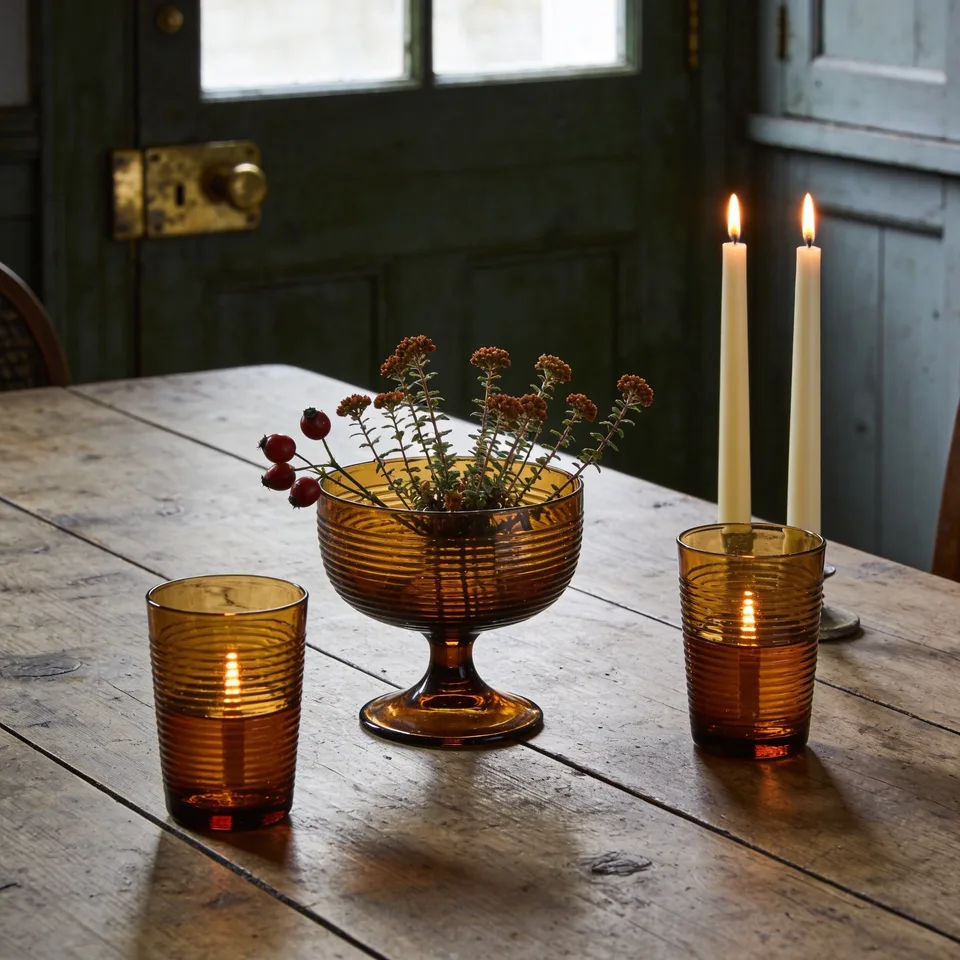
If the fall table settles on one material, it should be amber glass. Clear glass passes candlelight straight through and is done with it; amber holds a share back, so a tumbler the color of steeped tea sits on the table faintly lit from within, and the pressed patterns of the old stuff — thumbprint, hobnail, diamond-point — break one flame into a dozen small warm ones scattered down the wood. Two or three pieces will carry a whole table: tumblers to actually drink from, a footed compote under short stems in the middle, a dessert bowl that turns the color of dark honey beside a flame. Pressed amber was made by the ton through the middle of the last century, which is why the secondhand fall layer turns it up so reliably; a chip on a foot ring or a pattern gone faint at the lip only means it has been to supper before.
Bare wood most nights, a cloth when it matters
The everyday table does its best work bare. Wood is the warmest surface a room owns, it wipes down in the minute after supper, and its marks — heat rings gone soft at the edges, a scorch beside where the trivet should have been, the dents of homework and jar lids — are the house's minutes, kept where everyone eats. Covering that every night hides the best thing in the room. The cloth belongs to the gathering table. On the night the leaf goes in and the odd chairs are pulled up, cloth changes the table's posture: it quiets the plates, slows the settling-in, announces an occasion without anyone saying the word. The one to reach for is linen or heavy cotton washed well past stiffness, creases left where the cupboard folded them, from the same drawer as the kitchen's older linens; the napkins need not match the cloth, or each other, so long as they have been washed soft too.
Candlesticks gathered singly
Candlesticks should arrive one at a time. A matched pair reads as one purchase; five singles — brass mostly, one pewter, one turned wood with paint left in the grooves — read as years, and their unequal heights do real work, holding small flames at different levels so the light reaches the faces around the table from more than one angle. The candles themselves stay plain: ivory, white, unbleached beeswax where it turns up, because the flame is the point and a colored taper competes with it. And burn them. A candlestick wearing the same unlit taper all season is a prop; one with a stub in it and a run of wax down its shoulder is being lived with. In a dining room kept dark on purpose this is most of the lighting plan year-round; at the fall supper table it is the better half of the light.
What the table does between meals
A table is set for an hour and off duty for the other twenty-three, and the off-duty hours are the ones the room mostly wears. Between meals the fall table should stand nearly, but not quite, bare: the wood, the jug of stems, the candlesticks with their stubs, maybe the apples. That near-bareness is not neglect but readiness — a table kept this way is laid in the time the pot takes to come off the stove, and until then it looks like what it is, a kept thing at rest in the middle of the house. Come evening the plates arrive from a kitchen already deep in its own season, the tapers are lit, the dark fills the window, and the room assembles itself around the wood without anything needing to be arranged at all.
If the wall above the table wants something for the season, our free fall printable set is six prints to run off at home, and it costs nothing but the paper. If it wants the supper table's own things on paper, apples and bread rather than seed heads and grasses, The Autumn Larder is six studies from the same drawing table, a willow basket of orchard apples, a round cottage loaf on its board, damsons on a worn pewter plate, and they belong over the sideboard for the off-duty hours, since once the dark fills the window the wall goes with it.
Start with an ordinary supper. Some weeknight when nothing is being celebrated, set the table anyway — tapers lit, the big light off, the jug filled with whatever the garden will still spare — and eat the usual food by that light. The meal does not have to rise to the table; it is the other way around. An ordinary Tuesday, set low and lit warm, is the fall table doing exactly what it is for.
Common questions
How tall should a fall table centerpiece be?
Low. Keep everything within about a hand's width of the wood, with candle flames the only thing standing taller, since flame is thin enough to talk through. The honest test is taken sitting, not standing: pull out a chair, look at the place across from yours, and anything that makes you lean to see it belongs on the sideboard, where tall things live well.
Should you use a tablecloth on a wood table?
Most nights, no. Bare wood is the warmest surface a room owns, it wipes down in the minute after supper, and its marks are the house's minutes, kept where everyone eats. Save the cloth for the gathering table: on a night that matters it quiets the plates and announces an occasion without anyone saying the word. Reach for linen or heavy cotton washed well past stiffness, creases and all, and do not worry whether the napkins match.
Do candlesticks on a table need to match?
No, and the table is better when they do not. Candlesticks gathered one at a time, brass mostly with the odd pewter or turned wood among them, read as years rather than one purchase, and their unequal heights hold small flames at different levels, so the light reaches the faces around the table from more than one angle. Keep the candles plain, ivory or white or unbleached beeswax, and burn them; a stub and a run of wax down the shoulder mean a candlestick is being lived with.