 Cottage at Home
Disclosure: some links below are affiliate links — buy through one and we may earn a small commission, at no extra cost to you.
Vintage wall decor: hung over years, not in an afternoon
What vintage wall decor means in a kept house — transferware plates, a clouded gilt mirror, job-lot frames and salvage, hung one nail at a time over years, never as a set.
In this guide
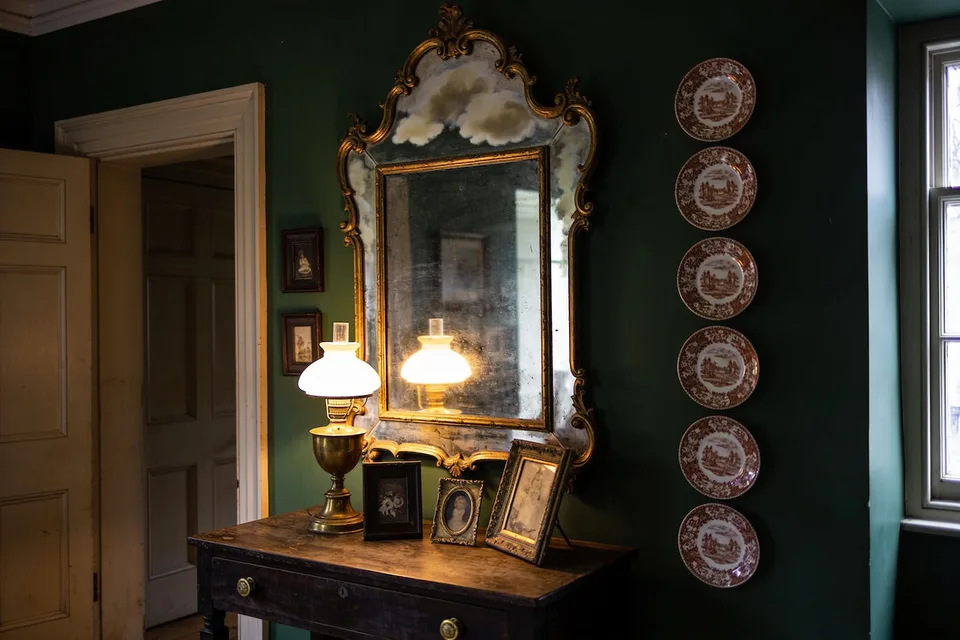
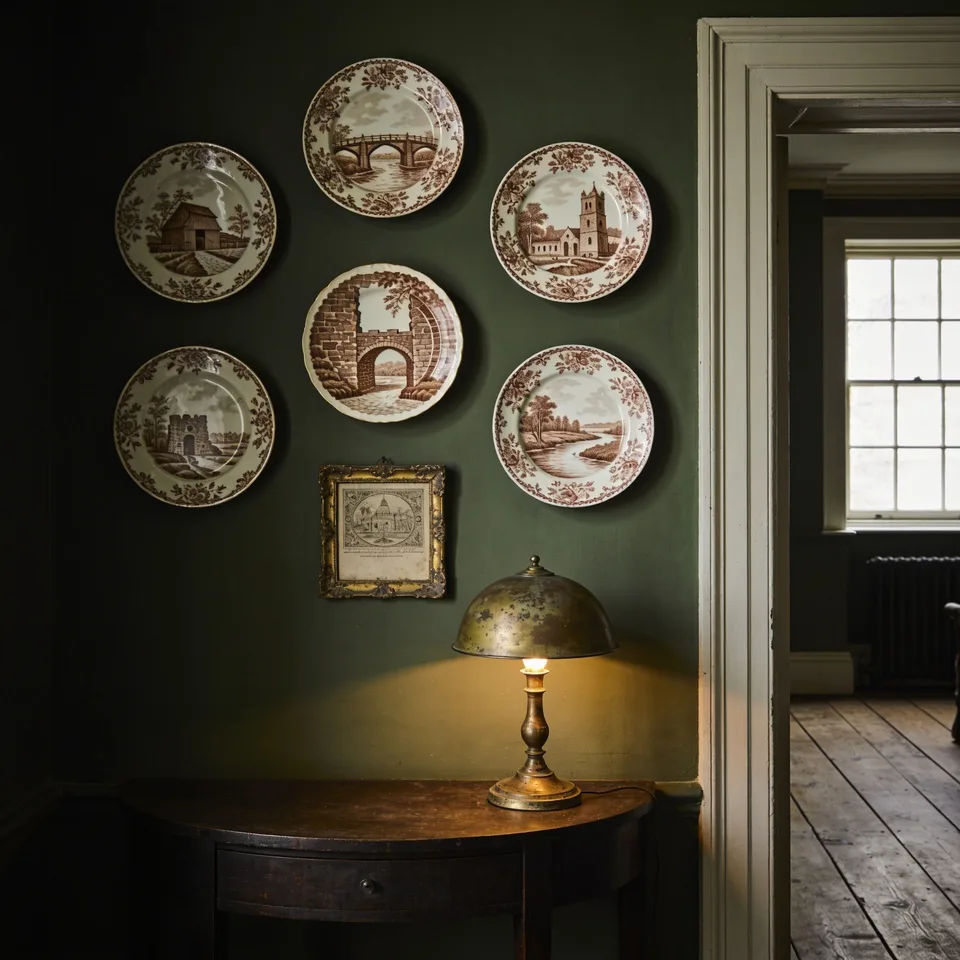
The wall beside the sitting room door has been filling for longer than anyone can prove. Plates climb it in a line that is not quite a line — brown scenes on cream, a mill, a bridge, a ruin nobody has ever placed — hung by whichever hand hung them, for reasons that did not survive. Lower down, a small dark painting sits a few degrees off level in a frame worth more than it is, and beside the door the mirror gives back the lamp and the room both a shade warmer and a step further away than they are. By evening, with one lamp lit and the fire gone quiet, this wall does more furnishing than the furniture.
Nobody arranged any of it. The wall filled — a plate at a time, a frame at a time, out of emptied houses and family attics and the last hour of estate sales — and the filling took years because it was supposed to. A wall is the easiest surface in the house to do all at once: one order, nine matched frames, an hour with a hammer, and by supper it is done. But done is exactly what such a wall keeps saying, every evening afterward, in the flat voice of a single afternoon. The walls of a kept house fill last and slowest of everything in it, and the slowness is not the cost of the effect. It is the effect.
What makes a wall read as kept
Stand in front of a wall that has actually been kept and what registers first is not the layout. It is the plain evidence that things were hung by different hands, in different decades, each for a reason that mattered at the time. Go looking for vintage wall decor ideas and what comes back is mostly arrangement — grids, templates, nine frames spaced to a rule, the wall planned on the floor before a nail goes in. Arrangement is not wrong, only beside the point.
That evidence has tells, and every one of them can be honestly come by:
- Nothing arrived together. The plates outnumber their patterns, the frames disagree about wood and century, and no two pictures share a subject. A matched set in matched frames says one order, delivered on one afternoon, and the wall spends years living it down.
- The spacing is kindly wrong. Things cluster where the life is — thick beside the door, crowding over the desk — and go sparse where nobody stands. A wall spaced to a rule was measured once; a kept wall was added to.
- Some of it is nobody's taste. The engraving of a church this family never attended stays up because of whose it was. A wall with one inexplicable picture on it has a history; a wall of chosen things has only a chooser.
- It hangs low. Old houses hang pictures at the height of a seated evening, not a standing viewing. Drop everything four inches from where instinct puts it and the wall stops performing and joins the room.
Under the tells runs the same quiet keeping the rest of the house gets: frame tops dusted along with the mantel, the crooked thing straightened after the door slams, a nail moved the width of a thumb when it was wrong. Minutes a week, and no plan at all.
Plates went up first
Plates were on cottage walls before pictures could afford to be, and for the plainest reason: the dresser filled, the plates kept coming, and a plate is the one picture a working house was certain to own. The habit outlived the shortage because it was right — a plate throws no glare, needs no frame, and carries its pattern to the back of a dim room the way paper never quite manages.
The wall's plate is brown transferware plates — willows, mills, rivers, ruins, printed in one color on cream for every ordinary table of the 1800s. Pattern collectors pay properly for the set of twelve; the wall wants the odd survivor, which costs a dollar or two precisely because it is odd. Buy singles, and buy freely across patterns — brown holds brown together, and the mismatch is the collection. A rim chip that would retire a plate from the table retires nothing up here; the wall asks only that a plate be worth looking at. Hang them from wire plate hangers, the sprung kind, and let them climb rather than march: around the doorframe, up the wall in a drift, thickest at sitting height and thinning toward the ceiling. A row of plates on a shelf is storage. A climb of plates beside a door is the oldest wall decor the cottage has.
A mirror that has stopped trying
Decorating advice hires a mirror to do a job — bounce the window, talk a small room into believing it is a larger one. The dark sitting room has already declined that campaign: deep walls are not asking to be brightened, and a bright new mirror on a deep green wall reads as exactly what it is, a device. The old mirror is hung on the opposite understanding. It is not there to enlarge the room. It is there to deepen it.
A gilt mirror gone soft at the edges — the gilding rubbed through to the red clay ground where a century of dusting took it, the glass clouded in gray continents where damp found the silvering — gave up doubling daylight long ago. What it does instead is hold the lamplight. The lit lamp lands in it a second time, dimmed and warmed, and the room behind the glass hangs a step further off, like the house remembering itself. Choose one by exactly those flaws: the faint waver in old glass, the soft cloud at the rim, gesso chipped to show the wood beneath. Every one is the age, and the age is the work. It weighs what old things weigh, so it hangs from a proper anchor — and not over the mantel, where the clock has tenure, but wherever it can catch a lamp from across the room and keep it burning twice. One room is refused it outright: the bath clouds a mirror in a single winter, so the glass over its basin sits in plain painted wood with nothing old enough to lose.
A job lot of frames
The thrift shop's frame shelf and the final hour of an estate sale agree on one thing: old frames outlast the taste for what was in them. So they pile up and sell by the box — a job lot of old picture frames, six or eight for less than one would cost new, oak and walnut and softened gilt with their corners still true after a hundred years of holding on. Take the box. The gilt worn to the red beneath is the value, and the price runs the other way.
What goes into them can take years, and should. An empty frame on a deep wall is furniture enough while it waits — proof the wall is still filling — and the sale that sold the frames sells fillings too: small dark oil paintings that drew no bids, a sampler with a strange child's alphabet stitched crooked, a pair of silhouette portraits of strangers a household adopts simply by hanging them.
Some frames, though, will come home empty and stay empty until paper finds them — and paper is a different errand from the one this page is on. The case for the printed page — real botanical plates and survey engravings out of the old books, copied honestly and printed at home — is made properly on its own page, and it serves a different wall and a different reader: paper turns with the seasons; the plates and the mirror hold their nails for a decade. The two habits meet at the frame and part at the wall. When a frame here does want a sheet, the free prints arrive by email in the same low register, and the drawn sets in our shop were made for these exact rooms — but everything else on this page answers to the older rule: found, never printed.
Salvage, or the wall wearing the house
Some of what belongs up here was never decor at all; it was building. Salvaged wooden corbels — carved brackets that spent their first life holding up somebody's eave — hang singly or in pairs and hold nothing, or take a narrow board across their shoulders and go back to work. A run of cast iron coat hooks screwed to a scrubbed plank makes the most honest wall in the back hall, because it is hung with what the day actually wore. The rule with salvage is single servings — one corbel, one board of hooks, one shutter with its paint gone to scales. A wall of salvage is a shop display; one piece of salvage on a wall is a house quietly wearing an older house's timber.
How the wall fills
The arithmetic runs from three directions. From the family: the plate that was a grandmother's, boxed for decades and too good to stay hidden; the picture nobody chose that everyone now defends. From the sales: the last-hour tables where wall things go cheapest of all, because by then every car is full and every mirror is heavy. And a steady share arrives wrapped, because the things worth giving a house like this were old before they were given — and a given thing goes up fast, the nail being how a household says it stays.
Little of it would carry against white. Deep walls are what let this wall work at all — the whole darker house runs on the bargain that the paint keeps its voice down so the things in front of it can speak — and brown print, rubbed gilt, and clouded glass are exactly what that bargain favors. The green takes them the way it takes brass: kindly, and better at night.
One nail first
Not a purchase — the house goes first. Somewhere in it already is the first piece: a plate stood too good to use and never used, the picture from a parent's house still leaning in the spare room, the small mirror that has waited years in a cupboard for a wall to want it. Tonight, carry the likeliest one to the wall beside the sitting room door and drive one nail — lower than instinct argues — and hang it, straighten it, and leave it a week. If by Sunday the eye has stopped snagging on it, it lives there now. The second thing will name itself; it always does, once there is something to hang beside. And the wall has begun the only work a wall in this house is ever asked to do, which is fill.
When that wall is ready to hold more than two or three things, the cottage gallery wall is about where to start the cluster, how it grows, and how to fix one that has gone wrong.
Common questions
How high should you hang pictures on the wall?
Lower than instinct argues. Old houses hang pictures at the height of a seated evening, not a standing viewing — drop everything four inches from where instinct puts it and the wall stops performing and joins the room. Let the spacing be kindly wrong while you are at it: things cluster where the life is, thick beside the door, crowding over the desk, and go sparse where nobody stands. A wall spaced to a rule was measured once; a kept wall was added to.
How do you hang plates on a wall?
From wire plate hangers, the sprung kind, and let them climb rather than march: around the doorframe, up the wall in a drift, thickest at sitting height and thinning toward the ceiling. Buy singles, and buy freely across patterns — brown holds brown together, and the mismatch is the collection. The odd survivor costs a dollar or two precisely because it is odd, and a rim chip that would retire a plate from the table retires nothing up here; the wall asks only that a plate be worth looking at. A row of plates on a shelf is storage. A climb of plates beside a door is the oldest wall decor the cottage has.
What should you look for in an antique mirror?
The flaws, chosen on purpose: the faint waver in old glass, the soft cloud at the rim, gesso chipped to show the wood beneath. Every one is the age, and the age is the work — a gilt mirror gone soft at the edges gave up doubling daylight long ago, and what it does instead is hold the lamplight, handing the lit room back a shade warmer and a step further away. It weighs what old things weigh, so hang it from a proper anchor — and not over the mantel, where the clock has tenure, but wherever it can catch a lamp from across the room and keep it burning twice.