 Cottage at Home
Disclosure: some links below are affiliate links, and if you buy through one we may earn a small commission, at no extra cost to you.
Cottage gallery wall ideas: how to hang one, grow it and put it right
A cottage gallery wall is a loose cluster of old frames hung low and left open at the edges. Where to start it, what goes in it, and how to fix one gone wrong.
In this guide
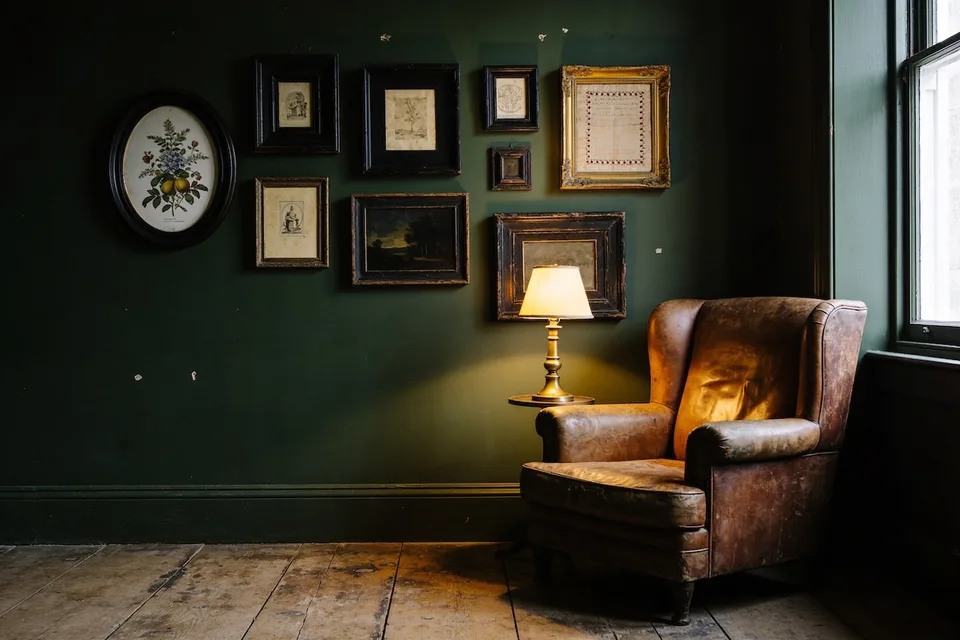
Most gallery walls in pictures were hung in an afternoon and photographed the next morning. A cottage gallery wall is the other kind: it goes up a few pieces at a time, it is still growing a year later, and now and then it needs putting right. This page is about how to start one, how to add to it without taking it all down, and what to do when it looks wrong.
What a cottage gallery wall is, and which wall it goes on
A cottage gallery wall is a loose cluster of mixed old frames, hung at the height of someone sitting down and left open at the edges so it can keep growing. It goes on the wall you face from the chair you use most. In a small room that is one wall, and one is enough.
Sit in your usual chair with a cup of tea and look up. The wall in front of you is the one you will actually see every evening, and it is the one worth filling. A wall you only pass on the way to the kitchen can take a single picture. A small room with low ceilings can carry one busy wall, but not two, and the second one usually ends up fighting the first.
If the chair faces a window or a chimney breast, take the wall beside it. The mantel has its own few things to hold, and the mantel page covers those.
Start from the middle and leave the edges open
Begin with one larger picture a little below where you would first hang it, then put three smaller ones around it, about a hand's width apart, each on its own hook. Set them by eye, standing back between each one. Stop at four. The open edges are where next year's pictures go.
A wall started from the middle has somewhere to grow in every direction. A wall started from a corner, or planned to its edges on paper first, is finished on day one, and anything added later looks squeezed in.
If you want to try it before making holes, lay the four pieces on the floor under the wall and move them around until they look right from the chair. Then hang the big one and put the others up around it.
What goes on it: mostly paper, and a few things that aren't
Most of a cottage gallery wall is paper: botanical plates, engravings, an old map, a page from a book, a postcard. Among it goes one small painting, one stitched thing, and one object that was never meant to be a picture. That mix is what makes a wall look like a house rather than a shop display.
Paper keeps the wall quiet, because paper in old frames tends to share the same faded browns, creams and greens. The painting gives the eye one dark, deep place to stop. The stitched thing breaks up all that glass: an old needlework sampler, with its crooked alphabet and a date somebody sewed a long time ago, is the classic one. A good old one costs more than the frames around it, so one is plenty. The object can be anything flat that hangs, like a wooden spoon, a small plate or a bundle of dried lavender tied with string.
Photographs belong too, printed small and warm-toned, on matte paper, in secondhand frames, one or two among the paper rather than a block of their own. A block of family photos is a different kind of wall.
Frames that agree on colour and nothing else
Let the frames agree on a colour family (dark wood, black, old gilt) and differ in everything else: size, width, age and shape. Matched frames make a set, and a set says it was all bought on one day. Frames that disagree about their century but agree on their colour look collected, and that is the look you're after.
One or two antique oval frames are worth looking for. An oval softens a wall of rectangles, and it is where a small portrait or a single flower print looks best. Mats, if you use them, should be warmer than white or left out entirely. Bright white card is the one thing that makes old paper look tired.
Vintage wall decor has more on where old frames come from and why they sell so cheaply.
Where the wall stops
A cottage gallery wall stops at the lines the room already has: the door casing, the chair rail, the top of a bookcase, the line of the ceiling beam. It never marches all the way up to the ceiling or out to the corner. Those edges keep it from spreading over the whole room.
In an old house with a picture rail, the rail is the top edge, and the wall hangs down from it. Vintage picture rail hooks let pictures hang on cord or chain from the rail, so you can move them along without new holes, and the cords themselves add to the old look. If there's no rail, the tops of the doors are the natural height to stop at.
Growing it without taking everything down
Add each new picture at an edge or into a gap you left, and move no more than two pieces to make room. The wall grows outward and settles as it goes. If adding one picture means rehanging six, the wall was planned too tightly, and the next addition should go somewhere else.
Most cottage gallery walls get their best pieces in their second and third years: a painting from an estate sale, a framed map of a place the family goes, something a friend gave you. That's why the edges were left open. A wall with room left on it looks lived in before it's half full.
The same wall can take a season on top, too. The Christmas gallery wall is about slipping December prints in behind the glass of frames that are already up and taking them out again in January.
Three walls that went wrong, and how to fix each
Most gallery walls that look wrong have one of three faults: everything is hung at the same height, there are too many small things and nothing larger, or the pieces have lined up into a grid. The fix is almost always to take something down or move two pieces. Adding more pictures makes each fault worse.
All at one height. Every frame top sits on the same invisible line, so the wall reads as a row. Drop two of them by a few inches and the row breaks.
Too many small things. A wall of little frames looks fussy from across the room. Take three small ones down and put up one larger picture in their place.
It reads as a grid. The gaps have turned into even channels, running straight across and straight down. Take two pieces down, and hang one of them back a little above or below the line.
Paper changes, frames stay
Once the frames are up, the paper inside them can change: a new print behind old glass costs less than a new frame and doesn't mean a new hole. Keep the frames you have, and when a picture stops being interesting, change what's in it.
That's also the easiest way to fill the empty frames a new wall starts with. The eighteen studies in our shop were drawn in one palette so they can sit together on a wall like this, or go in one at a time among older things. Print them to the sizes of the frames you already own, and swap them out as the wall grows.
Vintage printable wall art is about printing old plates and engravings well, on the right paper for an old frame.
Hang four things this weekend, and stop
This weekend, choose the wall you face from your chair. Lay out one larger picture and three smaller ones on the floor below it, hang them, and stop there. Live with it for a month. The fifth picture will turn up in its own time, and you'll already know where it goes.
Common questions
How do you make a cottage gallery wall?
Choose the wall you face from the chair you sit in most. Hang one larger picture a little below where you would first put it, then three smaller ones around it, a hand's width apart, each on its own hook. Leave the edges uneven, so the next picture has somewhere to go.
What do you put on a cottage gallery wall?
Mostly paper: botanical plates, engravings, an old map, a page from a book. Then one small painting, one stitched thing such as a sampler, and one object that was never meant to be a picture. A few small, warm-toned photographs can join in among the paper rather than in a block of their own.
Why does my gallery wall look wrong?
Usually one of three things: every frame is hung at the same height, there are too many small things with nothing larger to settle them, or the pieces line up into a grid. Each is fixed by taking something down or moving two pieces, not by adding more.