 Cottage at Home
Disclosure: some links below are affiliate links, and if you buy through one we may earn a small commission, at no extra cost to you.
Cottage hallway ideas for the passage you walk through forty times a day
Nobody stops in a cottage hallway, so it has to work while you walk through it: lighting, colour, a runner, pictures up the stair wall, and the landing.
In this guide
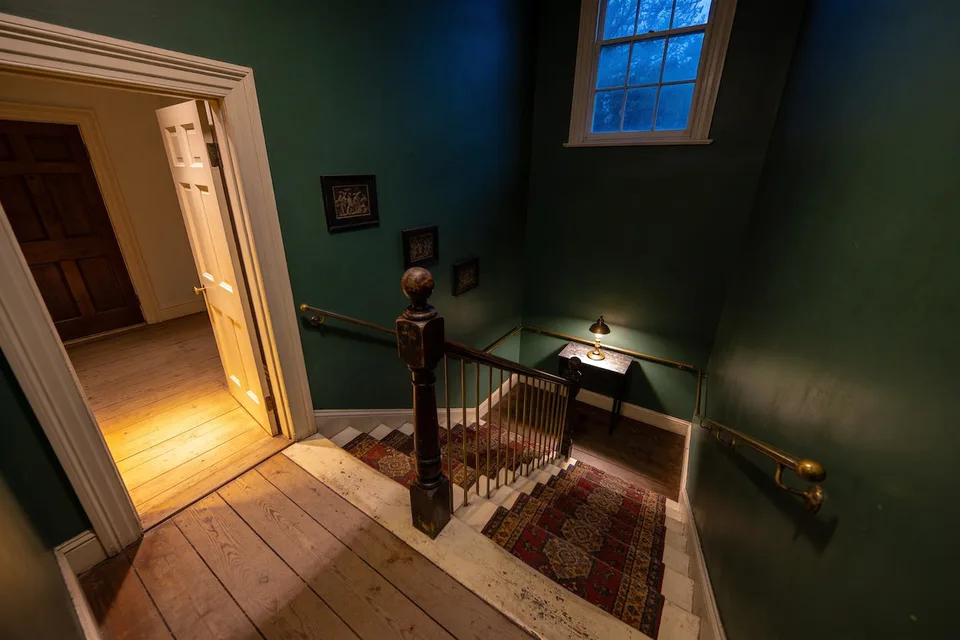
Nobody stops in a hallway. You cross it on the way to bed, on the way down to put the kettle on, at six in the morning in the dark and at eleven at night with a glass of water. So a cottage hallway is the one part of the house you only ever see while walking, and mostly sideways. This page is about making it right for that: the light, the colour, what goes underfoot and on the walls, and the landing, the one place the hall lets you pause.
Where the entryway ends and the hallway begins
The entryway is the arrival: the door, the coats, the wet boots, the first step inside. The hallway is everything after that, the passage between rooms, the stairs and the landing at the top. It carries no coats and holds nothing to sit on. Its whole job is to get you from one room to the next and look right while you do it.
That split matters because most advice treats the two as one room, and they want opposite things. The front door needs hooks, a tray and a seat, and the cottage entryway goes through all of it. The inside hall needs almost none of that. If the coats have started drifting down the passage, the fix is back at the front door, not here.
It helps to think of the hallway, the stairs and the landing as one line of sight rather than three places. You see them together, from the bottom step or from a doorway, and they read as a single long view. Decide things for the whole run at once and it will hold together.
Cottage hallway lighting: a lamp at the turn of the stairs
Light a cottage hallway with one small lamp left on at the turn of the stairs or on the landing, and keep the ceiling light for cleaning and for finding things. A hall gets its daylight secondhand, through doorways and one small window at best, so after dusk the lamp does the window's job. Low and warm beats high and bright.
A plug timer makes this work without anyone remembering it. Set it for the hour the light goes in the afternoon, and the lamp is on before the first person comes up the stairs in the dark. If the hall is long, a second small lamp at the far end, or at the foot of the stairs, will do more than any brighter bulb overhead. The idea is the same as in the dark cottage living room: a few pools of light rather than one flat wash, and nobody lit from directly above.
If the hall does need a ceiling light, and a long one often does, an old lantern suits a cottage far better than a flush fitting. An antique hall lantern hangs lower and gives a softer light through its glass, and it looks like something the house has always had. Keep it on a low setting, or on a dimmer if one is already fitted, and let the lamp at the turn do the evening's work.
Cottage hallway colours: one shade deeper than the rooms
Paint a cottage hallway one shade deeper than the rooms it opens into, in a warm dark such as green-black, umber or the brown of strong tea. From the passage, every open door then shows a lighter, lamplit room beyond it, and the hall itself holds the lamp's warmth instead of looking grey. Keep the woodwork dark too.
This goes against the usual advice that a hall should be pale to look bigger. In a cottage the hall rarely has a window of its own, so a pale colour doesn't get the light it needs to look pale. It just looks dim. A warm dark colour looks deliberate in the same light, and it makes the rooms off it look brighter by comparison. Cool darks, like slate or a blue-grey, tend to go flat in lamplight, so lean warm.
Wallpaper works well in a hallway because you only see it in passing, which suits a busy pattern that would be too much in a room you sit in. A small, dark, old-fashioned print on the walls below a picture rail, with paint above, is an easy way to try it. If the hall has a tiled floor, old patterned tiles and a dark wall go well together; let the floor be the pattern and keep the walls plain.
A hallway runner, and whether it goes up the stairs
Lay a long runner down the hall to quiet the boards and give the eye a line to follow, and if the stairs are bare wood, carry the same runner or one like it up the stairs. Choose a flat weave or a low pile in dark, mixed colours. Pale plain runners show every footprint in a passage this busy.
On the stairs you have two good choices. A runner up the middle, with a hand's width of wood showing either side, is warm underfoot and softens the sound of feet at night. Painted treads, in a dark colour or in the same colour as the woodwork, are the other road, and they suit a steep, narrow cottage stair where a runner would be fussy. Worn paint on a tread is part of the charm, so let it wear.
If you do run a carpet up the stairs, brass stair rods across the back of each tread are the old finishing touch. They catch the lamp on every step and make a plain runner look fitted and cared for. Old ones turn up secondhand in sets, often a little dented, which is fine.
Pictures on the staircase wall
Hang pictures on the staircase wall as a line that climbs with the stairs, so each one is at eye height from the step below it. A stair wall is looked at in the few seconds of walking up, so a run of small pictures in dark frames works better than one large one: each gets a glance on the way past.
Keep the frames in a family, dark wood or old gilt, without making them match. Small prints suit a hall well: maps, botanical plates, old engravings. Vintage printable wall art makes the case for a run of county maps climbing the stair, because a map rewards exactly the half-minute a landing gives it. If you'd like somewhere to start, there are prints in our shop.
A single picture light over the best picture on the landing turns it into the thing you see from the bottom of the stairs. A vintage brass picture light is a small, warm fitting, and on a stair wall it can do the job of a second lamp.
The landing: the one place the hall lets you stop
The landing is the only part of the hallway where anyone pauses, so give it one thing worth pausing for: a window you can see out of, a lamp, and a picture or a shelf of books. Keep the floor clear. It is still a passage, and whoever is carrying laundry up the stairs needs the whole width of it.
If the landing is wide enough for a chair, it is a reading corner already, and the reading nook piece covers that in full. If it isn't, a narrow table under the window for the lamp is enough. The same goes for the end of an upstairs hall, where the passage often runs on a little past the last door with a window at the end. That stretch is worth keeping clear and lit, not filling with a basket of things on their way to somewhere else.
The space under the stairs is a different matter. In most cottages it is a cupboard, and the best use for it is storage with a door that shuts. The cottage pantry counts the closet under the stairs as a pantry in its own right, and a shelf of jars there is a good use for it.
A narrow cottage hallway: what to take out
In a narrow cottage hallway, take things out before you add anything. A narrow hall is seen sideways and at walking pace, so it can hold one run of pictures, one lamp and a runner, and very little else. Anything standing on the floor is something to step around, usually in the dark.
Look along the hall from one end and count what's on the floor that isn't the runner. A console table in a hall barely wider than a person, a basket, a stack of shoes, a boot tray that drifted in from the front door: each one narrows the passage and catches the eye in the wrong way. Move them back to where they belong, or out. What's left will look calmer and feel wider than any paint trick.
Look at it from the top of the stairs
This evening, once the light has gone, turn off the ceiling light, switch on only the lamps you'd really use, and stand at the top of the stairs looking down. That is the view the hall has to get right, and you will see it most nights of the year.
From up there you'll see which pictures catch the light and which disappear, whether the wall colour holds the lamp or goes grey, and what on the floor is in the way. Fix those three things and the hallway is most of the way there, usually without buying anything at all.
Common questions
How do you light a cottage hallway?
Leave one small lamp on at the turn of the stairs or on the landing, on a plug timer, and keep the ceiling light for cleaning. A hall gets its daylight secondhand through doorways, so after dusk the lamp does the window's job. Two low, warm lights along the passage beat one bright one in the middle.
What colour should a cottage hallway be?
One shade deeper than the rooms it opens into, in a warm dark like green-black, umber or the brown of strong tea. Then every open doorway reads as a lit room seen from the passage, and the lamp has something to warm. Keep the woodwork dark too, so the stairs still read at dusk.
How do you decorate a narrow cottage hallway?
Take things out before you put anything in. A narrow hall is seen sideways and in passing, so it wants one run of small pictures up the stair wall, one lamp, and a runner that quiets the boards, with nothing on the floor but the runner. Coats and boots belong at the front door, so the passage carries nothing you'd have to step around.