 Cottage at Home
Disclosure: some links below are affiliate links, and if you buy through one we may earn a small commission, at no extra cost to you.
Cottage bookshelf ideas: the English cottage look from the books you already own
A cottage bookshelf looks lived-in when it holds books you read, arranged by reach. Which books go on show, jackets, stacks, one object a shelf, colour and a lamp.
In this guide
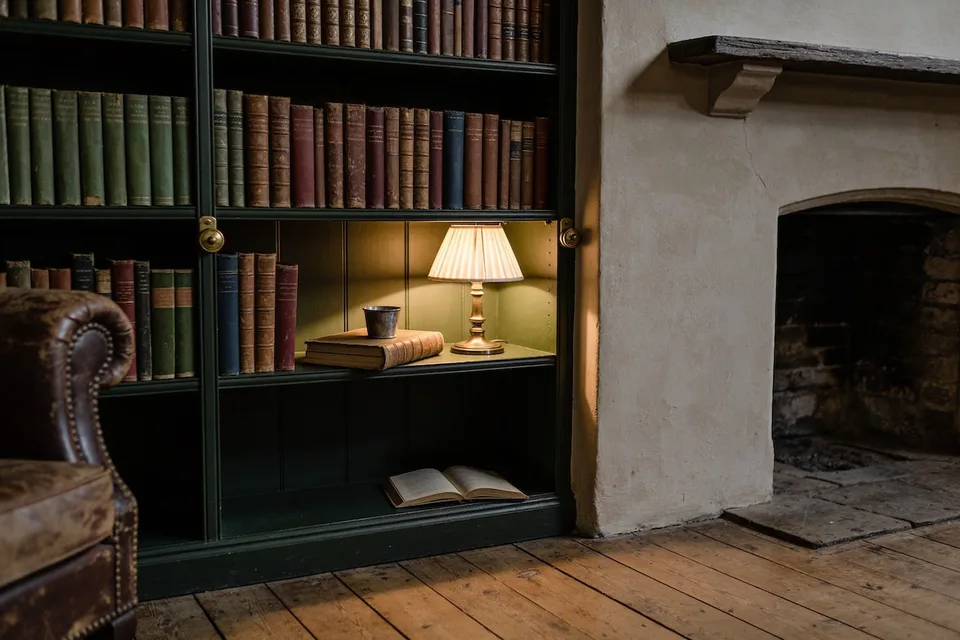
Sit in the chair you read in and look at the bookshelf from there. That is the view that matters, and it tells you most of what the shelf needs. A cottage bookshelf looks right when it holds books somebody reads, in the order somebody reaches for them. This page is about getting that look from the books you already own, in an evening, mostly without buying anything.
Start with the shelf you reach for
Put the books you read most at hand height from your chair, whatever they look like, and build the rest of the case around that shelf. A cottage bookshelf is a working shelf first. When the well-used books sit where the hand goes, the whole case looks lived-in, because it is.
For most cases that is the second or third shelf up, the one you can reach from sitting or with one step. Put the current book, the one you keep going back to, and the ones you lend out there. Tall books and heavy ones go on the bottom shelf, lying on their sides if they are too tall to stand. The top shelf is for the books you keep but rarely open.
Group the books the way you think about them: gardening together, the novels by one writer together, the old cookery books in a run. Then you can find things, and the shelf starts to say something about the house.
Which books go on show, and which go in the cupboard
Keep the books you would reread or lend on the open shelves, and put the rest in a cupboard, a box or a spare room. A cottage bookshelf is not an archive. When it holds only the books that matter to the house, it looks chosen rather than stored, and the gaps it leaves are useful.
Worn paperbacks can stay. A cracked spine and a softened corner are proof the shelf is read, and a row of them among the cloth books is part of the look. What looks out of place is the stuff that isn't books at all and ended up on a shelf because there was room: chargers, mail, a spare remote. Take those off first.
Whether the dust jackets come off
Take the paper jackets off the hardbacks you're happy to show bare. Underneath, most older books have cloth covers in faded greens, browns, reds and blues, often with the title stamped in gold on the spine, and a row of those is most of what people mean by an English cottage bookshelf.
Keep the jackets flat in a drawer rather than throwing them out; some books are worth more with theirs. Leave the jacket on any book whose cover you love, or whose bare boards are plain and bright. The aim is a shelf of mixed, softened colour, and a few bright jackets among the cloth are fine.
Standing, stacked or leaning
Stand most of the books upright and lay one flat stack every couple of feet. The stacks break up the long rows, give you a spot to set something down, and hold the upright books without a bookend. Let the heights vary inside each row rather than lining everything up tallest to shortest.
Turn one book face-out on a shelf at most, the one you would hand a guest. If the uprights lean when there is a gap, a pair of antique brass bookends holds a short row and catches the lamp. Heavy iron or stone ones do the same job, and an old pair that doesn't quite match is better than a new set.
One object a shelf, and where it comes from
Give each shelf one object at most: a small jug, an old clock, a candlestick, a little framed picture leaned against the books. More than one and the shelf becomes a display. The best objects are things that were set down there and stayed, not things bought to fill a gap.
A small print leaned against the back of a shelf, in front of the books, is an easy way to add a picture without a nail, and there are some in our shop if you want a place to start. Brass is worth having somewhere on the case because it catches the lamp, the same way it does in the dark cottage living room. A plant is fine on the top of the case, where it gets the light, but trailing ivy down the front hides the books.
What colour the bookcase should be
Paint the case a deep, warm colour, such as moss green, a dark brown or the colour of the wall only a shade deeper, or leave old oak and pine as they are. A dark case pushes the spines forward and lets the gold lettering catch the lamp. White shelves tend to make old cloth books look dusty.
If the case is painted, paint the back as well as the front. The back board is what you see between the books, and a deep colour there makes the gaps look deliberate. A built-in case in the alcove beside a chimney is the classic cottage spot; if the case is freestanding, stand it beside a chair, not by a doorway, so it is part of the reading corner and not something you pass. Keep a case out of a sunny window if you can, since the sun is hard on cloth spines.
Where the lamp goes
Put a small plug-in lamp on a shelf or on top of the case, so the books are lit from beside them rather than from the ceiling. After dark, a lit bookshelf is a warm, low glow that makes the whole room feel settled, and it is the easiest way to light a corner without adding another floor lamp.
The middle of a wide shelf, in front of a stack, is a good place for it. A small vintage brass library lamp is the classic choice, and any small lamp with a warm shade will do. The cottage home office puts a lamp on its shelf for the same reason: a few low pools of light instead of one bright one overhead.
Leave one shelf half empty
Leave one shelf, or the end of one, half empty. A little room gives the eye somewhere to rest, gives the new book somewhere to go, and keeps the case from looking stuffed. It is the same idea as leaving one end of the mantel empty, applied to a taller piece of furniture.
A half-empty shelf at reading height is also the natural spot for the book you're partway through, left face-down or on a stand. A vintage wooden book trough on a side table does the same job for the three or four books on the go, and keeps them off the arm of the chair.
Start at eye height, from the chair
This evening, clear the shelf you see first from your chair, take the jackets off the books going back on it, add a flat stack and one object, and switch on a small lamp beside them. Then sit down and look. One shelf done properly shows you what the rest of the case wants.
If your reading chair is in a small corner rather than a sitting room, the reading nook piece covers the chair, the lamp and the throw around it.
Common questions
How do you decorate a cottage bookshelf?
Start with the books you actually read and put them at hand height from your chair. Take the paper jackets off so the cloth spines show, lay a flat stack every so often, and give each shelf one old object at most. A deep, warm colour behind the books and a small lamp on the shelf do the rest.
What makes a bookshelf look like an English cottage?
Mixed heights of worn cloth spines, a few flat stacks, one worn object a shelf, a case painted a deep colour or old oak left as it is, and a small lamp. Nothing is sorted by colour and nothing was bought to fill a gap. It should look as if the books arrived over years.
Should you arrange bookshelves by colour?
Not in a cottage. Sorting by colour turns books into decoration and makes it hard to find anything. Group them the way you think about them, by subject or by who wrote them, and let the colours fall where they fall. The mix of worn spines is what gives a cottage shelf its look.