 Cottage at Home
Disclosure: some links below are affiliate links — buy through one and we may earn a small commission, at no extra cost to you.
Cottage entryway: the passage everyone comes through, and how to make it work in winter
A cottage entryway built for the four o'clock arrival in December: where coats really go, a settle instead of a bench, a lamp on a timer, and a floor that survives salt.
In this guide
At ten past four on a wet December afternoon the front door opens and four things happen at once. Somebody is holding a bag of shopping in one hand and the door in the other. There is a dog, or a child, or both. The boots are wet and there is grit stuck in the tread. And it is already dark enough inside that whoever has just come in is feeling along the wall for a switch.
That is the entryway's job, and it is the only test that matters. Search for cottage entryway ideas and you will be shown a photograph of a bench nobody has sat on, a console table with three books and a vase, and a coat rack holding one linen jacket in what appears to be July. This page is about the other version: the passage everybody in the house comes through several times a day, in the worst weather of the year, carrying things. The mudroom is the working back door and covers the muddy end of this. This is the front one, which has to do the same work and look like the front of the house while it does it.
What a cottage entryway is
A cottage entryway is a passage, not a room, and the difference decides everything. Nothing in it is standing in a space of its own; every object is in somebody's way. So the entryway is built by solving the arrival first, giving each of the four or five things that happen at the door a definite place, and treating whatever is left as decoration.
Cottages are unhelpful here and it is worth saying so plainly. The front door of an old house usually opens straight into a room, or into a passage the width of the door and no more, and almost never into the square hall that the photographs assume. There is rarely a cupboard. There is often a staircase starting within a step or two of the mat, and the hall and stairs past it have their own work to do. What that means is that the entryway is not a place you furnish; it is a set of jobs you assign to about two square metres, most of which is floor that people have to be able to walk on.
The compensation is that a passage this small only needs a handful of correct decisions, and they hold for years. The house makes the same case about rooms whose looks come out of their use: what is genuinely being used tends to look right, and an entryway is the purest version of that, because anything ornamental in it gets knocked off within a month.
Coats: hooks, and an honest count
Hang coats on a peg rail at the height of the person hanging them, and count the pegs against the coats that are actually in use this week. Six pegs holding six coats reads as a house; six pegs holding fourteen reads as a jumble sale, and the fourteen is what actually happens by February.
The rail is the cottage answer and it is the right one, but the count is the part everybody gets wrong. A coat rack in a passage is a storage device with no door, so whatever is on it is on show permanently, and the pile grows because a peg with a coat already on it will happily take a second. The fix is not more pegs. It is a decision about which coats live at the front door — this week's, in this weather, for the people who are here — and somewhere else for the rest.
Height matters more than it sounds. A rail set at the standard picture height puts the pegs above where a shorter adult can hang a heavy wet coat one-handed, which is exactly the moment this rail exists for. Two rails at different heights, or one low rail specifically for children, will do more for how the passage looks than any amount of arranging, because a coat hung properly hangs flat against the wall and a coat thrown at a too-high peg does not.
Underneath, leave the floor clear. Bags on the floor under the coats is the single thing that makes a narrow passage impossible to walk down, and the answer to it is the seat in the next section.
A settle, not a bench
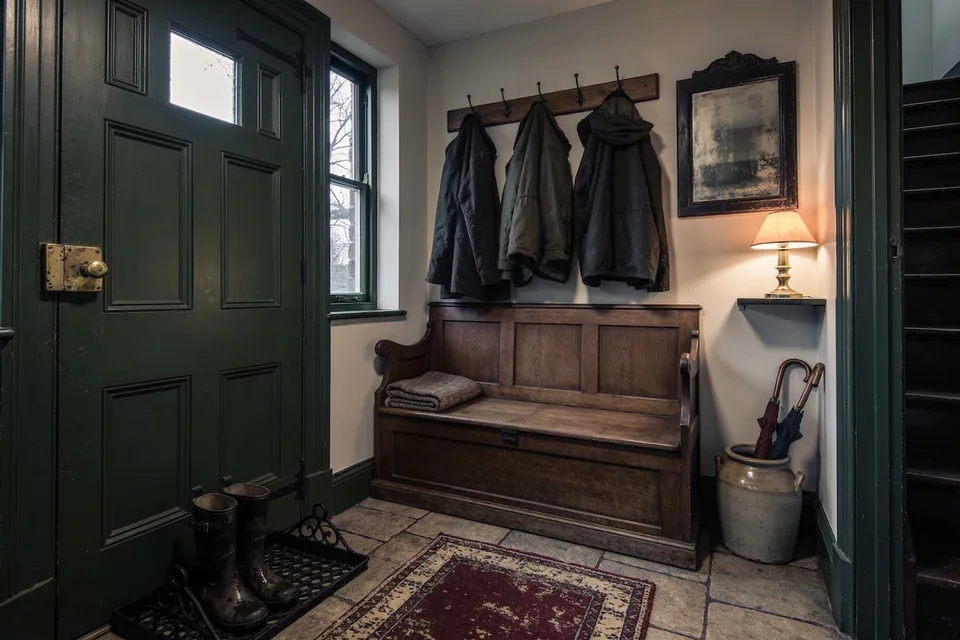
If there is room for one piece of furniture, make it a settle. A settle is a long oak bench with a high back and often wings, made to ward off the draught, and the box version has a hinged lid with a chest underneath. It does three jobs in the space of one: somewhere to sit and get boots off, a solid back against the cold coming under the door, and storage for what would otherwise be on the floor.
The history is the argument. Settles were built to stand by open fireplaces in country houses and inns, where the point of the high back and the wings was to make a pocket of still air in a room full of moving cold. Box settles have been made in one form or another since the sixteenth century and were in regular production into the 1920s, which is why they turn up at auction in every condition and price. Put one against the wall by a draughty front door and it is doing the job it was designed for, a few hundred years later.
What goes in the chest is the boring half and the useful half: hats, gloves, the dog's lead, a torch, the shoe brushes. What matters is that it is one lidded box rather than four baskets, because a lid is the only storage that survives a hurry.
If there is genuinely no room, and in many cottage passages there is not, skip the furniture entirely. A vintage umbrella stand in the corner and a hard boot tray by the door will take the floor clutter, and the sitting-down job can move to the bottom stair, which is what it has always done in houses like these.
The floor: salt, wet, and what survives it
Catch the wet at the door and the salt just past it. A hard tray immediately inside for boots to drip into, then a flat, beatable runner for the two or three steps people take before they have taken anything off. Deep pile and pale wool both lose to a December.
Salt is the real enemy and it is worth understanding why. It comes in stuck in the tread, it does not evaporate the way water does, and it goes on drawing damp and abrading fibres for as long as it sits there. So the goal is not absorption, it is interception: get it onto something that can go outside and be shaken, hosed or beaten. A vintage stair runner or any flat-woven length does this well, because there is nowhere for the grit to hide; a thick rug does it badly, because the salt sinks in and stays.
The tray goes tight against the wall by the hinge side of the door, where boots land anyway. Fight the instinct to put it somewhere tidier: the tray only works if it is where people are already standing when they kick their boots off, and a tray two steps away is a tray that gets walked past.
One more thing worth doing once. Whatever is under all of this, seal or oil it before the winter rather than after, because a stone or brick floor in a cottage entryway is porous and salt water will find it. The laundry room makes the same argument about the other wet floor in the house.
Light, and why it should already be on
Put the entryway light on a timer or a sensor so it is on before anybody reaches for a switch. Coming into a dark passage with both hands full is the single most annoying thing about a cottage front door in winter, and it is fixable for the price of a plug timer.
This is the highest-value thing on this page and it costs almost nothing. A small lamp on a shelf or a settle, set to come on at half past three and go off at bedtime, changes the arrival completely: the door opens onto a lit passage instead of a black one, whoever is coming in can see the peg and the tray, and from the outside the house reads as occupied. A low warm lamp does it far better than the overhead fitting, which in most cottage passages is a bare-ish bulb in the wrong place.
The rest of the lighting argument is the one the whole house runs on, and dark cottage rooms makes it at length: two low warm lights beat one high bright one, in every room, and a passage is no exception just because nobody sits in it.
The two things that are allowed to be decorative
A mirror and one small surface, and that is the whole of it. The mirror is genuinely useful at a front door and it does the work of a window in a passage that has none. The surface is for keys and post, and it should be small enough that it cannot become a shelf.
The mirror wants to go opposite or beside the light rather than facing the door, so it throws the lamp back down the passage instead of showing arriving visitors themselves. Old ones are better than new here for a plain reason: a hallway mirror gets knocked, and a mirror that already has some age on the glass takes another knock without it mattering.
The surface is where a house either wins or loses the war of the front door, and small is the whole trick. A narrow shelf or the top of the settle takes keys, today's post and nothing else. An antique brass letter rack on it gives the post a definite place to be, which is the difference between a passage with post in it and a passage with a pile in it. Anything wider than about twenty centimetres will be carrying a hat, two parcels and a coffee cup by Thursday.
Begin with the light
This week, put a plug timer on a small lamp in the entryway and set it for half past three.
That is a ten minute job and one cheap part, and it is the change everybody in the house will notice by Friday. Everything else on this page can wait for the weekend, or for the next auction with a settle in it. Walking into a lit passage with your arms full is the thing the room is actually for.
Common questions
How do you decorate a small cottage entryway?
Solve the arrival first and decorate second, because a cottage entryway is a passage rather than a room and everything in it is in somebody's way. Work out what has to happen in the ninety seconds after the door opens, give each of those things a place, and stop. Coats want hooks at the height of the person hanging them. Wet boots want a hard tray, not the floor. Keys and post want one small surface. A light wants to be already on. Whatever is left over after that is decoration, and in a narrow passage the honest answer is usually one mirror and one picture. The room is small, so every object in it has to be doing a job at four o'clock on a wet afternoon.
What furniture goes in a cottage entryway?
One thing to sit on that also holds something, and nothing else if the passage is narrow. The cottage answer is a settle rather than a bench, and it is a genuinely old answer. A settle is a long oak bench with a high back and often wings, built to ward off draughts, and the box settle version has a hinged lid with storage underneath. That is three jobs from one object in a space that has room for one object: somewhere to sit and pull boots off, a solid back that blocks the draught coming under the door, and a chest for the things nobody wants on the floor. If there is no room even for that, a peg rail and a boot tray will do the whole job.
How do you stop winter salt ruining an entryway floor?
Catch it before it travels, on something you can take outside and shake or hose. Road and path salt is the thing that actually destroys an entryway, and it does the damage by being walked further into the house. Put a hard tray immediately inside the door for wet boots so they drip in one place, then a runner beyond it for the two or three steps people take before they have taken anything off. The runner has to be washable or beatable, which in practice means a flat weave rather than anything deep and pale. Sweep or shake it weekly through the salt months rather than seasonally, because salt left in a pile of wool is doing its work the whole time it sits there.