 Cottage at Home
Vintage Halloween printables: six prints for a gentler October
Vintage Halloween printables from this house's own October walls: six free natural-history prints, with plain notes on paper, old frames, and where each hangs.
In this guide
The crow was the first to arrive. It hangs at the turn of the stairs, a small print in an oak frame gone nearly black, and for eleven months of the year it is only a bird on a bare branch, passed twenty times a day and hardly seen. Then October comes, the landing window begins giving up its light by late afternoon, and somewhere in the third week of the month the bird starts to mean something more. The house never says the word out loud; the crow says it.
Halloween arrives loud by default. The stores commit to it in August: orange plastic, cobweb by the bag, things that grin and cackle and run on batteries. A house that keeps its rooms quiet the rest of the year can feel there is no door into the holiday that doesn't cost the quiet. But there is an older door. Before Halloween belonged to the costume aisle, its whole cast (crow, moth, toadstool, the bare branch against the moon) belonged to the natural-history plate, drawn in earnest by people who thought a beetle deserved a whole afternoon of looking. Prints in that tradition hold all of October's dark and none of its plastic. This is a guide to the six vintage Halloween prints that hang in these rooms every year, the vintage Halloween pack, and to the plain work around them: the paper to feed the printer, the frames worth hunting, the wall each print keeps, and what becomes of them all in November.
October's one dark gesture
October in this house is the deep end of the amber autumn: the same moss and umber the rooms have run on since September, arrived at their darkest week. So Halloween here is not a second scheme fighting the first, and not a bin of things that live eleven months in the basement. It is one dark gesture laid over the season, made once and made well, and the walls take that gesture better than any surface in the house. Paper is small, quiet, and reversible. It offends nobody at noon, needs no storage tub, and steps down on the first of November without leaving so much as a nail hole it didn't already have.
Restraint is what lets the gesture carry. One crow, taken seriously, does more than a porchful of orange plastic, because the crow was drawn by somebody who had truly looked at crows. That is the particular gift of the old plates: they were never made to decorate, only to describe, and work done in earnest carries its subject's weight without theatrics. A moth's wing, rendered exactly, is stranger than anything the costume aisle has managed. Keep the walls gentle, let the one dark thing be excellent, and the season does the rest: the dark arrives on its own schedule, through the windows, a little earlier each evening.
What the vintage Halloween pack holds
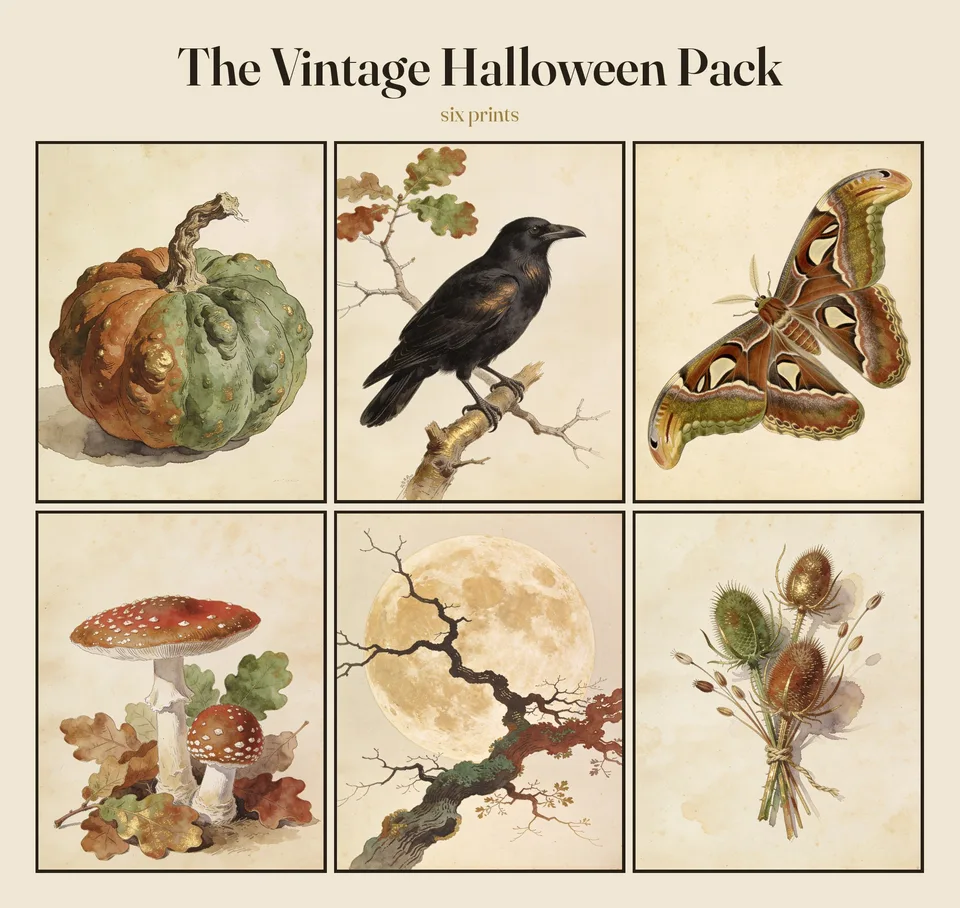
Six prints, drawn in the manner of the old natural-history plates: ivory grounds, close attention, small enough to frame from a thrift-shop table. Each has a post it keeps in this house from the first of October. Here they are the way they hang: one to a wall, each in its own light.
The heirloom pumpkin study is the door into the set, being the least Halloween of the six until the light drops. An uncarved variety, warted and ribbed, sage green giving over to rust, drawn the way a seed catalog of 1890 would have drawn it, as an achievement. It keeps to the kitchen, propped on the dresser shelf in a cream-painted frame with honest chips, where the morning light finds it first: no face cut into it, no candle inside, a pumpkin with its dignity intact.
The crow on its bare branch is the spine of the set: a naturalist's bird, feathers counted, one foot gripping the bark, nothing menacing in it except everything October adds. It has the turn of the stairs, in that blackened oak frame, precisely because the landing gives up its light by four. A crow met at dusk, half-lit by the hall lamp below, is the whole holiday in a single glance.
The autumn moth study is the smallest sheet and takes the smallest frame: brass, scarcely bigger than a postcard. The wings are laid open flat in the old specimen manner, umber and ash with two watchful eyespots. It hangs above the reading chair, inside the lamp's low circle, which is where a moth would have ended up anyway.
The fly agaric plate carries the only red in the set: scarlet caps flecked with white, rising out of fallen oak leaves. It belongs above the boot bench by the back door, in a plain pine frame, where the walks come in and half the leaves come with them. On paper the toadstools are admired up close; in the field they are admired and left standing, which is a lesson the old plates were partly drawn to teach.
The bare oak branch against a full moon is the darkest sheet in the pack: most of it night, the branch cutting across a moon drawn with its seas showing. It goes where dark is welcome: the bedroom, above the chest of drawers, in a thin dark frame with a wide ivory mat to keep the night from swallowing the wall. It is the last thing the lamp reaches before it clicks off, and the room is better for it.
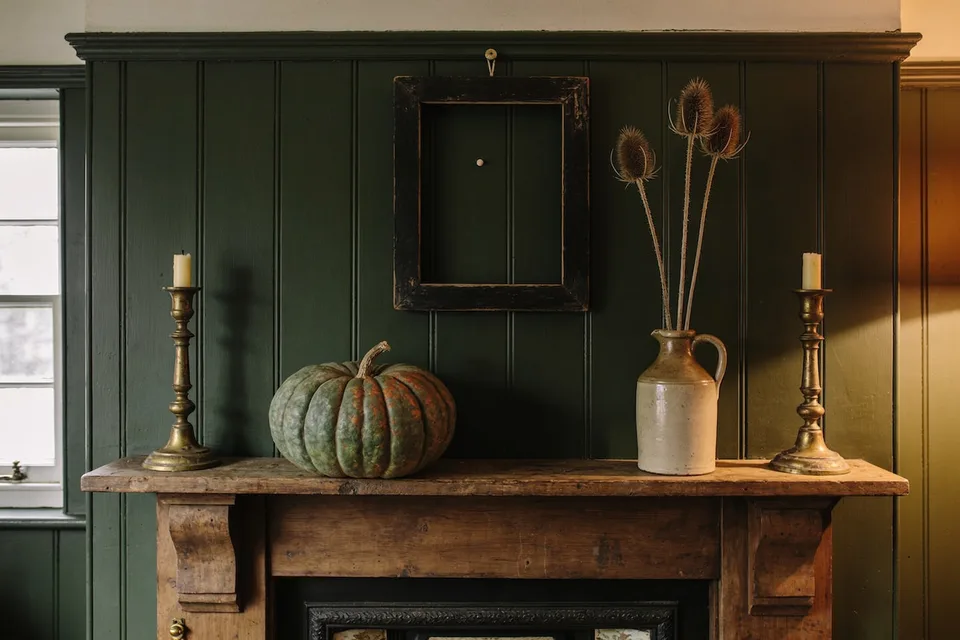
And the dried teasel and seed stems, tied with twine, are the quietest of the six, barely Halloween at all, which is their job. They hang in the hall by the coat pegs, in a gilt frame rubbed soft at the corners, a foot from the jug where the real stems stand. Every set needs one print that lets the others land, the way a dark room needs its one lamp lit.
Nothing in the six grins or glows. They tell the season the long way (field, branch, moon) and they sit without argument beside everything these rooms already keep: the brass, the stoneware, the wool.
If this kind of October would suit your walls, the set is free. From the first of October it is the pack behind the free-printables door, where September's amber autumn set hangs today: leave an email address then, and the six arrive ready for whatever frames the thrift shop surrenders next. If October still feels a few weeks off, the amber set is these same rooms in an earlier light, and it is there now.
And when a house wants more October than six free sheets can carry, there is a second Halloween set in our Etsy shop: six more studies in the same hand, a lit turnip lantern, a watchful black cat, apothecary bottles, a besom broom, a brass candlestick, and a harvest wreath of wheat and oats, none of them repeated from the free pack.
Printing dark plates at home
None of this needs a print shop. An ordinary home inkjet at its best-quality setting, fed ordinary matte paper, makes a print worth an old frame at these sizes. The whole pack is built for 8×10 inches or A4 and under, which is what the frames on the rummage table mostly measure anyway. Matte is the one word that matters: a glossy sheet turns every lamp into a white glare sliding across the crow, and these are prints for lamplit rooms. A heavier matte sheet, if the drawer holds one, takes the moon plate's deep night a little flatter; a good print on plain matte paper tonight beats a perfect one still being deliberated.
Two small honesties. Ink lands a shade away from the screen, and with this palette that is no loss: an umber that dries a step darker has only gone a step further into October. And the dark sheets want a few minutes to dry before they go behind glass: the moon will smudge if it is hurried. If there is a choice of whites, choose the warmer one; the ivory ground is half the vintage in a vintage print.
Frames worth hunting
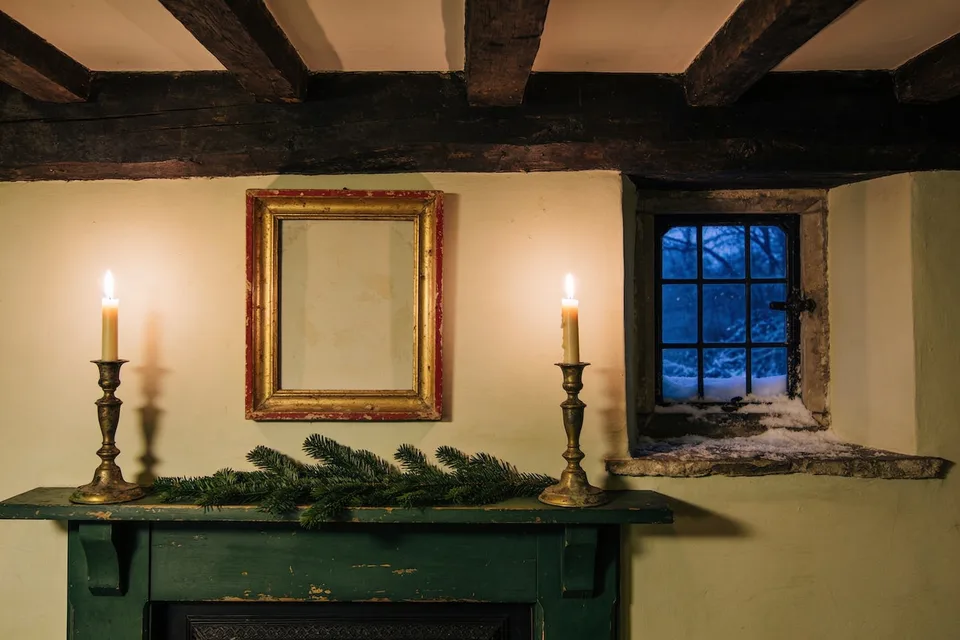
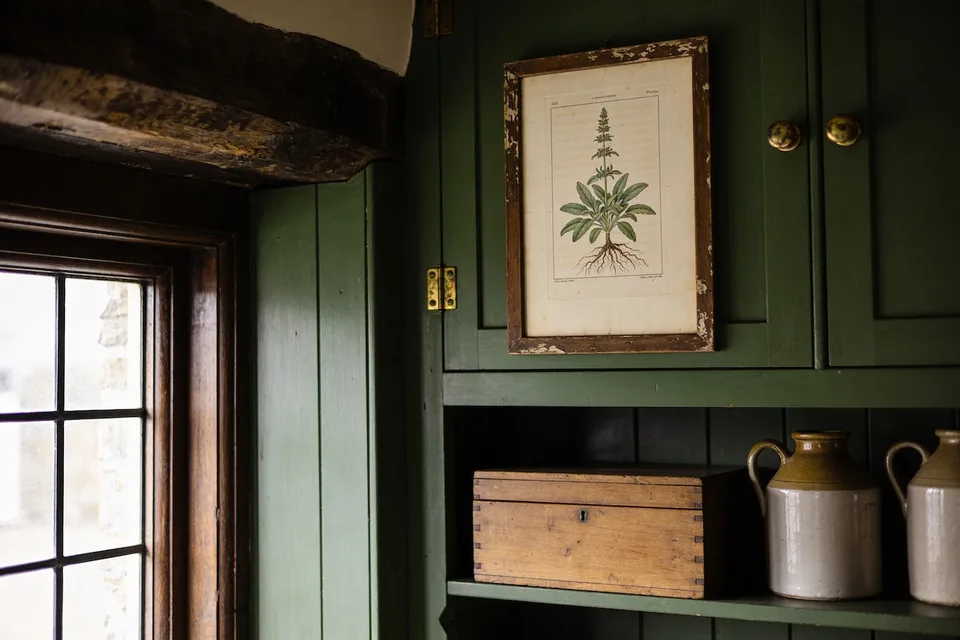
A dark print wants a frame with some age on it. New frames (white, boxy, sold in threes) do to a crow what a porch light does to the evening: the bird survives, but the hour is gone. The frames these six hang in came off thrift-shop tables across a run of autumns: oak gone almost black, a brass rectangle the size of a postcard, gilt rubbed back to the red underneath, pine carrying somebody else's nail holes. Old frames are priced for their wood and their glass, not for what they hold, and dark old wood is often the cheapest kind on the table: it photographs badly and hangs beautifully, and only one of those matters here.
The checks are quick: corners tight, glass whole, and a slightly wavy pane is a finding, not a flaw. A crow behind wavy glass looks as if it has kept that stair since the house was papered. Nothing needs to match anything. Six prints in six frames that never met before October is not a compromise; it is what a wall that accumulated looks like, and accumulation is the only style this house will admit to.
Where the six hang, together and apart
For most of the month the six live apart, one dark note to a room, which is how a small set covers a whole house. Spread thin, no room tips over into theme; each print reads as something the house has always owned that October has simply turned up. Fewer walls, fewer nails: run them as pairs instead, pumpkin with teasel where gentleness is wanted, crow with moon where the dark can be trusted, or hang three in a column in the hall, a hand's width apart, low enough to meet the eye of someone passing in a coat.
In the last week of October the house breaks its own rule. The three darkest sheets (crow, moth, moon) come off their nails and gather on the mantel, propped in a row behind the candlesticks, the jug of real teasel standing at the end. It is the nearest these rooms come to decorating for the holiday outright: one shelf, one week, the lamps kept low. Gathered, they read as a single dark sentence; and the gathering costs nothing, because paper is the one decoration that moves house without complaint. On the first of November each goes back to its own wall, and the mantel returns to brass and beeswax.
What comes down in November, and what stays
Halloween ends overnight; autumn does not, and the pack was made with that seam in mind. On the first of the month the moth and the fly agaric go to sleep, flat between plain sheets in a drawer, never rolled, and the mantel three disband. The rest hold longer contracts. The pumpkin study keeps the kitchen through the last pie of November, because an uncarved pumpkin was never in costume; it was only ever harvest. The teasel stays by the coats deep into winter: dried stems tied with twine are simply what the season looks like now. The oak branch and its moon stay as long as the real oaks outside agree, which is usually well past February. Even the crow is moved rather than retired: down from the stair to a quieter wall, an ordinary winter bird again with the holiday folded away.
That is the other argument for keeping Halloween on paper. Half this pack is October wearing its one dark week; the other half is the whole cold season and knows how to stay. And when a sheet comes back next year softened or sun-touched, it is printed again in a minute (the pack is free the second time, too) and the wall starts its month new.
Season by season, whatever this house makes for its own walls gathers with the rest of the printables.
Tonight, the darkest wall
Start with the wall, not the prints. When the lamps come on tonight, walk the rooms once and notice which wall gives up the light first: the turn of the stairs, the end of the hall, the strip beside the bookcase the lamp never quite reaches. The instinct all year is to fight that wall with a brighter bulb; October is the month to stop. Leave it dim, drive one nail, and give the darkest wall in the house to the crow. The rest can follow as the frames turn up. The season only needs one place to perch.
Common questions
What is in the free vintage Halloween pack?
Six prints drawn in the manner of the old natural-history plates: an heirloom pumpkin study, a crow on its bare branch, an autumn moth, a fly agaric among fallen oak leaves, a bare oak branch against a full moon, and dried teasel tied with twine. Nothing in the six grins or glows, and each is small enough to frame from a thrift-shop table.
When can I get the free Halloween printables?
From the first of October. The set takes its turn behind the free-printables door then: leave an email address and the six arrive ready for whatever frames the thrift shop surrenders next. If October still feels a few weeks off, the amber autumn set is these same rooms in an earlier light, and it is there now.
Can I print the Halloween prints at home, or do I need a print shop?
No print shop. An ordinary home inkjet at its best-quality setting, fed ordinary matte paper, makes a print worth an old frame at these sizes: the whole pack is built for 8x10 inches or A4 and under, which is what the frames on the rummage table mostly measure anyway. Matte is the one word that matters, since a glossy sheet turns every lamp into a white glare. And give the dark sheets a few minutes to dry before they go behind glass; the moon will smudge if it is hurried.