 Cottage at Home
Disclosure: some links below are affiliate links, and if you buy through one we may earn a small commission, at no extra cost to you.
Cottage curtains, room by room: the kitchen, the living room and the bedroom
What cottage curtains are, and what to hang in each room: a café curtain in the kitchen, lined weight in the living room, and bedroom curtains that close.
In this guide
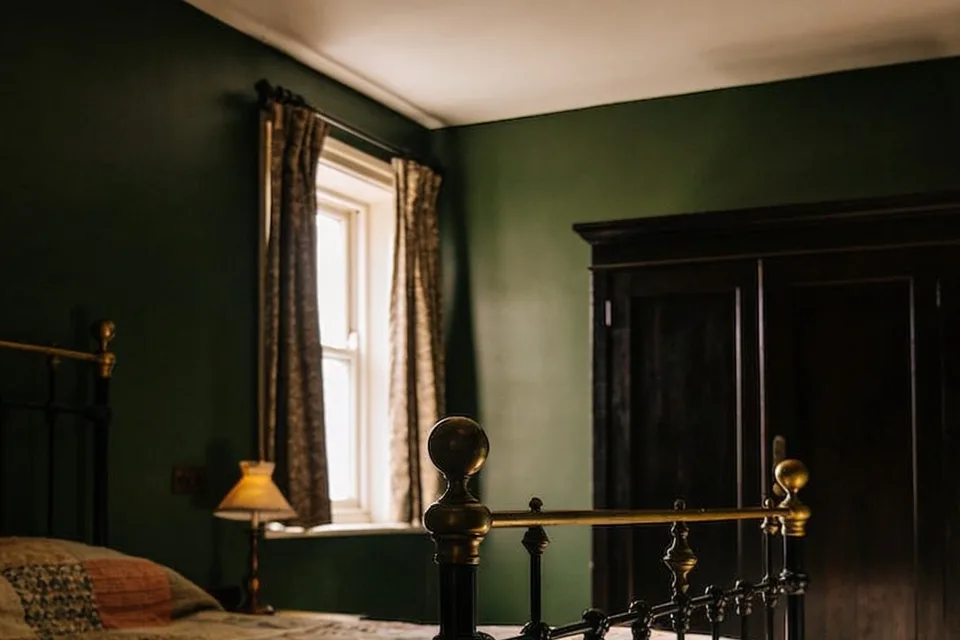
Every window in the house does a different job. The kitchen window is for daylight and for watching the weather while the kettle boils. The living room window is for the hour after dusk, when you want the room closed in around the lamps. The bedroom window has to give you the dark. The curtains follow from those jobs, room by room, and that is how this page is laid out: what the words mean first, then the kitchen, the living room and the bedroom, then the rod, the cloth and the measuring.
What "cottage curtains" means
Cottage curtains are, strictly, a pair of curtains in one window: a short café curtain across the lower half and tie-back curtains, often ruffled, across the top. Most people now use the words for any simple, soft curtain in a cottage room: linen, cotton, a small print or a stripe, hung from a plain rod.
The strict meaning is the one in the Getty's Art and Architecture Thesaurus, the vocabulary museums use to catalogue furnishings, which describes "a combination of café curtains across the lower part of an opening and tieback curtains, usually ruffled, across the top." It is still a good idea for a window that faces the street. The lower curtain keeps people from looking in, and the upper pair frames the glass and can be let down at night.
The looser meaning is the one in shops, and it is fine too. What it describes is a mood more than an arrangement: soft cloth rather than stiff, plain rather than swagged, a curtain that looks as if someone made it rather than ordered it with the blinds. Both meanings agree on one thing. A cottage curtain is simple. No pelmet, no swags, no tassels, and in this house no valance either.
Cottage curtains for the kitchen: a café curtain over the sink
Hang a café curtain across the lower half of the kitchen window, from a rod set at about the middle of the glass, and leave the top half bare. It hides the washing-up from the street and keeps the daylight, which is what a kitchen window is for.
The English cottage kitchen puts it the same way: privacy holds at eye level and the light comes in over the top all day. Use linen or a heavy cotton that will take being washed often, since a kitchen curtain catches steam and cooking. Gather it on small rings or slip it straight onto the rod, and keep it short enough that it clears the tap and the sill.
A slim brass café curtain rod set inside the frame is the plainest answer, and old ones with a bit of tarnish look better than new. If the kitchen is dark-walled, use a curtain a shade heavier than you would in a pale room: at night an undressed window turns into a black mirror, and the moody cottage kitchen explains why a little cloth at the glass fixes it.
Cottage curtains for the living room: weight, a lining, drawn at dusk
Living room curtains want weight. Choose lined linen, wool or a heavy cotton, hang them from a plain pole that runs past the frame on both sides, and make them wide enough to close with folds still in them. Draw them at dusk and the room closes in around the lamps.
Width matters more than anything else here. A pair that only just meets in the middle looks mean when closed and pulls flat, so allow about twice the width of the window in fabric, split between the two curtains. Running the pole past the frame lets the curtains stack against the wall in the day, clear of the glass, so the room keeps all of its light.
The lining does the real work. It keeps the sun from fading the face of the curtain, it gives the folds their body, and on a winter evening it puts one more layer between the room and the cold glass. Ready-made lined linen curtain panels are the simple answer if you are not sewing. In a dark-walled living room, a pale curtain is a good place for the one light surface the room needs, and in an English cottage sitting room a wool curtain over the door does the same job against the draught.
Cottage curtains for the bedroom: lined, and long enough to close
Bedroom curtains are there for the dark. Hang lined linen or wool, close enough to the glass that light does not leak round the sides, and make sure they close fully. A two-part café arrangement looks lovely in a bedroom by day and fails at night, so keep it for downstairs.
The English cottage bedroom says it plainly: in a deep-walled room, black open glass at night undoes the lamplight, and drawn curtains give the walls back their colour. In June the light comes before five, which is when a lining earns its place. If you want the bedroom to stay pale and light in the day, hang a lighter curtain and put a blind behind it for the dark, the same fix the guest room uses for a visitor who sleeps badly in a bright room.
Spare-room curtains are usually whatever came off another window. Check them the same way you check the bed: draw them on a bright morning and see where the light still gets in.
The rod, the rings and a heading that hangs straight
Use the plainest rod you can find: a thin iron or brass pole on two brackets, or a wooden one painted the colour of the window frame. Hang the curtain from rings or simple tabs, never a stiff pleated heading, and let the cloth fall straight to its hem.
Set the pole a hand's width or so above the top of the frame, not up at the ceiling. In a cottage the windows are small and the ceilings low, and a pole hung high makes the window look like it is pretending to be bigger. Let the pole run past the frame on each side by about a quarter of the window's width, so the curtains can open fully.
Rings that slide easily are worth paying for. A curtain that sticks on its pole gets left half-drawn, and half-drawn is the one position a curtain never looks right in. Sew-on rings or clip rings both work; clips are easier to take down for washing.
Linen, wool, ticking and a faded floral
The cloth for cottage curtains is plain and natural: linen above all, then wool for winter, cotton ticking for a kitchen or a child's room, and an old faded floral where the room wants a pattern. Avoid anything shiny, stiff or blackout-backed on the face.
Linen hangs well, softens with washing and lets a little light through even when lined, which is why the kitchen and the bedroom both use it. Wool is for cold rooms and the long months, and it holds a fold better than anything else. Ticking stripes are hard-wearing and look right in working rooms. For a pattern, look for old fabric rather than a new print made to look old: vintage curtain fabric is sold by the metre and as old curtains, and a small window needs very little of it.
Wash linen before you hem it. It shrinks the first time it goes through the machine, and a curtain hemmed first and washed second ends up short.
How to measure a cottage window
Measure the width of the pole, not the window, and double it for the fabric. Measure the drop from the pole to where you want the hem: just below the sill for a small window, just off the floor for a tall one. Measure each window on its own, top and bottom.
Old houses are rarely square. A window can be a centimetre or two wider at the top than at the bottom, and two windows on the same wall can differ by more than that. Measure every window, write the numbers down by room, and buy or sew for each one. A curtain hemmed a little long can be taken up; one hemmed short cannot be let down unless you left a deep hem, which is the other reason old curtains always have one.
Two sets a year, and where the other set lives
We keep two sets of curtains for the main rooms: unlined linen for the summer and lined wool or heavy linen for the winter. The swap in October and again in May is a morning's work, and it changes how the whole house feels.
The summer set lets the long evenings in and moves in the breeze. The winter set closes the rooms in early and keeps the cold glass out of sight. Wash the set coming down, dry it fully, fold it with as few creases as you can and put it away in a cotton bag or an old pillowcase, never plastic, in a dry cupboard. It will want a short hang and a shake before it goes back up, and a little fading along the folds after a few years is only the curtain showing its age, the way everything else in the house does.
Common questions
What are cottage curtains?
Cottage curtains are, strictly, a pair of curtains in one window: a short café curtain across the lower half and tie-back curtains, often ruffled, across the top. Most people now use the words for any simple, soft curtain in a cottage room: linen, cotton, a small print or a stripe, hung from a plain rod.
Should cottage kitchen curtains be short?
Yes. Hang a café curtain across the lower half of the kitchen window, from a rod set at about the middle of the glass, and leave the top half bare. It hides the washing-up from the street and keeps the daylight, which is what a kitchen window is for.
Should bedroom curtains touch the floor?
Long enough to close properly and to block the light at the sides is what matters, whatever the length. A small cottage window with a radiator or a deep sill below it is better with curtains that stop just under the sill. A tall window with open floor below it can take curtains that just kiss the boards.