 Cottage at Home
Disclosure: some links below are affiliate links — buy through one and we may earn a small commission, at no extra cost to you.
Moody cottage bathroom: dark walls and the face in the mirror
A moody cottage bathroom is judged at the mirror, not the doorway: light at eye height, a finish that takes the steam, and the pale things the room already owns.
In this guide
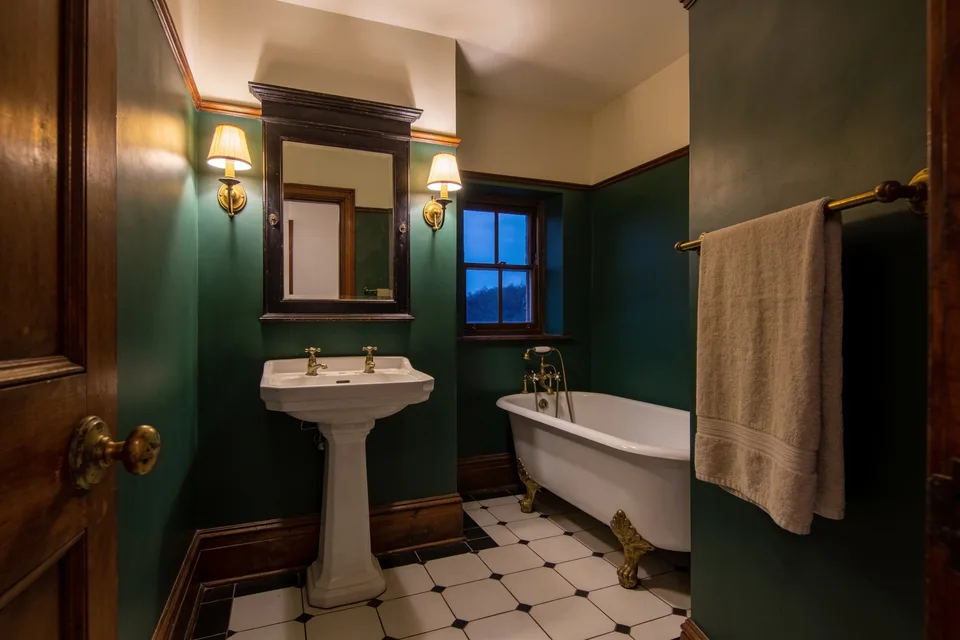
Most dark bathrooms are photographed empty, from the doorway, at noon. Nobody lives in one that way. The room is used at the basin, early and late, with your own face in the middle of the view, and that is where a moody cottage bathroom is won or lost. The wall is something you mostly see from behind yourself.
The wall you see behind your own face
A moody cottage bathroom is judged at the mirror, not the doorway, because that is where you spend nearly all your time in it. A dark wall behind you is the backdrop to your own face twice a day, and the question is simply whether that face looks rested against it. Get the light right and the answer is yes.
That changes what matters. In a dark cottage living room the deep wall is the room's big gesture, seen from the sofa across the fire. In here the wall's job is smaller and more personal: to fall back and let the one lit thing in the mirror, which is you, come forward. A deep green, a smoky blue or a brown-black all do that well when they are lit from the front.
The small size helps. A bathroom is the room where going dark costs least and is easiest to undo, and it is closed off behind a door, so the rest of the house never has to agree with it. The larger case for a darker house is made in moody cottage decor; the bathroom is often where that case gets tried first.
Why the overhead light makes everyone look tired
The single light in the middle of a bathroom ceiling is the reason most dark bathrooms feel unkind. It shines down onto the top of your head, so every shadow on your face falls downward, under the brow, under the eyes and under the chin, and a dark wall has no pale surface to bounce any of it back.
In a white bathroom that overhead light gets away with it, because the walls throw light back in from every side. Paint the walls deep and the bounce is gone, and the same fixture that seemed fine before now makes the morning face look older than it is. People blame the colour. The colour is doing what it was asked; the light is coming from the wrong place.
So the overhead stays for cleaning, and for finding something dropped behind the tub, and it goes off for everything else.
Two lights at the height of your eyes
Light a moody bathroom from the front, at eye height, from both sides of the mirror. Two wall lights or two small lamps flanking the glass fill the shadows the ceiling fixture makes, light your face evenly, and leave the dark wall behind you to go quiet. Warm bulbs keep skin looking like skin.
If the wiring is only in the ceiling, there is still a way. A plug-in wall light with its cord run neatly down the wall, a brass swing arm wall lamp being the old answer, does the job of a sconce without an electrician, and a small lamp on a shelf or the back of the basin does more than any ceiling fixture ever will. Keep anything plugged in well away from the water, and if you are adding a fixture near a bath or shower, that part is an electrician's job, not a Saturday's.
Try it before painting anything. Turn the overhead off, light one lamp beside the glass, and look. If your face comes forward and the wall goes soft behind it, the room has already told you it can take the colour.
Steam picks the finish before you do
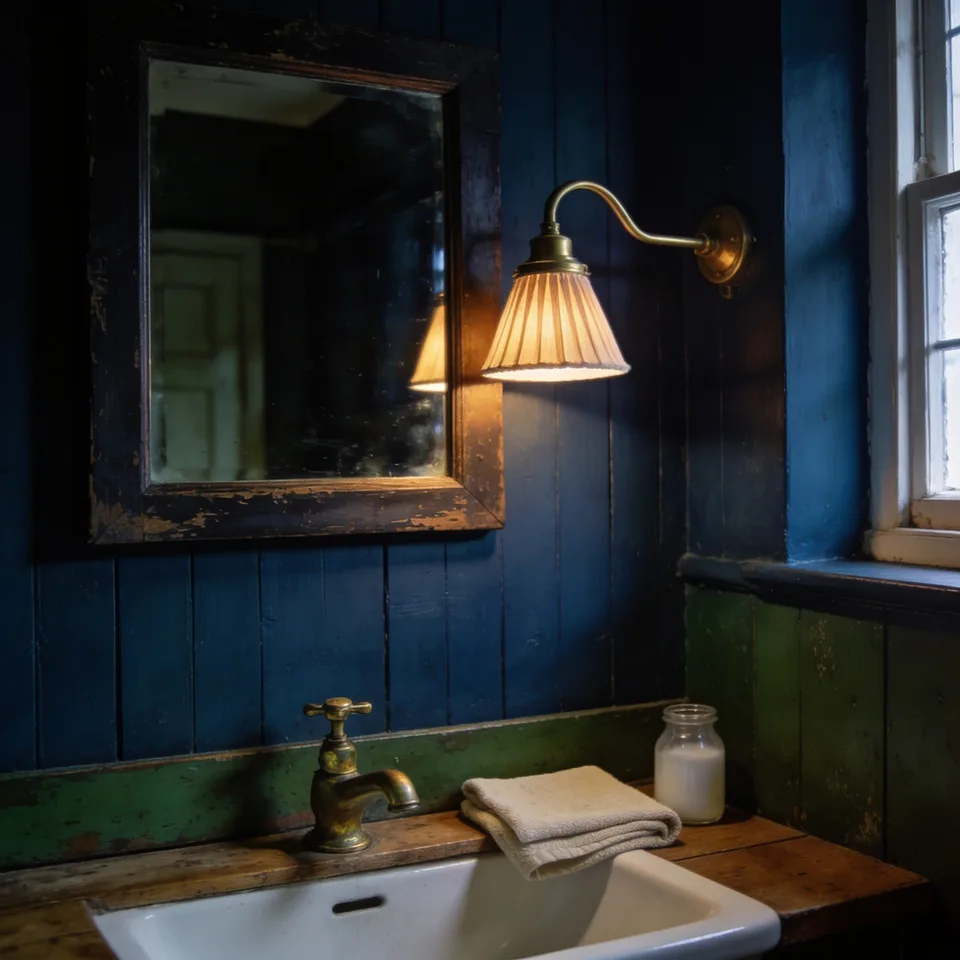
A dark bathroom wants a soft sheen, eggshell or satin, not the flat finish a dark bedroom does best in. Steam and splashes mark flat paint, and flat paint marks again when it is wiped, and deep colours show every mark. A little sheen wipes clean and survives a winter of hot showers.
This is the one place in a moody house where the rule bends. In the moody cottage bedroom the walls stay flat because flat paint drinks lamplight and never glares back. Flat paint drinks lamplight beautifully in here too, but it also drinks the shower, and shows you where. So the bathroom takes the soft sheen and gets something for it: a dark wall with a little shine catches a small window or a lamp as a low glow, like dark water catching the sky.
The ceiling can stay flat, since it is rarely touched, and a good bathroom paint in the soft sheen is worth the extra cost on the walls. Keep the fan running, or the window open an inch, for a while after every bath.
The pale things the room already owns
A bathroom can go darker than any other room without turning gloomy, because it already holds pale surfaces you would never paint: the basin, the tub, the toilet, often a run of white tile. Those give the eye its rest and the light something to land on, so the walls are free to go deep.
In a living room, part of the craft of going dark is choosing one surface to keep pale. The bathroom has done that for you, in white china and enamel that will be there as long as the plumbing is. Let those pieces be the bright things and don't fight them with more white.
Grout is worth one thought. White grout between dark tiles greys within a year and looks tired; dark grout under white tile stays honest and draws the pattern of the tile instead. The white towels can go too, if you like, for oatmeal, stone or a dark linen that does not glare in the mirror. The objects that suit a bathroom, the brass, the milk glass, the old linen on the rail, are all in the vintage bathroom, and every one of them looks better against a deep wall than a white one.
What colour, and under which light
Choose a bathroom colour under the bulbs that will light it, not by a window and not on a card. A bathroom is used mostly early and late, and many have little daylight or none, so the lamp by the mirror is the light the colour will live under. Paint a test board and hang it there for a week.
Deep green, smoky blue, warm charcoal and brown-black are the safe starting places. A cooler colour can work in a bathroom in a way it rarely does in a sitting room, because the room is often at its busiest in grey morning light rather than by a fire. The vintage bathroom makes that case for a slate blue chosen at seven in the morning. A warm dark suits a room used mostly at night by lamplight. Either way, look at it with the lamps on and the overhead off before you buy a litre.
A mirror with a real frame helps a dark wall more than a frameless sheet of glass. A plain painted or waxed wooden frame catches the lamps at its edge and reads as a piece of furniture against the paint, where a bare glass panel looks like a hole in the wall. Keep the old gilt and the old silvering for drier rooms, for the reason the vintage bathroom piece gives: steam clouds in a winter what took a century anywhere else.
Change the bulb tonight, paint on Saturday
Start with the light, because it costs least and tells you most. Tonight, turn the overhead off and put a small warm lamp beside the mirror. Live with that for a few days. If you like the room better in that light, the dark paint will only take it further, and the weekend is enough time to do a room this small.
Common questions
Does a dark bathroom make you look tired in the mirror?
Only if the light comes from above. A single ceiling fixture throws shadow down under the eyes and the chin, and a dark wall gives nothing back to soften it, so the face looks worn. Light at eye height on both sides of the mirror fills those shadows from the front, and then a dark wall does the opposite: it goes quiet behind you and your face comes forward.
Can you paint a small bathroom with no window a dark colour?
Yes, and a small room with no window is one of the easiest places to try it, because its light never changes. Whatever colour you choose will always be seen under the same bulbs, so choose it under those bulbs: paint a test board, hang it by the mirror for a week of mornings and evenings, and judge it there rather than on a paint chip in daylight.
What paint finish does a dark bathroom need with all the steam?
A soft sheen, eggshell or satin, rather than the flat finish that suits a dark bedroom. Flat paint holds every splash and fingerprint and marks when it is wiped, and dark flat paint shows it most. A little sheen wipes clean after a steamy week, and on a dark wall it catches a lamp or a small window as a soft glow, which is no loss at all in a room this size.