 Cottage at Home
Disclosure: some links below are affiliate links — buy through one and we may earn a small commission, at no extra cost to you.
The English cottage bathroom: a room before it was a bathroom
An English cottage bathroom was often a bedroom first, and it shows: a bath on its feet, a washstand, a chair, a window. How to borrow that in any bathroom.
In this guide
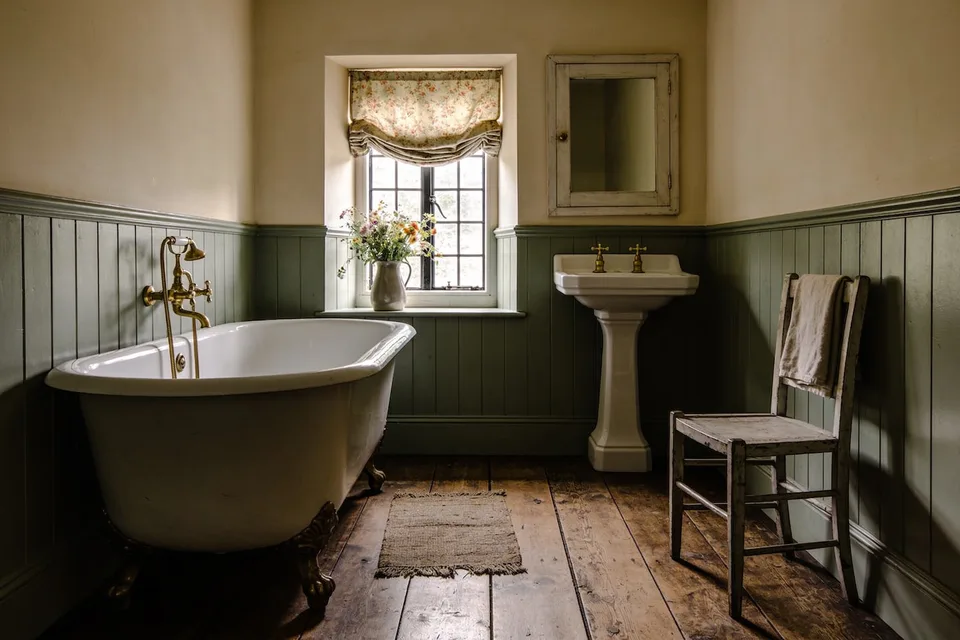
Walk into an old English cottage bathroom and the first thing you notice is that it looks like a room. There is a window with a curtain, a floor of boards, a chair, and a bath standing out on its feet like a piece of furniture. Nobody designed it that way. It is what happens when a bathroom moves into a room that was built for something else.
Why the English cottage bathroom looks like a bedroom
An English cottage bathroom looks like a bedroom because very often it was one. Old cottages were built without bathrooms, and when the plumbing finally came it went into whatever room could be spared: a small bedroom, a box room, the end of a landing. The window, the floorboards and the proportions stayed, and the bath moved in.
That is why the look travels. You don't need an old house to borrow it, only the habit of treating the bathroom as a room first and a set of fittings second. The same idea runs through the English cottage kitchen, where the cupboards are painted like furniture, and it matters even more in here, because a new bathroom is usually nothing but fittings.
A modern bathroom is planned from the pipes outward: a tub boxed into an alcove, a vanity built to the wall, glass wherever the water goes. The English cottage bathroom works the other way round. It starts with a floor, a window and four walls, and lets a few pieces of furniture stand in it, some of which happen to hold water.
A bath that stands on its own feet
The bath is the biggest piece of furniture in the room, and in an English cottage bathroom it stands on its own feet on the floor rather than being boxed into an alcove. A cast iron roll-top on claw or ball feet is the classic, but any freestanding tub with a little air around it does the same job.
What it does is show you the floor running underneath it. That line of boards or tile carried under the bath makes a small room look bigger than a fitted tub ever does, and it is why the old baths look at home in rooms whose walls are not quite straight.
If a new bath is not on the cards, the fitted one can still be helped. A painted wooden bath panel in the colour of the boards reads as part of the room rather than as plastic. Plain brass taps, left to age with use, say more than any new tub, and there is no need to buy them aged; the water and your hands will do it.
A washstand, or a skirted basin, instead of a vanity
Swap the vanity for something that looks like furniture. The old answer was a washstand, a small table with a basin on it, and a pedestal basin against a plain wall is its modern cousin. If the vanity is staying, a gathered cotton skirt on a rail hides its doors, and that costs an afternoon.
An antique wooden washstand with a marble or painted top can take a basin set into it, and a plumber can connect it where the vanity stood. Painted wood is the right material in here, for the reason the vintage bathroom gives: it takes the steam, and when the paint gets tired it is a weekend to put right.
A skirt is the renter's version, and a good one. A length of washable cotton gathered on a tension rod under the basin covers the cupboard doors and softens the one hard box in the room. Take it down and wash it with the towels. A small print, a ticking stripe or a faded floral all belong, and this is the one place the room can take a pattern without the steam arguing.
A curtain on a rail, not a glass door
If your bath is also your shower, hang a cloth curtain on a rail instead of fitting a glass screen or door. A curtain pulls back to show the tub and the room when nobody is using it, it goes in the wash, and it is the one soft thing a small tub-shower alcove can hold.
A plain linen shower curtain with a waterproof liner behind it does the work: the liner keeps the water in, and the linen is what you see. Leave both drawn open when the room is empty so they dry, and wash them every few weeks. That keeps mould away better than any spray.
The rail matters as much as the curtain. A plain brass or painted rod straight across the alcove looks like part of the house, where a curved chrome one looks like a hotel. Glass doors are the hardest thing in a small bathroom to make feel old, and taking one off is often the biggest single change the room can have.
Boards to shoulder height, and what goes above them
Run painted boards, tongue-and-groove or beadboard, to around shoulder height, and paint the wall above them a warm cream. The boards take the splashes and carry the colour, a green with grey in it, a soft blue or a stone, while the cream above keeps the room light from the window down to the floor.
Paint both in a soft sheen, eggshell or satin, not flat. The reason is in the moody cottage bathroom: steam marks flat paint, and flat paint marks again when it is wiped. The boards can be the darker of the two, because they are where the room gets touched.
Wallpaper is what most pictures of this room show above the boards, and it is the one thing the steam argues with. In a bathroom with a shower it lifts at the seams and ripples within a few winters. If you want the florals, put them in cloth, at the window and under the basin, where they can come down and be washed. A powder room with no bath or shower is the exception, and there paper is fine.
A chair, a rug, and a jug on the sill
The small things that make it read as a room are the ones a bathroom is usually denied: a wooden chair for the towel, a washable rug on the floor, and something alive on the window sill. None of them does a plumbing job. Each one tells you somebody lives here, and that is what this style is really about.
The chair can be any old painted kitchen chair; it holds the towel, the clothes, or you, while you wait for the bath to run. A cotton rag rug goes in the wash with everything else and dries over the chair back. On the sill, a jug of whatever the garden or the roadside has, cut stems in plain water, changed when they drop.
If there is room, a small painted cupboard on the wall does what a medicine cabinet does and looks as if it came from another room of the house. In an English cottage bathroom most things did.
Light it like a room, not a fitting
Light an English cottage bathroom the way you would light a bedroom: from the side and at eye height, not only from a fixture in the middle of the ceiling. Two small wall lights beside the mirror, or one lamp on a shelf well away from the water, give a warm light that suits the boards and your face.
The ceiling light stays for cleaning. The English cottage bedroom retires its overhead light for the same reason, and anything wired in near a bath or shower is an electrician's job, not a Saturday's. Keep the window dressing light too: a short curtain or a blind that pulls fully up, so the morning gets in.
The mirror over the basin wants a plain painted or waxed wooden frame. The old gilt and the old silvering belong in drier rooms, where a century of clouding is worth keeping and a winter of steam cannot forge it.
Bring in one chair
Start with the cheapest move: carry a painted chair in from another room and set it beside the bath with a folded towel on it. Then stand in the doorway and look again. If the room already reads a little more like a room and a little less like a set of fittings, the rest can follow one piece at a time.
Common questions
Why is there a chair in an English cottage bathroom?
Because the room is treated as a room and not as a set of fittings. The chair can be any old painted kitchen chair; it holds the towel, the clothes, or you, while you wait for the bath to run. It does no plumbing job at all, and that is the point: it tells you somebody lives here.
Can a small bathroom with a tub-shower look like an English cottage bathroom?
Yes, and without moving a pipe. Hang a cloth curtain on a rail instead of a glass door, skirt the vanity or swap it for a pedestal basin, run painted boards to around shoulder height, and light the mirror from the sides at eye height. A painted chair and a washable rug do the rest.
Can you use wallpaper in an English cottage bathroom?
Wallpaper is the one thing the steam argues with. In a bathroom with a shower it lifts at the seams and ripples within a few winters. If you want the florals, put them in cloth, at the window and under the basin, where they can come down and be washed. A powder room with no bath or shower is the exception, and there paper is fine.