 Cottage at Home
Disclosure: some links below are affiliate links — buy through one and we may earn a small commission, at no extra cost to you.
English cottage gifts: the ones that read as inherited
English cottage gifts that read as inherited, not shopped for — a brown teapot, horn, ticking, a blanket box, brass — argued from material and wear.
In this guide
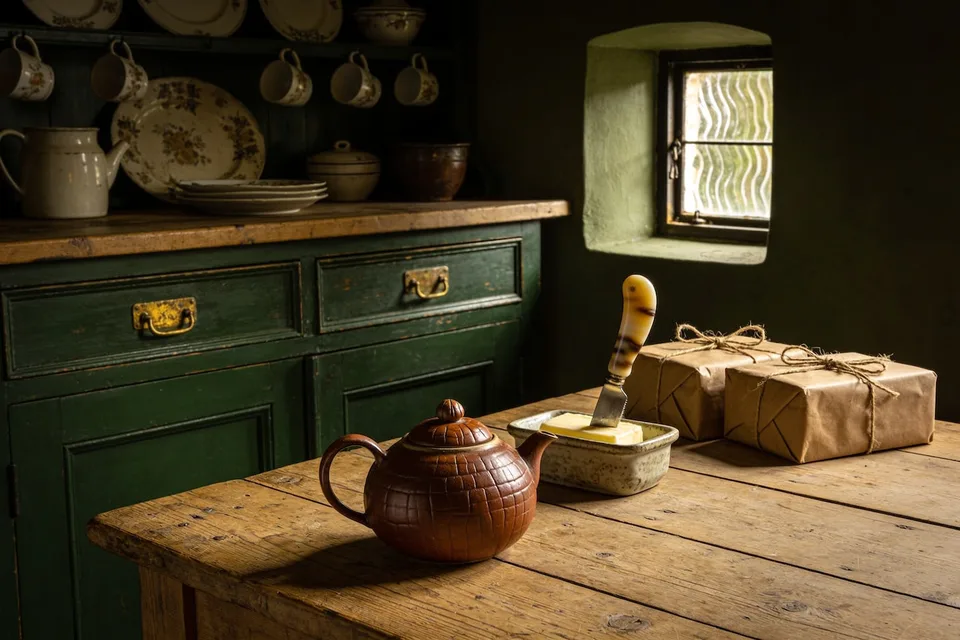
The teapot on the breakfast table is brown, round, and assumed by every guest to be a third-generation resident; it arrived four birthdays ago, new in its box. The butter knife with the mottled horn handle came the Christmas after. The pine box at the foot of the bed upstairs is newer to the household than the dog. Every one of them was a gift, and not one of them will admit it.
That is the whole art of giving to an English cottage home. These rooms read as kept — accumulated over years, tended rather than furnished — and an object that announces its own newness stands in them like a visitor who kept their coat on. The gift that lands looks handed down: bought on a Tuesday, at home for decades by supper. December states the law outright — the English cottage Christmas is handed down, not bought — but it governs the parcels as firmly as the paper chains. Nobody can give a family history. What can be given is a thing that looks like one.
What lets a gift pass as inherited
Three qualities do the passing, and all three are still sold. A shape that stopped changing: some things have been made to one pattern for a century and more, so a new one cannot be dated by looking, and what cannot be dated is assumed old. A surface in a hurry to age: horn, raw pine, unlacquered brass, tight ticking all take their wear early and wear it well, so the first year does a decade of cosmetic work. And installation: a thing screwed to the wall joins the architecture, which was always there. Buying genuinely old works more directly — the estate sale stays the honest shortcut — but the quieter game is the new thing that refuses to look it.
The kitchen: a brown teapot and a horn handle
The English cottage kitchen earned its standing by accumulation — open shelves, nothing arriving together — which makes it the easiest room to get wrong: anything boxed as a set, or styled to its own year, sits on those shelves like a misprint. The safe gifts are the two oldest patterns in the cupboard.
A plain brown teapot — the round-bellied sort glazed the color of a chestnut, made to the same pattern since the 1800s — is the proof that undatable works. Thick clay holds the heat, the round belly lets the leaves turn, and the glaze runs a little differently on every pot, so nobody can tell this year's from a fifty-year resident without turning it over. It goes to work the afternoon it is unwrapped and looks tenured by the weekend.
Horn is the same argument at teaspoon scale. A horn-handled butter knife, or horn spoons for the eggs, earns its drawer on reasons, not nostalgia: no two handles share a figure, the material takes a soft polish from nothing but handling, and horn was always the answer to the boiled egg, which turns a silver spoon black within the week. Small, inexpensive, impossible to date — the whole brief in a breakfast drawer.
The bedroom: the box at the foot of the bed
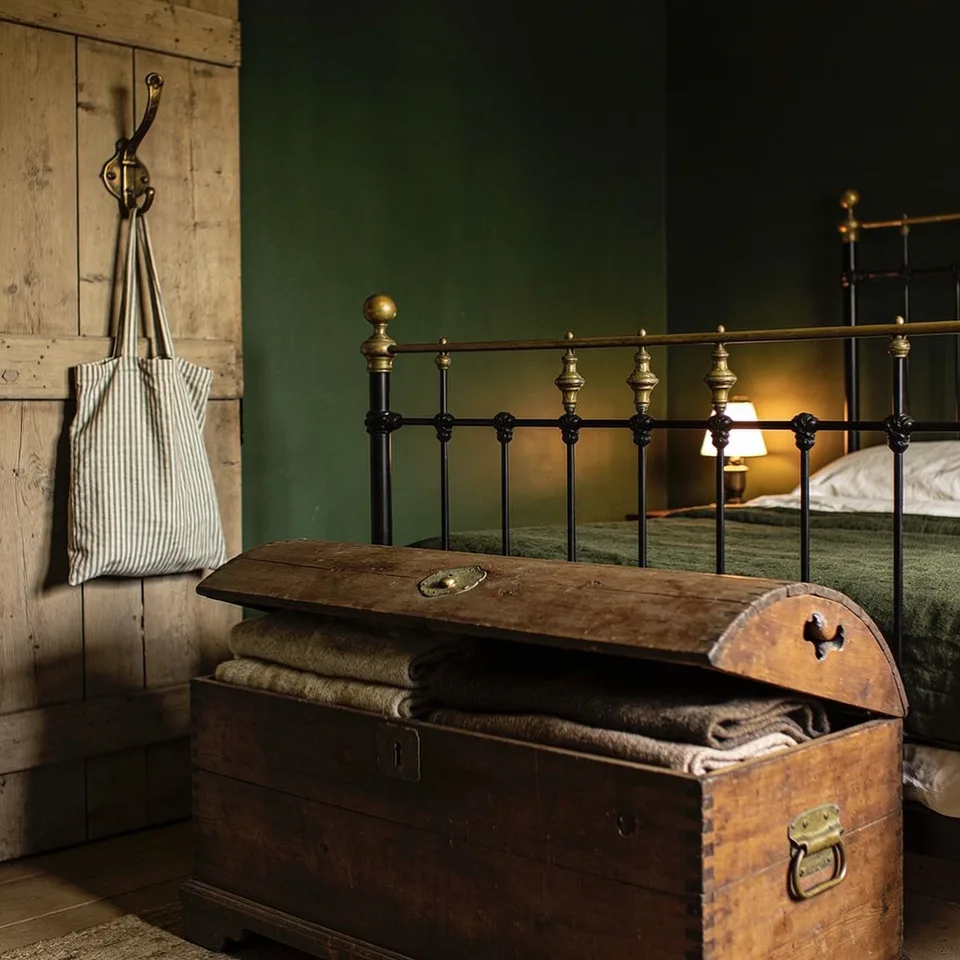
The English cottage bedroom fills from the rest of the house — it is where good furniture retires — so the right gift looks long since retired there. The blanket box does this better than anything that can still be carried up a staircase: six planks of pine, a hinged lid, room for the winter layers the bed sheds every May. Pine dents readily and keeps every one, which is why this is the one gift here better bought old — boxes like it were made by the thousand for two centuries, and they surface at estate sales for less than new pine costs, their records already begun. Set at the foot of the bed, it is furniture within the hour, and by its first winter nobody will remember the room without it.
The small parcel upstairs is ticking. A laundry bag in ticking stripe — the narrow-striped cotton that once cased every feather mattress — hangs on the back of the door and outlasts every printed fabric in the room: ticking was woven dense enough to hold feathers in, and a cloth that can keep a feather can shrug off decades of socks. The stripe is woven, not printed, so it fades honestly, straight through.
The threshold: gifts that arrive with screws
At the back door, where the weather stops, gifts stop looking like gifts at all — which is the camouflage working. Heavy cast brass hooks are the pattern case: uncoated, screwed to a board or straight to the wall, taking the dog's lead, the market bag, the key that must not wander, while the first winter begins the polish — bright where the hands land, dark where they never do. Loose in a box they are hardware; driven home before the visit ends, they are original features by spring, and nobody thanks anyone for architecture, which is the compliment.
The same door wants a wool curtain across its inside face — the old answer from houses that never met weatherstripping. A plain rod, a cloth with real weight, drawn on winter evenings against the draft that finds every keyhole: it reads as a habit the house has always kept, because in the old houses it was. And a beech boot jack — the notched form unchanged in two hundred years — proves undatable can still be bought new, in plain wood, for very little; everybody who trips over it will assume it Victorian.
The walls: let the frame do the inheriting
The walls take gifts on the same terms, with an advantage: half the object can be genuinely old for pocket money. A print in a thrifted frame — oak gone dark, gilt rubbed soft at the corners — is backdated the day it is hung; the frame brings thirty years of provenance and lends them to the paper. The Kept House, from our own shop, was drawn for that arrangement: twelve still lifes of the things a cottage hands down — the kettle, the stacked quilts, the oil lamp, the door's own iron key — CA$39 for the set, sized to the frames the thrift shelf actually offers. Framed one or two to a room, in frames that never met before, they read as pictures the household stopped noticing years ago, which is what inherited pictures are. The same trick works at zero: the free cottage prints put one botanical in one old frame for the price of the sheet — a gift nobody can price, or date.
One gift, given installed
A single habit finishes the subject: give the thing already in service. Arrive with the screwdriver as well as the parcel — hooks driven while the kettle boils, the curtain rod up, the print hung, the box carried upstairs — so the gift spends no time standing about being new. By the next visit it will be fielding questions about how long it has been in the family, and giving nothing away.
Common questions
How do you give a gift that feels like an heirloom?
Choose a thing that cannot be dated by looking. Three qualities do the passing, and all three are still sold: a shape that stopped changing, since some things have been made to one pattern for a century and what cannot be dated is assumed old; a surface in a hurry to age, the way horn, raw pine, unlacquered brass, and tight ticking all take their wear early and wear it well; and installation, because a thing screwed to the wall joins the architecture, which was always there. Buying genuinely old works more directly — the estate sale stays the honest shortcut — but the quieter game is the new thing that refuses to look it.
Why is a plain brown teapot a good gift?
Because it cannot be dated. The round-bellied sort glazed the color of a chestnut has been made to the same pattern since the 1800s, so a new one goes to work the afternoon it is unwrapped and looks tenured by the weekend. The reasons it lasted are working reasons: thick clay holds the heat, the round belly lets the leaves turn, and the glaze runs a little differently on every pot, so nobody can tell this year's from a fifty-year resident without turning it over. In a kitchen that reads as accumulated — open shelves, nothing arriving together — that is exactly the gift that lands.
Why use a horn spoon for boiled eggs?
Because horn was always the answer to the boiled egg, which turns a silver spoon black within the week. A horn-handled butter knife, or horn spoons for the eggs, earns its drawer on reasons rather than nostalgia: no two handles share a figure, and the material takes a soft polish from nothing but handling. Small, inexpensive, and impossible to date — which is why horn makes such a quiet, certain gift for a kitchen that reads as kept.