 Cottage at Home
Disclosure: some links below are affiliate links — buy through one and we may earn a small commission, at no extra cost to you.
Cottage kitchen essentials: iron, copper, linen, and wood
Cottage kitchen essentials, the short list a kept kitchen runs on — cast iron, one good Dutch oven, copper that answers the flame, flax linen, stoneware — and why old comes first.
In this guide
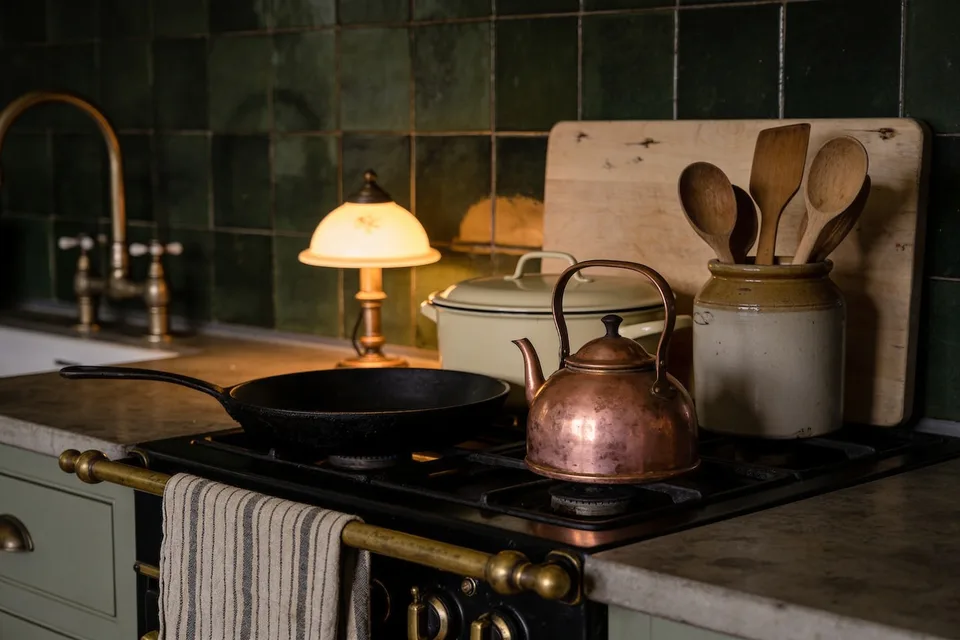
By the last hour of the evening the kitchen is down to one lamp, and everything still out on the counter has earned the right to be there. The skillet cools on the back burner with supper's gloss still in it. The kettle holds what light there is along one copper shoulder, a linen towel dries over the oven rail, and the scrubbed board leans behind the tap, pale as bone. Nothing in sight is new, and nothing is only decoration. That, standing in plain view, is the whole secret of the room.
Kitchens that feel this way run on a short list — shorter than the shops would have it, and much older. Nearly everything on it has been made the same way for a century or more and tends to outlast whoever bought it, which is why so much of it waits in thrift aisles and estate sales for less than the new version costs. Here is the list, piece by piece, argued from material and wear — and where the money honestly matters.
Iron first, and one good Dutch oven
The list begins at the stove. A cast-iron skillet, ten or twelve inches across, is the nearest thing a kitchen has to a hearthstone: slow to take heat, stubborn about keeping it, and improved by every supper it cooks, because the seasoning that makes iron easy is nothing but use accumulating. It is the one pan honestly better at forty than at four. Old iron is often finer than new — the pans of two generations ago were ground and polished at the factory until the cooking face went glassy, a step most modern foundries skip — and a rusted one from a sale table asks only an afternoon of sanding and a film of oil to come back entire. Rust is a chore, not a wound. This is the oldest arithmetic in the English cottage kitchen: few pots, good ones, at the fire for life.
Beside the skillet, one enameled Dutch oven — round, five or six quarts, cream or bottle green — does the slow work bare iron can't. Iron quarrels with tomatoes and wine; enamel ends the quarrel, so a braise can sit at the back of the stove all afternoon without taking a taste of the pan. The weight is the point: a heavy lid is the seal that keeps a simmer barely moving — the only temperature the cheap and flavorful cuts respect — and the same mass carries the pot from stove to oven to the table's trivet. Bought secondhand, it has exactly one flaw that matters: a chip in the enamel on the inside floor, where the food sits. A scuffed flank or a chipped rim is service, not damage.
Copper where it counts
Copper is the list's one small extravagance, and it earns the place with behavior, not looks. A copper kettle comes to the boil ahead of its steel cousins and says so in a softer voice; a tin-lined copper saucepan of about two quarts answers the flame the moment it changes — heat up, heat off, no sulking — which is precisely the manners a custard, a caramel, or a pan sauce demands. Working kitchens kept copper at the stove long before anyone thought to hang it as decoration, and they kept it for this.
Two pieces are plenty; a rack of it overhead has crossed into display, which is another subject. As for the shine, polish is honest and so is patina — a kettle gone dusky brown is not neglected, only off duty — but the inside matters more than the outside ever will. Old copper wants its tin lining intact, gray and continuous; where the lining has worn through to a warm glow, the pan is due for retinning, a trade that survives precisely because these pans were built to be relined and handed on rather than replaced. That is the entire case for copper in one word: kept. The old French and English pans are usually heavier in the hand than their new equivalents, and the weight is where the even heat lives.
Wood, scrubbed and never saved
Wooden spoons cost little and outlast nearly everything, which is why a crock of them stands within reach of any stove that works for a living. Beech and maple are quiet against the pan and kind to enamel — the Dutch oven's lining prefers wood and says so by lasting — and they wear to their cook: a spoon stirred for years goes flat along one edge like a boot heel, and the flat is fit, not damage. The scrubbed board is the same argument at counter scale. Thick, plain hardwood, washed hot and stood on edge to dry, takes its knife scars as a record rather than a ruin; when the surface finally goes gray and furred, an hour of sanding and a spoonful of oil return it to service. Wood mends. That is its whole case against plastic, which only ever wears.
Linen, because it ages in the right direction
Most kitchen cloth wears out; flax wears in. Linen tea towels — plain weave or a woven stripe, hemmed, nothing clever about them — are the proof in daily use: linen leaves no lint on a glass, dries on the rail before bedtime, and turns softer and thirstier with every hot wash for years, so the best towel in the drawer is reliably the oldest. A washed-linen runner brings the same fiber to the table, where its habits read as looks — linen creases rather than wrinkles, takes a spill as a soak instead of a loss, and fades the way good cloth fades, evenly and without complaint. Buy more towels than seems sensible — they take the kitchen's daily beating — and let the rail wear one openly: a striped towel in use is furnishing, a stack shut in a drawer only inventory.
Stoneware, glass, and a willow basket
Storage on this list is heavy on purpose. A salt-glazed stoneware crock by the stove holds the spoons; a larger one holds flour, or bread under a board; glass jars take whatever turns over weekly, because glass admits its level without being opened. Stoneware's virtue is that it stands where it stands — a full crock does not skid or wander, and its glaze shrugs off a century of counters. Old crocks from long-closed potteries surface at nearly every estate sale, usually wearing one politely rounded chip. Whatever stands in the open must still be working, though; the open kitchen shelf has its own law about that, and the crocks obey it.
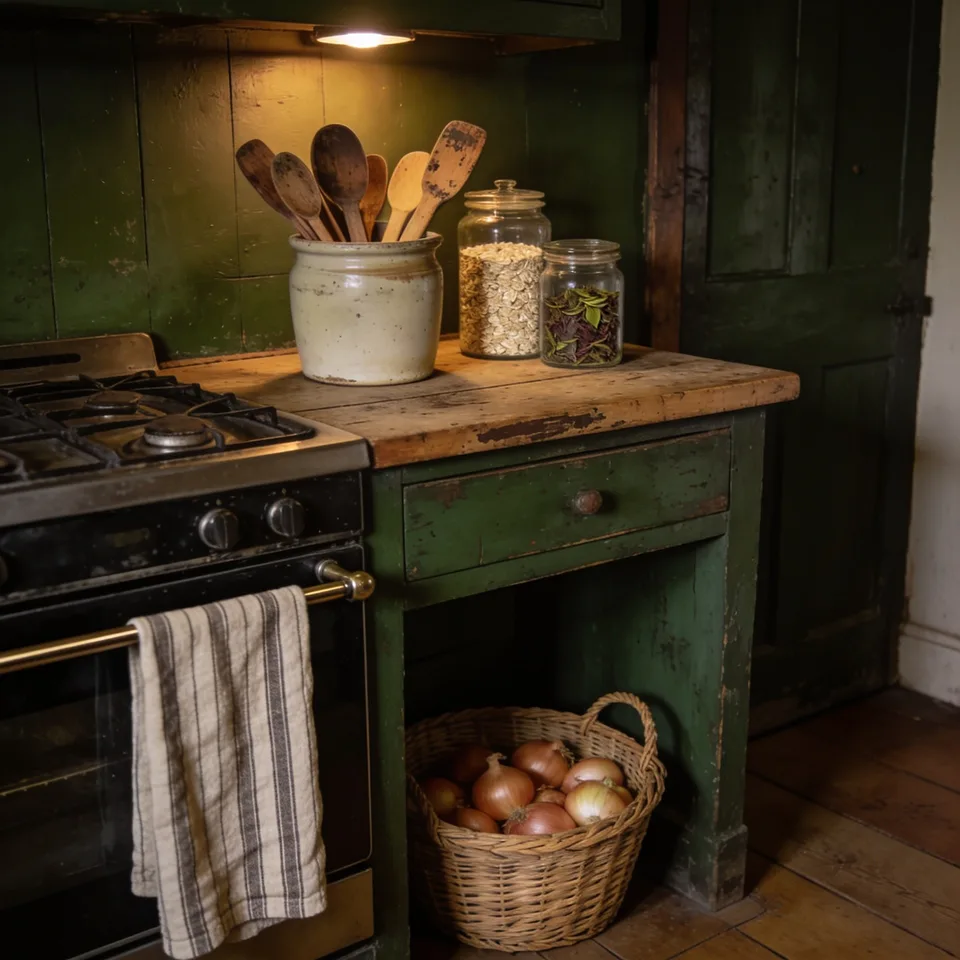
A basket or two finishes the set. Willow or split ash: one for onions and potatoes, because woven walls let air through and papery skins want air, never plastic; one kept by the door for the Saturday shop. A basket is the rare container that improves the errand it serves.
One low lamp on the counter
The ceiling light is for cooking; the lamp is for the room. A small lamp at the counter's end — a warm bulb, a low shade, switched on when the work ends — is what lets a kitchen stay a room after supper instead of going dark like a shop. Its pool of light flatters everything on this list: iron goes soft black, copper answers from across the room, linen warms by two shades. The dark cottage kitchen makes the long case for keeping a kitchen's light low and deliberate; the lamp is that whole argument at the scale of one plug.
The wall behind it can carry the room's one modest picture. The free cottage prints include botanicals that sit quietly over a counter, and for the kitchen itself on paper — the copper pot gone green with use, the garlic braid, the brass scales — a set of six kitchen studies hangs in our own Etsy shop, drawn in the same low register. One frame is enough; the room's real pictures are the shelves.
Old before new, as a habit
Everything above shares one property: it was made in great numbers, for generations, by makers who expected it to outlive its buyer. It mostly has, and that is the kept kitchen's quiet advantage — its first shop is not a shop. Ask the family cupboards first; a handed-down skillet arrives already seasoned and already storied. Then the estate sale, where the kitchen boxes are the last thing picked over and the best reason to go early. Then the thrift aisle, on an ordinary weekday, with no particular hopes. Decorating with vintage kitchen finds is its own subject, but the buying rules fit in one hand: iron wants a smooth cooking face and no deep pits; enamel wants a sound inside floor; copper wants its gray tin unbroken; a crock with crazed glaze keeps onions rather than brine; wood should smell of nothing at all.
Where old can't serve, buy new without guilt — linen towels rarely surface secondhand in usable numbers, and a good new Dutch oven bought once is a purchase the next generation inherits. The list fills in seasons, not in an afternoon, and it is better for the wait. A kitchen gathered slowly ends up looking like it happened on its own, because it did.
Start with a card in pencil
Nothing needs buying this week. Write the list small, on a card — iron, Dutch oven, kettle, saucepan, spoons, board, towels, runner, crock, jars, basket, lamp — and cross off what the house already holds; more goes than expected. The card rides in the coat pocket where the Saturday errands start, and from then on the sales do the work. The kitchen is not waiting to be bought. It is waiting to be kept.
Common questions
What are the essentials for a cottage kitchen?
A short list, and an old one: a cast-iron skillet, one enameled Dutch oven, a copper kettle and a small copper saucepan, wooden spoons and a scrubbed board, linen towels and a runner, a stoneware crock, glass jars, a willow basket or two, and one low lamp for the counter. Nearly everything on it has been made the same way for a century or more and tends to outlast whoever bought it, which is why so much of it waits in thrift aisles and estate sales for less than the new version costs. The list fills in seasons, not in an afternoon — write it small on a card, cross off what the house already holds, and let the sales do the rest of the work.
Is vintage cast iron better than new?
Often, yes. The pans of two generations ago were ground and polished at the factory until the cooking face went glassy, a step most modern foundries skip, so old iron frequently arrives finer than anything on a store shelf. Rust should not put you off either — a rusted skillet from a sale table asks only an afternoon of sanding and a film of oil to come back entire, because rust is a chore, not a wound. And iron is the one pan honestly better at forty than at four: the seasoning that makes it easy is nothing but use accumulating, so every supper improves it. Look for a smooth cooking face and no deep pits; these pans were made by makers who expected them to outlive their buyers, and they mostly have.
What should you look for when buying a used Dutch oven?
Turn it to the light and check one place: the inside floor, where the food sits. Bought secondhand, an enameled Dutch oven has exactly one flaw that matters — a chip in the enamel on that inside floor — while a scuffed flank or a chipped rim is service, not damage. Beyond that, the shape to hunt is round, five or six quarts, cream or bottle green, with real weight in the hand: a heavy lid is the seal that keeps a simmer barely moving, the only temperature the cheap and flavorful cuts respect, and the same mass carries the pot from stove to oven to the table's trivet.